Unknown's avatar

About Mark Winter / Chicane

Cartoonist. Artist. Illustrator. Oh, and autograph hunter.

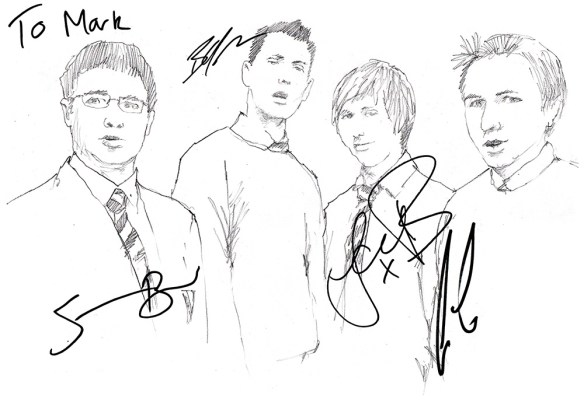
Drawing: The Inbetweeners

INBETWEENERS

The boys are back for their final instalment. The Inbetweeners 2 movie had its London Premiere at the Vue Cinema yesterday and the Rudge Park Comprehensive quartet of Will, Simon, Jay and Neil all attended masquerading as actors Simon Bird, Joe Thomas, James Buckley and Blake Harrison. After the award winning TV series and the first movie in 2011 the lads have reached cult status.

The quickest of quick sketches just to capture their likeness. It was a last minute decision to attend with half and hour to draw, race to the train, (which was cancelled), get the re-scheduled service which chugged into town. Made it to a public pen near the drop off point, six rows deep, thinking this is not a good idea. Getting one siggy, let alone four, looked like mission impossible. Minutes later a big black car arrives and all four slip out, doing the obligatory group photo, then move around the line. Blake slipped past first, and if it wasn’t for Robert (a fellow grapher) grabbing my sketch and hurtling himself to the front, accompanied by a shrill, “Blake Blake Blake!” I would have missed. A young guy in front of me wanted to high five them, so I said to him, “As you do that could you also point to this sketch,” which I conveniently held up next to him. It worked and I got all four – Simon even dedicated. Mission accomplished.
Drawing: Handbagged at the Vaudeville Theatre

handbagged

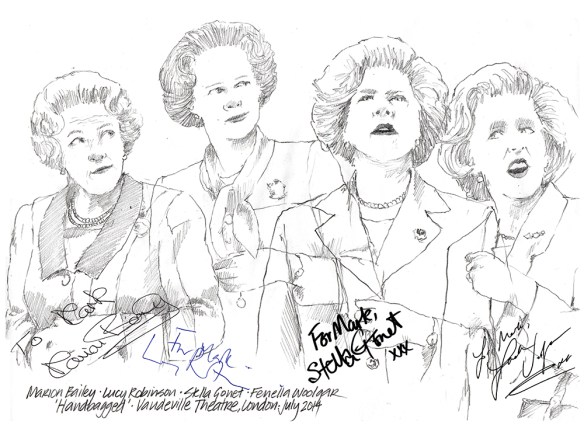
Undoubtably one of the theatrical highlights of the past year was Handbagged, Moira Buffin’s latest play tells the tales of the Queen’s weekly meetings with Margaret Thatcher. Premiering at the Tricycle Theatre in October 2013, the sold out run won an Olivier Award and transferred to the West End. It was commissioned by the Tricycles new artistic director Indu Rubasingham.

The play arrived at the Vaudeville Theatre with the cast more or less in tact; only Clare Holman was substituted as the younger monarch by Lucy Robinson. As the slogan stated “Liz. Maggie. Tea at four. Handbags at dawn.”

Two enduring icons of the 20th Century, born six months apart – what did the world’s most powerful women talk about? It’s a shrews piece that cleverly explores what might have gone on behind closed doors.

The play’s runaway success, and unanimous critical acclaim, depended in large on the brilliant performances of its four actresses who play older and younger versions of the two leaders. Marion Bailey is the older monarch sitting in judgement of her younger self, and the older Maggie played by Stella Gonet looks back on the woman that she was in office “embodied with all her mannerisms down to a T” by Fenella Woolgar. As The Telegraph’s Tim Walker stated in his five star review, “only a director of Indhu Rubasingham’s sensitivity could cope with the gear changes that shift the action form slapstick to moments of unbearable pathos.”

All four kindly singed my sketch in the final week, as the play completed its Vaudeville run on Saturday 2 August.

Drawing: Nigel Havers in The Importance of Being Earnest at the Harold Pinter Theatre

Nigel Havers

The quintessential English charmer, Nigel Havers is 62, and returns to a role he played at 26 in Oscar Wilde’s classic farce The Importance of Being Earnest at the Harold Pinter Theatre in London. Wilde’s masterpiece has some additional material added by Simon Brett as a framing device to enable older actors to play younger roles.

Nigel originally player Algernon Moncrieff in Peter Hall’s 1982 production at the National alongside Martin Jarvis, who also reprises his role as Jack Worthing.

The latest re-imagining revolves around The Bunbury Company of Players, an amateur troupe of veteran thesps performing a dress rehearsal. In one of the added lines, someone suggests that the ageing roué is not really an actor, Nigel’s character quips, “that’s true of so many who make a living at it.” And he has made a good fist of it over a 30 year career playing smoothies, gentlemen and cads, in such films as A Passage to India, Empire of the Sun and Chariots of Fire, plus a string of small screen roles – his latest being the charismatic con-artist Lewis Archer in Corrie.

Nigel is always on the go. On the number of occasions our paths have crossed he has definitely taken the fast lane. But, he always has time to sign. Just as well he has a swift siggy to complement his famous charm.

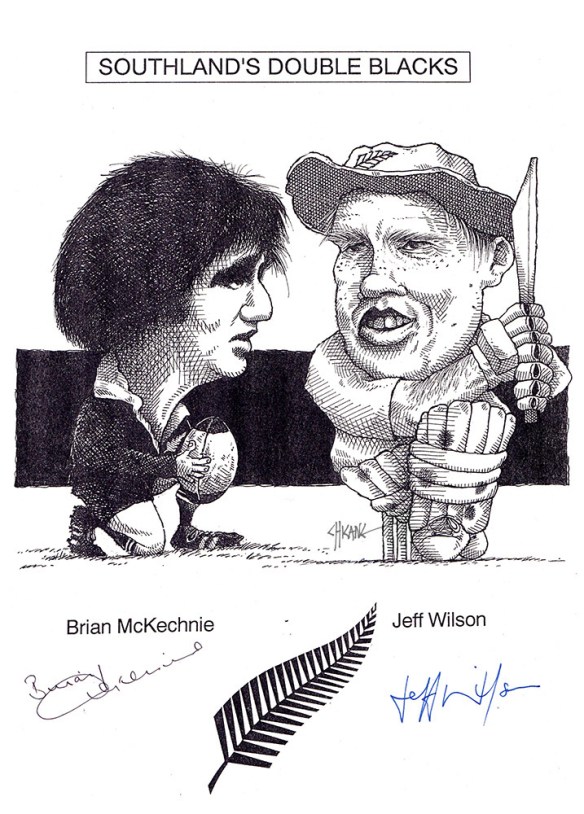
Drawing: Colt and Goldie (Brian McKechnie and Jeff Wilson)

Double Blacks

Only seven men have played both rugby union and cricket for New Zealand. The last two – Brian McKechnie and Jeff Wilson – are both from my home province of Southland and likely to be the last dual internationals dubbed “Double All Blacks”. It is a rare achievement from a forgotten era unlikely to be repeated because rugby has morphed into a year round code.

Jeff, nicknamed Goldie, played four ODIs as a 19 year old all rounder against Australia before turning his attention to rugby where he became an All Black legend with 44 tries in 60 appearances on the wing. After retiring from footy he returned to cricket after a 12 year gap and played two more ODIs and a one off Twenty20 in 2005.

Brian, known as Colt, was an unwilling participant in controversies in both sports. In 1981 he was the batsman on the receiving end of Trevor Chappells’ infamous underarm delivery  at the end of the third final in the World Series against Australia at the MCG. Oz captain Greg Chappell ordered his brother to bowl the controversial final ball to prevent a six being hit to tie the match. It was an incident he later described as the biggest regret of his career.

Three years earlier McKechnie kicked a late penalty that gave the All Blacks a 13-12 win over Wales at Cardiff, securing the ‘Grand Slam’. Andy Haden’s ‘dive’ from a line out near full time was thought to be the reason for the penalty, but years later the referee said it was a completely separate incident – which video footage clearly verifies.

An economical right-arm pace bowler and useful lower-order batsman, McKechnie played 14 ODIs for the Black Caps. The underarm incident was his final match. He played 26 matches for the All Blacks at first five-eigth (fly half) and full back, between 1977-1981.

I drew these two caricatures of Colt and Goldie sometime in the 1990s. Twenty five prints were signed by both as part of a fundraiser for charity.

Drawing: Gillian Anderson in A Doll’s House at The Young Vic Theatre

gillian anderson

Kfir Yefet’s staging of Ibsen’s A Doll’s House played London’s Donmar Warehouse through the summer of 2009. I’ve been carrying this sketch around with me ever since. Well, not this specific sketch and not ever since. I originally did another one which I carried arouond with me, hoping to get Gillian to sign it since I missed her at the theatre (note to self: never leave signings to the last performance). Gillian was a regular at screenings, premieres, film festivals and press nights, so I carried the sketch just in case. When I didn’t have the sketch, Gillian would make an appearance. In the end I mailed it to her via her agent and re-drew this one, which I have carried around ever since (and when I haven’t, déja vu!)

My chance came last night. Gillian has returned to the London stage to rave reviews as Blanche Dubois in Tennessee Williams’ A Streetcar Named Desire at the Young Vic. He opened this week after a short preview season. It’s a long play which can be a help or a hinderance for ‘graphing. After three and a half hours of “shatteringly powerful”  performing I guess the last thing she would want to do is meet, greet and ‘graph with the gathered throng.

Normally at the Young Vic I position myself near the interior stage door that opens out onto The Cut Bar, but the two security persons (first time I’ve seen that at the Young Vic) corral to  a line near the ticket desk. It’s well after 11pm, so the bar’s closing. “Programmes and tickets only,” one of the security guys told the handful of people waiting.

“Ms Anderson will only be signing programmes or tickets, so don’t offend her by offering anything else.”

Gillian popped down and stood behind the ticket desk and started signing. I waited until everyone had finisihed then approached her, apologising that I didn’t have a programme or a ticket, but a sketch from 2009, which I showed her and asked if she could sign it “to Mark”. She looked at it, smiled and said, “is that with a ‘c’ or a ‘k’?”

“A ‘k’,” I replied, and left thanking the security on my way out to catch the last train.

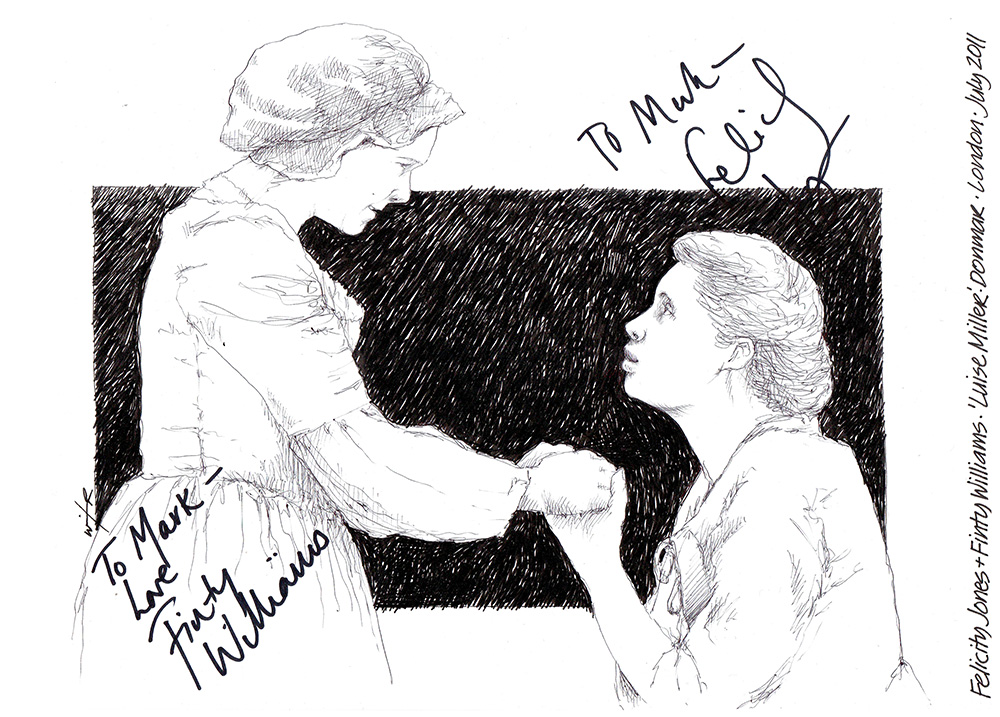
Sketch: Felicity Jones and Finty Willilams, in Luise Miller

Luise Miller

Kabale und Liebe, Love and Intrigue, Love and Politics or simply Luise Miller, are all titles for the same play written by the German dramatist Friedrich Schiller in 1784.

The Donmar Warehouse in London chose Luise Miller in June and July 2011, directed by Michael Grandage, working with translator Mike Poulton on a more contemporary version of this landmark bourgeois tragedy.

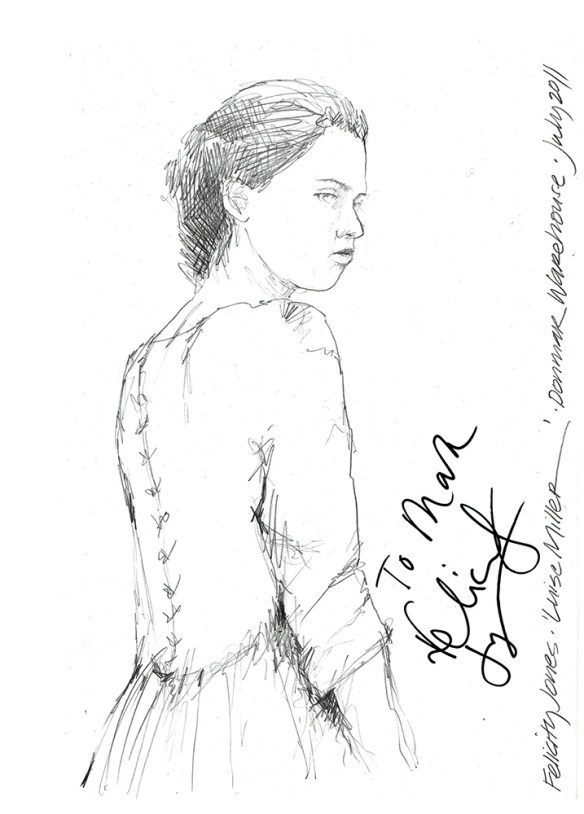
In the title role was East Londoner Felicity Jones, who turned down a major film role to do the play. She plays the wholesome daughter of a modest violinist in a tale of “precarious liaisons, shadowy desires, backroom skulduggery and the iniquities of class snobbery.” It’s Schiller’s answer to Romeo & Juliet with melodramatic tendencies.

Having just won the special jury prize at the Sundance Festival for Like Crazy, she was in great demand for more film roles. “I want to keep a balance,” she said, “West End won’t lose me to the movies.”

Her ‘mother’ was played by Finty Williams, described by one review as “a sweet natured blabbermouth”. I had drawn a sketch of the both of them with a fine black biro. Whilst waiting outside the Donmar on a balmy summer’s evening for the cast to emerge (which took a bit longer because I think the were doing a Q+A session with the audience) I drew a quick pencil sketch of Felicity with my 2B – which in the balminess became a softer 4B! This was based on a publicity photo pinned to the Donmar Wall.

Felicity Jones

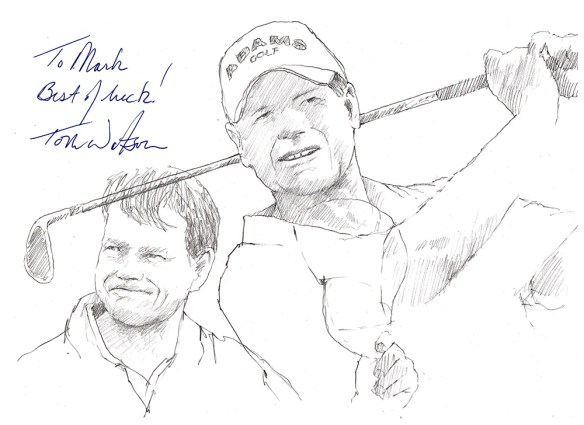
Drawing: Tom Watson

tom watson

During the 1970s and 80s Tom Watson was one of the leading golfers in the world and he doesn’t play a bad game these days either. Pushing sixty and 26 years after his last major victory Tom led much of the 2009 Open Championship at Turnberry in Scotland but eventually lost in a four hole playoff to Stewart Clink.

I remember watching the last day glued to the TV, hoping he would win. He had a chance in regulation play with a par on the last hole, but missed an eight foot putt.

He is regarded as one of the greatest links players of all time, winning five Open Championships and three Senior British Open Championship titles. He’s also won the Masters twice and the US Open. In fact he was number on from 1978-1982, replacing Jack Nicklaus.

Tom was back in Britain this year playing both Open Championships, so I quickly did a sketch for signing and sent it to him at Royal Porthcrawl in Wales where he played the senior championship last week. He didn’t disappoint. What a nice guy.

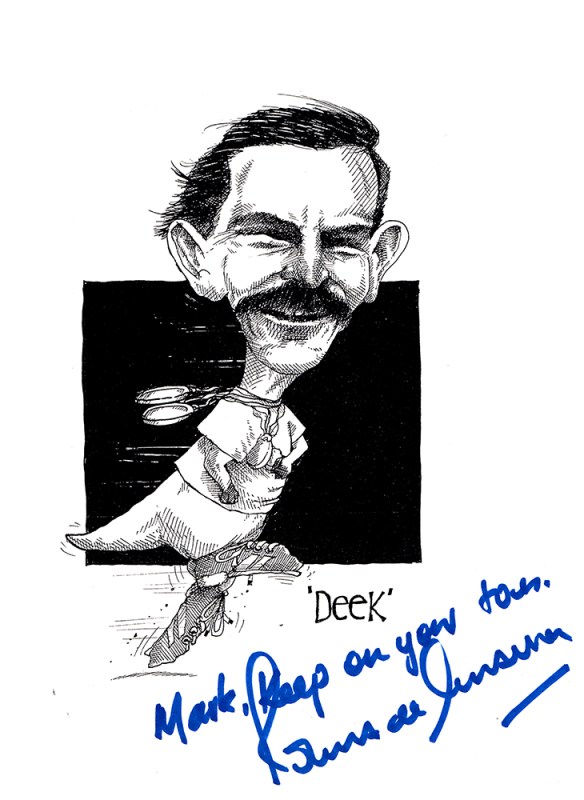
Drawing: Deeks (Robert de Castella)

Robert de Costella

Robert de Castella (Deeks) as one of the leading marathon runners in the 1980s. The colourful Australian, off Swiss-Italian descent, was the World Champion in 1983 and won back-to-back golds at the 1982 (Brisbane) and 1986 (Edinburgh)  Commonwealth Games. He also took the Boston title in 1986.

“If you feel bad at 10 miles, you’re in trouble. If you feel bad at 20 miles, you’re normal. If you don’t feel bad at 26 miles, you’re abnormal,” was one of his famous quotes.

In 2013 he launched ‘Deeks’ – a chain of grain and gluten free bakeries and cafés and for good measure earned a black belt in the traditional Okinawan style of karate, Goju Ryu.

His distinctive moustache made him an ideal caricature target, which I drew and got it signed when he visited my home town in Invercargill, New Zealand, as the director of the Australian Institute of Sport.

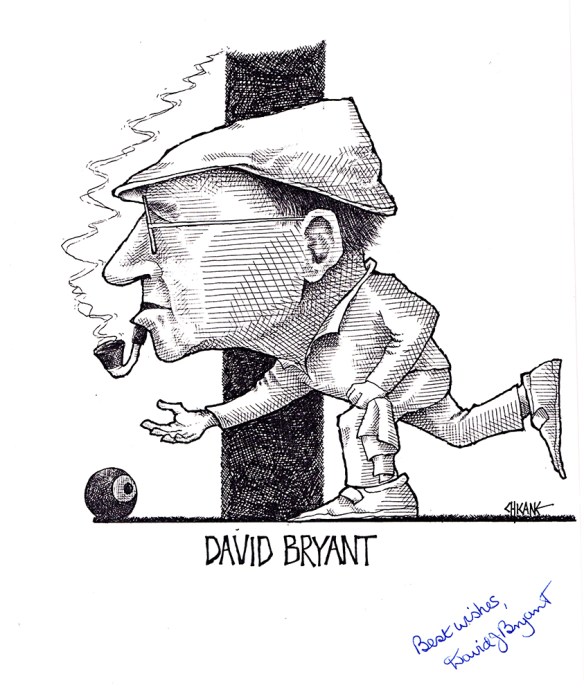
Drawing: David Bryant

David Bryant

Whilst watching the Glasgow Commonwealth Games yesterday, I was reminded of some of its legends, as the BBC punctuated its coverage with mini profiles of its famous past participants. Among them was Englishman David Bryant, the bowls icon.

Lawn bowls as opposed to opposed to bowling of the ten pin variety in an ‘alley’. It involves rolling biased balls towards a smaller ball called a ‘jack’ or ‘kitty’. Distinctively British, dating back to the 13th Century. In fact, the game was banned by King and Parliament, fearing it would jeopardise the practice of archery which was important in battle. Given their resemblance to cannon balls, they may have been better to use them in battle instead of arrow… maybe they did. Regardless, in 1541, Henry VIII ordered that artificers, labourers, apprentices, servants and the like were forbidden to play bowls at anytime except Christmas, and then only in their master’s home and presence. A penalty of 6 shillings and 8 pence was the fine.

Anyway, enough of that and back to more recent history. David was perfect for a caricature, wearing his white cap, pipe-smoking and with his distinctive delivery style with his raised leg. The English teacher was the master of the rink. Some would say god.

Definitely one of the greatest, if not the greatest, exponents of the sport, along with Bowls Englands’s current CEO Tony Allcock. Together they won six world indoor pairs titles and individually too many to mention. David collected five Commonwealth Golds dating back to Perth in 1962. I haven’t checked if the King’s edict’s been revoked. If not, not a bad haul for an illegal activity.

At the World Championships in Auckland in 1988 (where David won the singles title and was runnerup in the pairs) he found time in between games to sign my caricature.

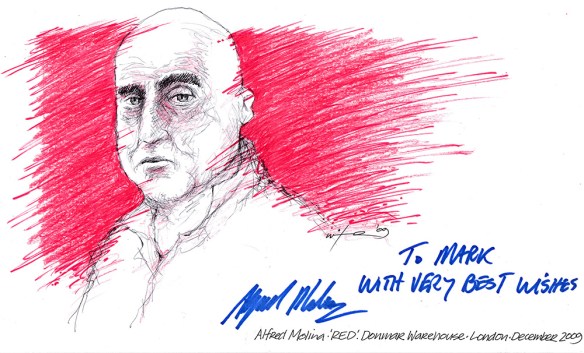
Drawing: Alfred Molina in Red at the Donmar Warehouse

Alfred Molina

Alred Molina played celebrated abstract artist Mark Rothko in John Logan’s RED in London and New York. The play opened at the Donmar Warehouse in December 2009 to excellent reviews and sold out performances before moving to Broadway in March 2010, winning six Tony Award including Best Play.

Marcus Rothkowitz emigrated with his family to the US from Russia as a boy in 1903. He became a central figure in the postwar American abstract expressionists, the so-called New York School. The group, who couldn’t really draw, also included Barnett Newman, Clifford Still, Franz Kline and Jackson Pollock. They sought refuge in abstractionism to camouflage their modest artists talents.

RED revolves around Rothko’s last decade of his life when his palette reduced dramatically from glowing oranges and yellows to the sombre shades of red and black – banal work on a large canvas!

“There is only one thing I fear in life, my friend… one day the black will swallow the red.”

At the centre of it is his undertaking of the Four Seasons restaurant commission in Manhattan’s Seagram Building in which he famously declared that his paintings would “put  all the rich bastards off their food.” In the end, due to his moral conflict of interest, he returned the $35,000 advance and refused to have his work hung in the restaurant.

Alfred signed my ‘representational impressionist’ piece at the Donmar in January 2010. Unlike Rothko who experimented with a lot of mediums, including glue and eggs, I stuck to more conventional rendering materials such as black biro , crayons and a felt tip pen. I did allow colour to add impact and reinforce the play’s ttitle. In this case ‘red swallows the black!’