Drawing: The Motive and the Cue

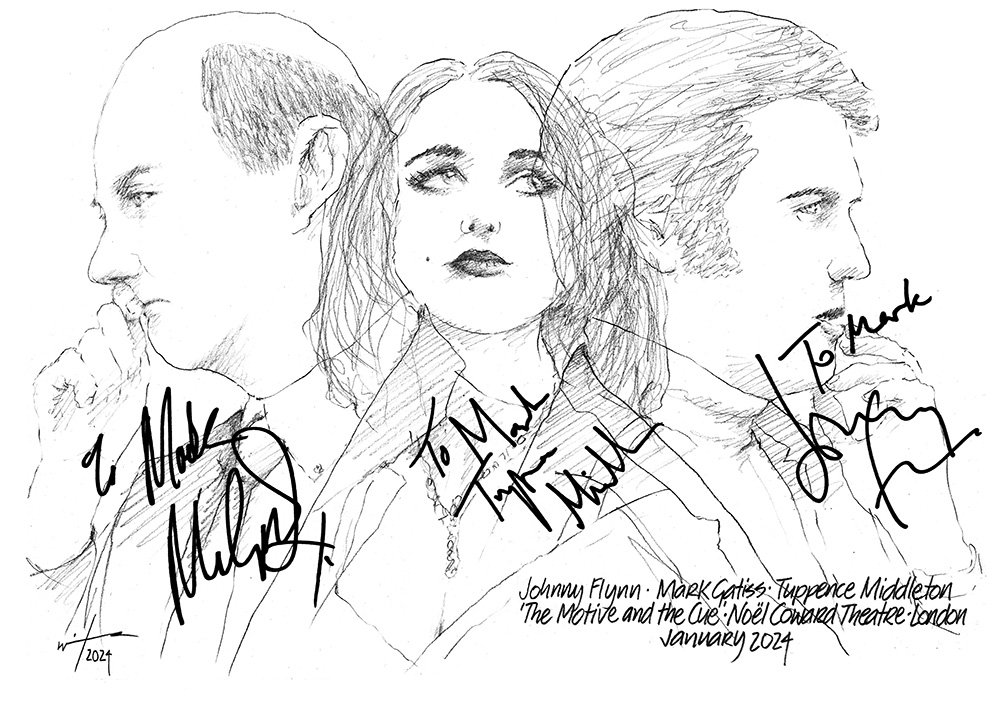
Autographed drawing of Johnny Flynn, Mark Gatiss, Tuppence Middleton in The Motive and the Cue at the Noel Coward Theatre on London's West End

After a sell-out season at the National Theatre last spring, THE MOTIVE AND THE CUE, Jack Thorne’s latest, critically acclaimed fierce and funny play directed by Sam Mendes, described by many critics as ‘a love letter to theatre’, transferred to the Noel Coward Theatre in London’s West End in December, running until 23 March.

Winner of the Best New Play at the Evening Standard Theatre Awards, it centres on the 1964 experimental, modern-dress Broadway production of Shakespeare’s HAMLET starring Richard Burton, the most famous actor in the world at the time, newly married to Elizabeth Taylor, directed by theatre royalty, Sir John Gielgud. Burton,”still smoking hot from his big-screen romance with Taylor in CLEOPATRA, was looking to solidify his street cred as a serious actor after a few Hollywood duds. Gielgud’s motivation was a little less obvious, as gradually became clear to the rest of the cast and crew”.

As rehearsals progress, two ages of theatre collide, as the collaboration soon threatens to unravel. It was a difficult production with Burton behaving badly because he didn’t get the direction from Gielgud he felt he required… or perhaps he got more direction than expected. The two, who were prior friends, couldn’t work out how their HAMLET might work. For Gielgud, the play mattered a great deal, having played the role more than 300 times, over forty-plus years of playing Shakespearean roles.

Jack Thorne was inspired by two first-hand accounts of the politics of the rehearsal room and the relationship between art and celebrity. William Redfern, a cast member, who played Guildenstern, wrote a series of letters to his friend Bob Mills, which were eventually published as ‘Letters From An Actor’ and Richard L. Sterne’s ‘John Gielgud Directs Richard Burton In Hamlet’. The title comes from HAMLET’s “O, what a rogue and peasant slave” speech. As Gielgud explained, the motive is Hamlet’s reason for a given act, the cue is the passion behind that act.

The three leads, Johnny Flynn as Burton, Mark Gatsis as Gielgud and Tuppence Middleton as Taylor reprised their roles for the West End run and kindly signed my quick sketch at the stage door a couple of weeks ago.
Drawing: Kit Harington and Johnny Flynn in True West

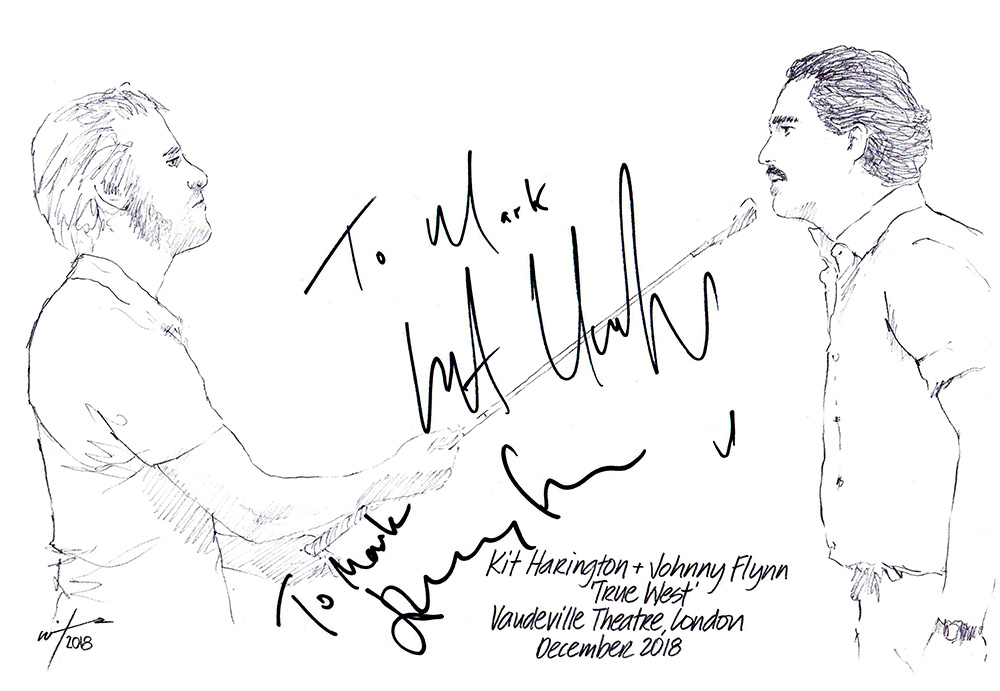
Auotographed drawing of Kit Harington and Johnny Flynn in True West at the Vaudeville Theatre on London's West End

Kit Harington and Johnny Flynn are currently playing warring brothers Austin and Lee until next month in the West End revival of Sam Shephard’s ‘ferociously funny’

TRUE WEST at London’s Vaudeville Theatre. Described as a classic study of sibling rivalry, the 1980 play was a finalist for the Drama Pulitzer Prize. Austin is a clean-cut family man and Hollywood writer who has retreated to his mother’s Southern California home to finish a screenplay. He is disrupted by Lee, his older, feral brother, a petty thief and drifter, who has been wandering the Mojave Dessert for past three months.

In his Guardian review, Michael Billington points out that, “putting it crudely, Austin and Lee are both sides of a single personality – the instinctual and the intellectual aspects of the American character,” and summarises the performances, “At their best, the two actors are very good. Harington is especially convincing in the later stages as Austin unleashes his inner fury, aiming wild, drunken swings at the empty air and threatening to strangle his brother with a whipcord. Flynn also captures Lee’s initial menace as he hovers in a bullying manner over his brother and turns a golf club swing into a virtual death threat.”

Both Kit and Johnny kindly signed my drawing at the stage door prior to Christmas, and not a golf club in sight.

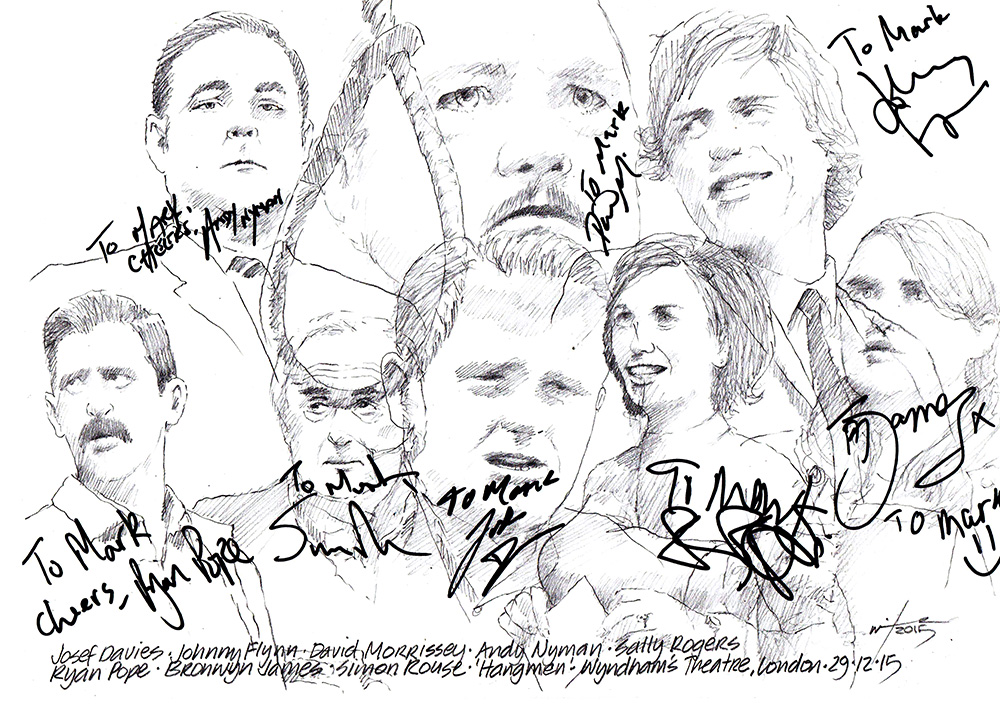
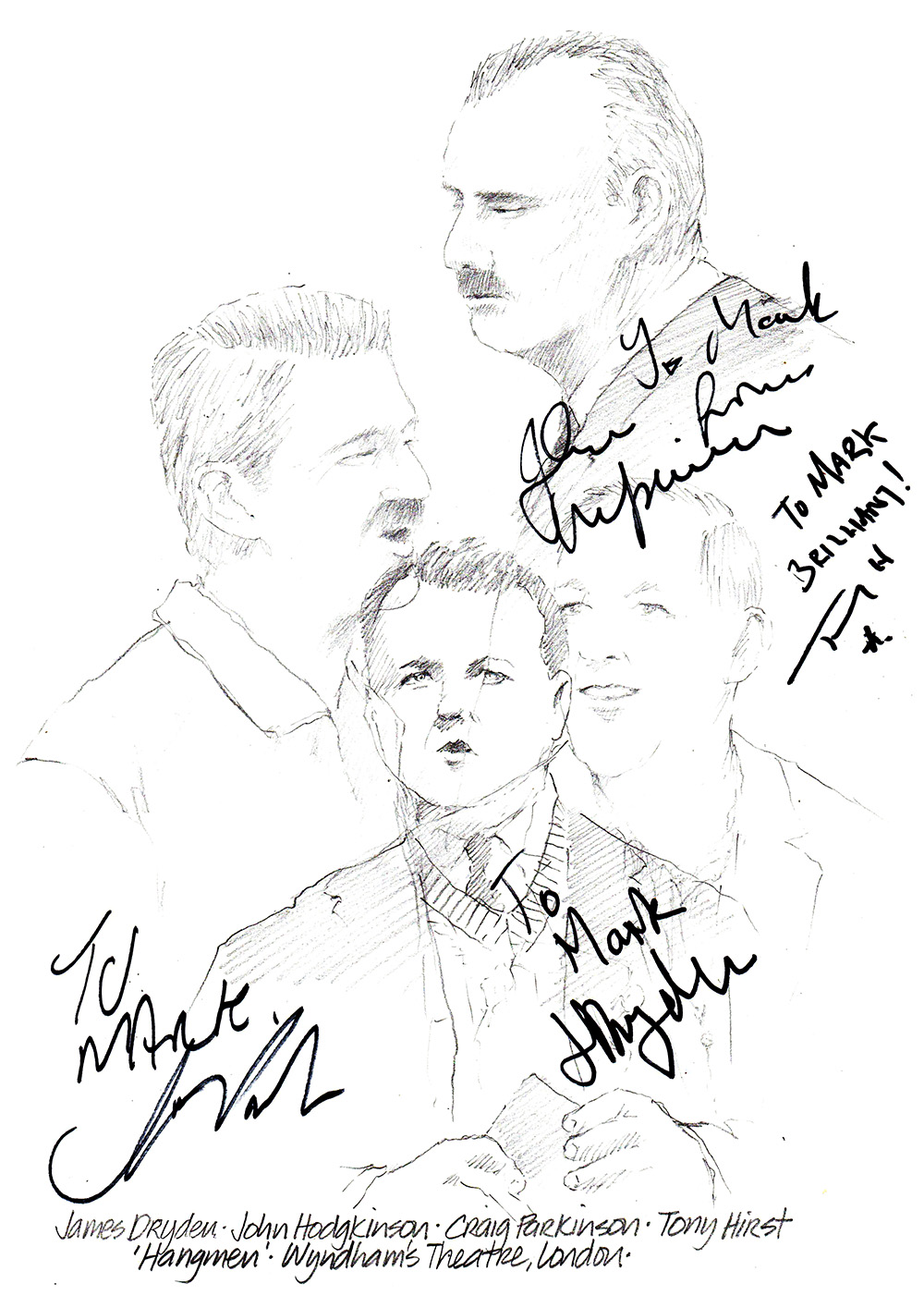
Drawing: Hangmen

Hangmen 2

After a 12-year hiatus writing for the stage, London-born Irish playwright Martin
McDonagh returns to theatre, which he described in The Observer as the ‘worst of all artforms’. If that’s the case, he’s doing his best to mock that  statement with his latest dark comical  offering, HANGMEN, a savage satire on the justice and punishment system – ‘the grimmer side of the swinging sixties’.

Described by one reviewer as a cross between Harold Pinter’s ‘linguistic gamesmanship’ and Joe Orton’s ‘gallows humour’, it’s the Olivier, Oscar and BAFTA winner’s first play set in England, in a small pub in Oldham in 1965 to be precise. Receiving rave reviews and a cluster of five-stars after it’s sell-out run at the Royal Court earlier last year, the production transferred to the West End’s Wyndham’s Theatre and is scheduled to finish in March this year.

What’s Harry Wade, the second-best hangman in England to do on the day they’ve abolished hanging? A reporter and the regular tavern sycophants want to know his reaction, as a peculiar stranger lurks amongst them with a very different motive. Led by David Morrissey as Wade, the outstanding cast includes Andy Nyman, Johnny Flynn, Sally Rogers, Bronwyn James, Ryan Pope, Simon Rouse, Craig Parkinson, Tony Hirst, John Hodgkinson,James Dryden and Josef Davis.
With such a large  ensemble, it took more than one sketch to fit them all in and more than one attempt to get it graphed. At this point I thought of resisting the term ‘hanging around stage doors’. But I didn’t. If it’s good enough for distinguished critics like Dominic Cavendish to write “doesn’t loosen it’s grip from start to finish,” and Paul Taylor to say “drop-dead hilarious… perfectly executed,” then I’m in good company. And speaking of good company, the HANGMEN cast were excellent on and off the stage.

Hangmen