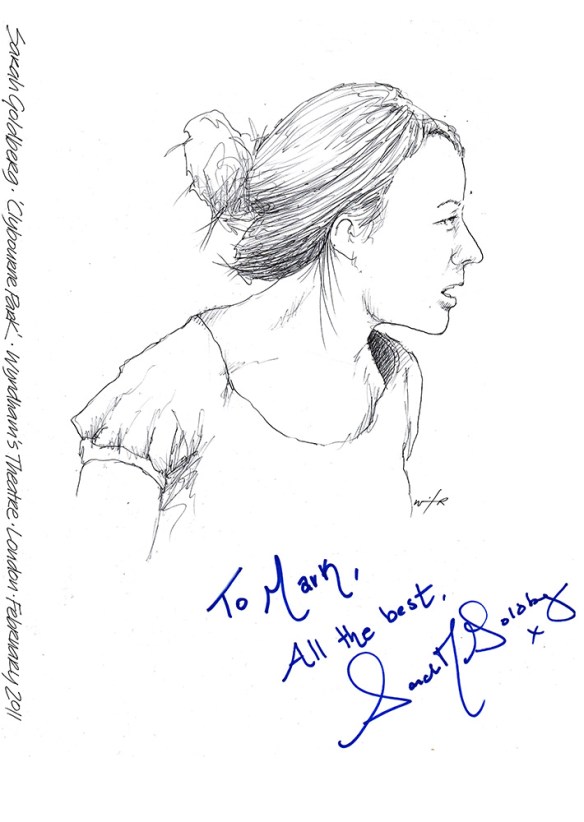
Drawing: Sarah Goldberg in Clybourne Park at Wyndham’s Theatre

sarah goldberg

Canadian film, television and stage actress Sarah Goldberg made a swift impression on the London Theatre scene. After graduating form the prestigious London Academy of Music & Dramatic Art she stayed on and picked up an Olivier Award for Best Supporting Actress in Bruce Norris’ Pulitzer Prize winning play Clybourne Park. An ensemble of seven versatile actors plays two sets of characters in a black comedy of manners, fifty years apart.

Sarah played dual roles of Betsy, a deaf, pregnant wife of a racist community activist in the 1950s and Lindsey, the contemporary and also pregnant home buyer whose renovations disturb her African American neighbours.

The production premiered in the UK in August 2010 at the Royal Court Theatre, directed by Dominic Cooke before transferring to Wyndham’s in London’s West End with most of the original cast.

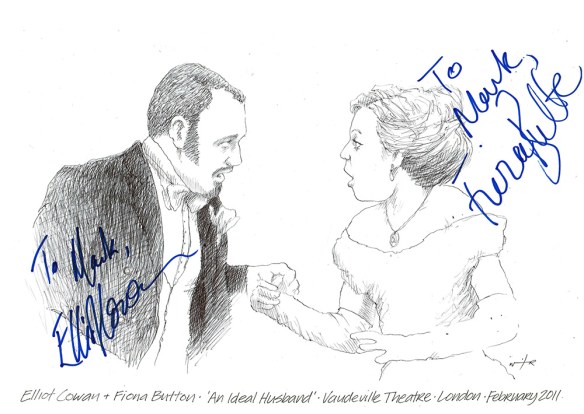
Drawing: Fiona Button and Elliot Cowan in An Ideal Husband at the Vaudeville Theatre

cowan:button

Lindsay Posner’s production of Oscar Wilde’s An Ideal Husband, a classic comedy of political blackmail and corruption played London’s Vaudeville Theatre during the festive season of 2010.

Wilde gave the funniest lines to Lord Arthur Goring. SOme have suggested that the character with his similar wit and fashion to be based on the playwright himself. The ‘dandy’ was portrayed by Elliot Cowan, with his fancy threads and wayward habits, which critics agreed made “a splendidly lived in hero”.

He is engaged to Miss Mabel Chiltern, who, at half his age, is play by Fiona Button, “…whose silken repartee flowed as elegantly as her skirts”.

Her line “An ideal husband! Oh, I don’t think I should like that,” sums up her innocence. Both Fiona and Elliot signed this black biro sketch amongst the snow flurries at the uncovered Vaudeville stage door.

Drawing: Lisa Dwan in Not I, Footfalls and Rockaby

lisa dwan

Irish actress Lisa Dwan has just completed a two week solo season of three short works by fellow Celt Samuel Beckett, following critically acclaimed sold-out performances at the Royal Court Theatre and the West End. Not I, Footfalls and Rockaby completed its sold out run today (30 August 2014) at the Southbank Centre’s Purcell Room in Central London as part of the Festival of Love.

Lisa plays the part of Mouth in Not I, a nine minute monologue where the audience sees only a woman’s disembodied mouth suspended eight feet above a black stage. To achieve this Lisa wears black makeup, a black blindfold, covers her hair with black tights, then straps her head to a blackboard with a hole in it – so that her mouth stays in the single beam of light. She first performed the piece in 2005.

It’s certainly one of the most challenging stage roles with total sensory deprivation. “I can’t see or hear anything. It’s like driving down the motorway the wrong way with no handbrake  – it’s terrifying… but it’s almost the most exhilarating role I’ve ever known,” Lisa said in an interview. The crucial thing is it’s done at speed – after a lifetime of virtual speechlessness, the character has ‘verbal diarrhoea’.

Completing the Becket trilogy is Footfalls, the moving story of May who moves back and forth like a metronome on a bare landing outside her dying mother’s room, and his most famous piece Rockaby with a woman recounting moments form her past sitting in her rocking chair. Metro called it “A mesmerising, heart-wrenching, terrifying triple.” The Standard simply said, “sensationally good” and The Telegraph said, “A stunning performance.”

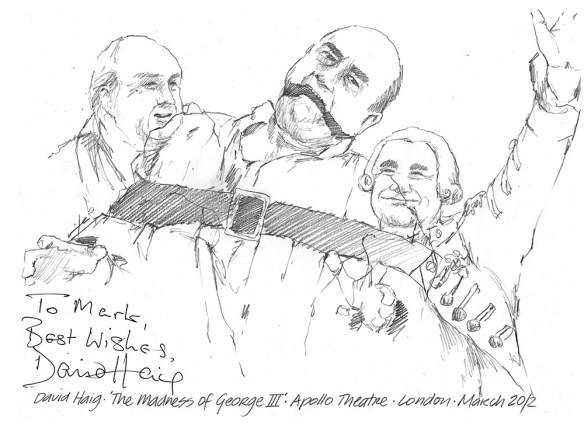
Drawing: David Haig in The Madness of George III

The Madness of George III

Alan’s Bennett’s play The Madness of George III premiered in November 1991 on the Lyttelton stage of the National Theatre in London, directed by Nicholas Hytner, with the late, great Nigel Hawthorne in the title role.

It’s the fictionalised biographical study of the latter half of the reign of George III. Critics labelled Nigel’s Olivier Award winning performance as “astonishing” and “unforgettable”. He also played the role in the 1994 film version, entitle The Madness of King George, also directed by Sir Nicholas H. I’ve always liked the film’s tagline: ‘His Majesty was all powerful and all knowing. But he wasn’t quite all there.’ It was nominated for 4 Oscars, including one for Nigel and 14 BAFTAS.

David Haig played the mental monarch in the revival of the play at The Apollo in the Spring of 2012. The Telegraph’s Charles Spencer compared David’s performance to Nigel’s saying, “it seemed an impossible act to follow, but David Haig proves every inch Hawthorne’s equal in a performance of extraordinary emotion, tenderness and humour”. David was nominated for an Olivier Award.


Drawing: Gemma Atkinson in Calendar Girls

Gemma Atkinson

British actress, TV personality and model Gemma Atkinson first came to prominence playing Lisa Hunter in the teenage soap Hollyoaks. In theatre she appeared in Peter Pan at the Manchester Opera House in 2012, playing the lead role. “It’s nice to be boyish and not have to worry about my appearance and I get to fly!”

She played the more revealing role of Elaine in the West End production of Tim Firth’s Calendar Girls, at the Noël Coward Theatre in the Summer of 2009, where she signed this quick black biro sketch for me. Gemma also toured with the production, this time playing Celia, Miss September. She is currently back in BBC’s Casualty, playing Tamzin Boyle,


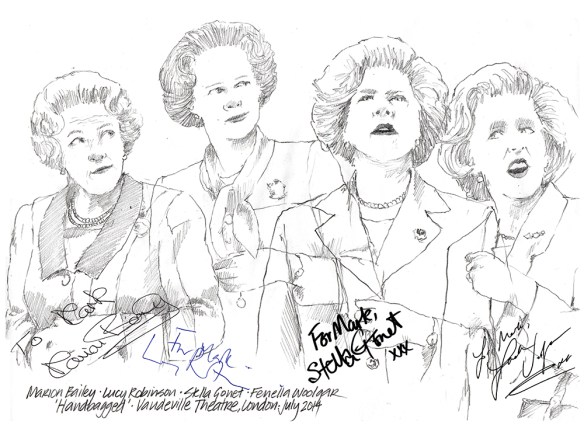
Drawing: Handbagged at the Vaudeville Theatre

handbagged

Undoubtably one of the theatrical highlights of the past year was Handbagged, Moira Buffin’s latest play tells the tales of the Queen’s weekly meetings with Margaret Thatcher. Premiering at the Tricycle Theatre in October 2013, the sold out run won an Olivier Award and transferred to the West End. It was commissioned by the Tricycles new artistic director Indu Rubasingham.

The play arrived at the Vaudeville Theatre with the cast more or less in tact; only Clare Holman was substituted as the younger monarch by Lucy Robinson. As the slogan stated “Liz. Maggie. Tea at four. Handbags at dawn.”

Two enduring icons of the 20th Century, born six months apart – what did the world’s most powerful women talk about? It’s a shrews piece that cleverly explores what might have gone on behind closed doors.

The play’s runaway success, and unanimous critical acclaim, depended in large on the brilliant performances of its four actresses who play older and younger versions of the two leaders. Marion Bailey is the older monarch sitting in judgement of her younger self, and the older Maggie played by Stella Gonet looks back on the woman that she was in office “embodied with all her mannerisms down to a T” by Fenella Woolgar. As The Telegraph’s Tim Walker stated in his five star review, “only a director of Indhu Rubasingham’s sensitivity could cope with the gear changes that shift the action form slapstick to moments of unbearable pathos.”

All four kindly singed my sketch in the final week, as the play completed its Vaudeville run on Saturday 2 August.

Drawing: Nigel Havers in The Importance of Being Earnest at the Harold Pinter Theatre

Nigel Havers

The quintessential English charmer, Nigel Havers is 62, and returns to a role he played at 26 in Oscar Wilde’s classic farce The Importance of Being Earnest at the Harold Pinter Theatre in London. Wilde’s masterpiece has some additional material added by Simon Brett as a framing device to enable older actors to play younger roles.

Nigel originally player Algernon Moncrieff in Peter Hall’s 1982 production at the National alongside Martin Jarvis, who also reprises his role as Jack Worthing.

The latest re-imagining revolves around The Bunbury Company of Players, an amateur troupe of veteran thesps performing a dress rehearsal. In one of the added lines, someone suggests that the ageing roué is not really an actor, Nigel’s character quips, “that’s true of so many who make a living at it.” And he has made a good fist of it over a 30 year career playing smoothies, gentlemen and cads, in such films as A Passage to India, Empire of the Sun and Chariots of Fire, plus a string of small screen roles – his latest being the charismatic con-artist Lewis Archer in Corrie.

Nigel is always on the go. On the number of occasions our paths have crossed he has definitely taken the fast lane. But, he always has time to sign. Just as well he has a swift siggy to complement his famous charm.

Drawing: Gillian Anderson in A Doll’s House at The Young Vic Theatre

gillian anderson

Kfir Yefet’s staging of Ibsen’s A Doll’s House played London’s Donmar Warehouse through the summer of 2009. I’ve been carrying this sketch around with me ever since. Well, not this specific sketch and not ever since. I originally did another one which I carried arouond with me, hoping to get Gillian to sign it since I missed her at the theatre (note to self: never leave signings to the last performance). Gillian was a regular at screenings, premieres, film festivals and press nights, so I carried the sketch just in case. When I didn’t have the sketch, Gillian would make an appearance. In the end I mailed it to her via her agent and re-drew this one, which I have carried around ever since (and when I haven’t, déja vu!)

My chance came last night. Gillian has returned to the London stage to rave reviews as Blanche Dubois in Tennessee Williams’ A Streetcar Named Desire at the Young Vic. He opened this week after a short preview season. It’s a long play which can be a help or a hinderance for ‘graphing. After three and a half hours of “shatteringly powerful”  performing I guess the last thing she would want to do is meet, greet and ‘graph with the gathered throng.

Normally at the Young Vic I position myself near the interior stage door that opens out onto The Cut Bar, but the two security persons (first time I’ve seen that at the Young Vic) corral to  a line near the ticket desk. It’s well after 11pm, so the bar’s closing. “Programmes and tickets only,” one of the security guys told the handful of people waiting.

“Ms Anderson will only be signing programmes or tickets, so don’t offend her by offering anything else.”

Gillian popped down and stood behind the ticket desk and started signing. I waited until everyone had finisihed then approached her, apologising that I didn’t have a programme or a ticket, but a sketch from 2009, which I showed her and asked if she could sign it “to Mark”. She looked at it, smiled and said, “is that with a ‘c’ or a ‘k’?”

“A ‘k’,” I replied, and left thanking the security on my way out to catch the last train.

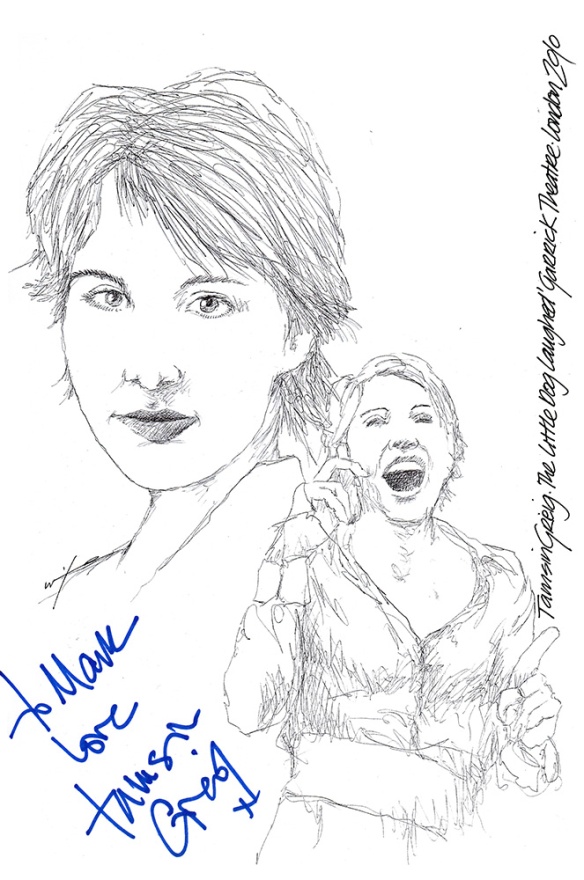
Drawing: Tamsin Greig in The Little Dog Laughed at the Garrick Theatre

tamsin greig

Tamsin Greig said she was inspired to become an actor going to rehearsals of school plays… because it got her out of science and the only other thing she was good at was trampolining which didn’t seem to have much of a future in it.

In 2010, Tamsin played Diane, a ferociously ambitious agent in The Little Dog Laughed, alongside Gemma Arterton, Rupert Friend and Harry Lloyd at the Garrick Theatre in London. By all accounts she stole the show, some critics even said “saved it”. She had all the best lines.

In fact, the play is more a vehicle for Diane’s character. As Michael Bilington calls it, “the play depends on an ingenious imbroglio. Diane… this power-dressed female Machiavel.”

“Tamsin Greig dominates as the lethally sharp agent, detonating every line with killer punch and timing.” Said The Daily Express.

She was nominated for an Olivier Award for Best Supporting Actress (having previously won in 2007 for Much Ado About Nothing) and won the WhatsOnStage Theatregoers Choice Award. Tamsin is known for doing both dramatic and Comedic roles, although the latter generally cause problems. Sh has admitted to ‘corpsing’ which is British theatrical slang for unintentionally breaking character by laughing.

When I looked at this sketch, which Tamsin signed in February 2010, I thought ‘her hands are disproportionally larger”. Taking into account some foreshortening with the left. So I looked at a number of photos of her and she does have large hands and long fingers! Art indeed imitated life. That must have been the same for Michelangelo when he was sculpting the the David statue.

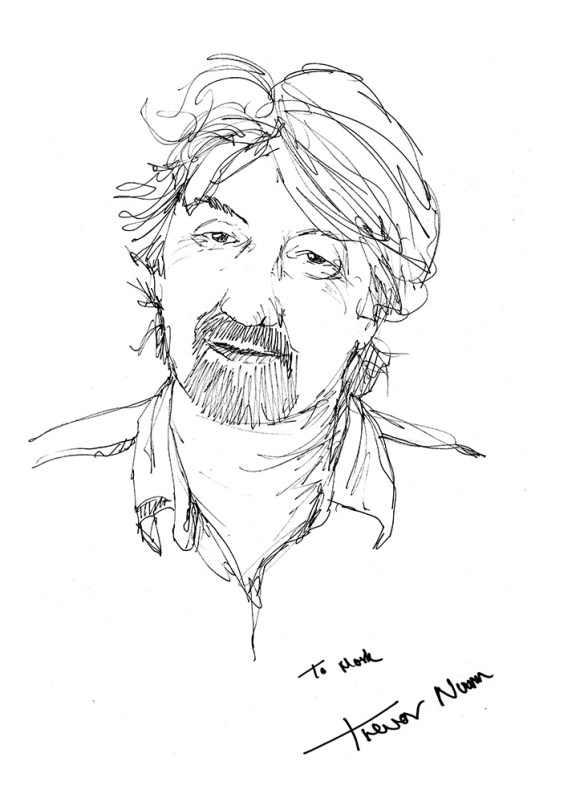
Drawing: Sir Trevor Nunn

Trevor Nunn

Sir Trevor Nunn is the Knight I would want to spend a day with. His list of productions include Les Miserables, Cats, Chess, Sunset Boulevard, Starlight Express, Piaf, Aspects of Love, A Little Night Music, not to mention just about every play by the Bard. In fact, it would be quicker to list what he hasn’t done. Not to mention his list of achievements and awards, far too numerous for this small space.

Some critics consider him the finest and most versatile theatre director in the world. He was one of the theatrical icons I always wanted to meet. Since living in London over the past five and a bit years, our paths have crossed on many occasions – all of which are memorable (to me).

Sir Trevor is the kind of person you can stop in the street (without security reminding you of your mortality) and ‘chew the fat’. He has always been very friendly and generous with his time and comments. He walks a lot around London. I remember waiting at the lights in Shaftesbury Avenue and he was beside me, so we walked and chatted.

“Hi, Sir Trevor, how’s rehearsal for Birdsong going?” I would say.

“I’m going there now,” as we both headed towards the Comedy Theatre.

He’s always wearing his denims – something he has been doing since 1961. Elizabeth Grice in an interview with Sir Trevor earlier this year in The Telegraph mentioned this fact in connection with his youthfulness. She said of the 74 year old: “if I mistype him as 47 it seems to make more sense… his thick, dark hair, also c. 1961, is still, improbably thick and dark. He might be the scruffy boy who has strayed in through the stage door to get autographs.” Now, that sounds familiar!

I drew this quick ink sketch which he signed for me at the front door of the Theatre Royal Haymarket on the opening night of Rosencrantz and Guildenstern Are Dead on a balmy June evening in 2011.