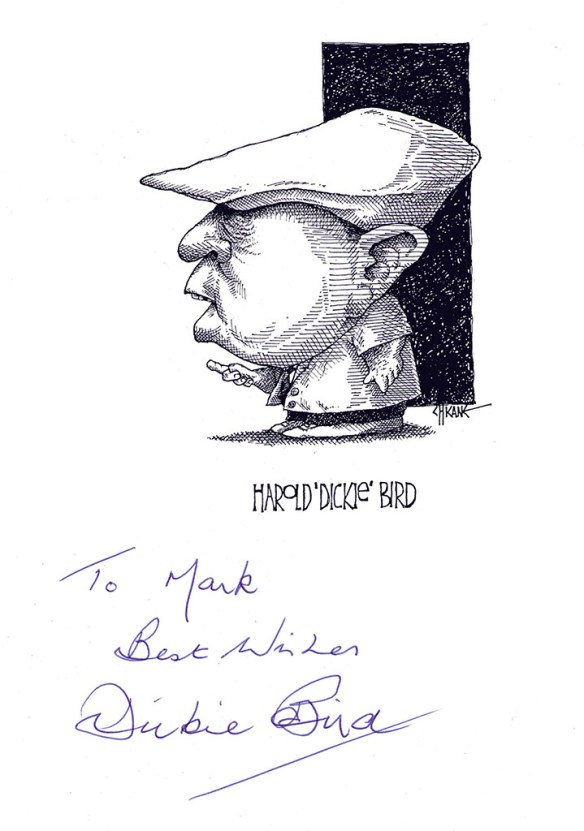
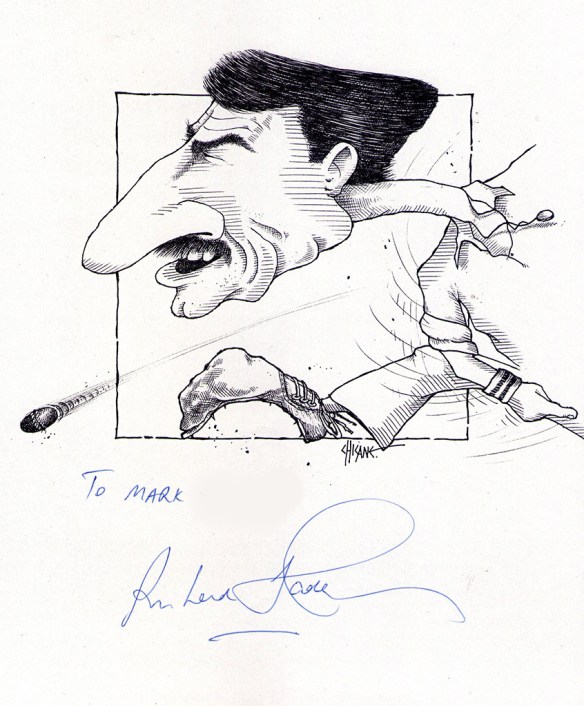
Drawing: ‘Dickie’ Bird

dickie bird001

Cricket’s most famous umpire Harold Dennis “Dickie” Bird has officiated in 54 test matches, the most in a single nation (England). Between 1973 – 1996, the Yorkshireman umpired 66 tests and 69 ODIs.

This year, on his 80th birthday, he ‘selected’  his greatest test XI: Sunil Gavaskar, Barry Richards, Sir Vivian Richards, Greg Chappell, Sir Garfield Sobers, Graeme Pollock, Allan Knott, Imran Khan, Dennis Lillee, Shane Warne, Lance Gibbs. An interesting  omission – no Sir Don Bradman!

Dickie signed my caricature at the Basin Reserve in Wellington, New Zealand during the test against Pakistan in February 1994 which he umpired with Brian Aldridge.

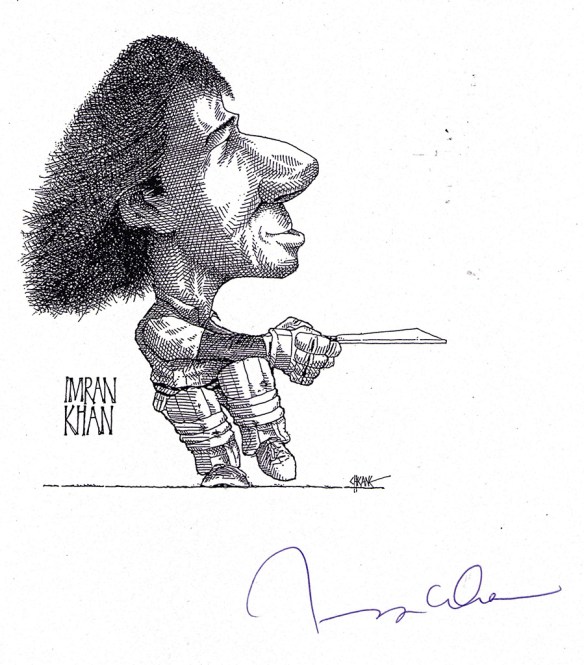
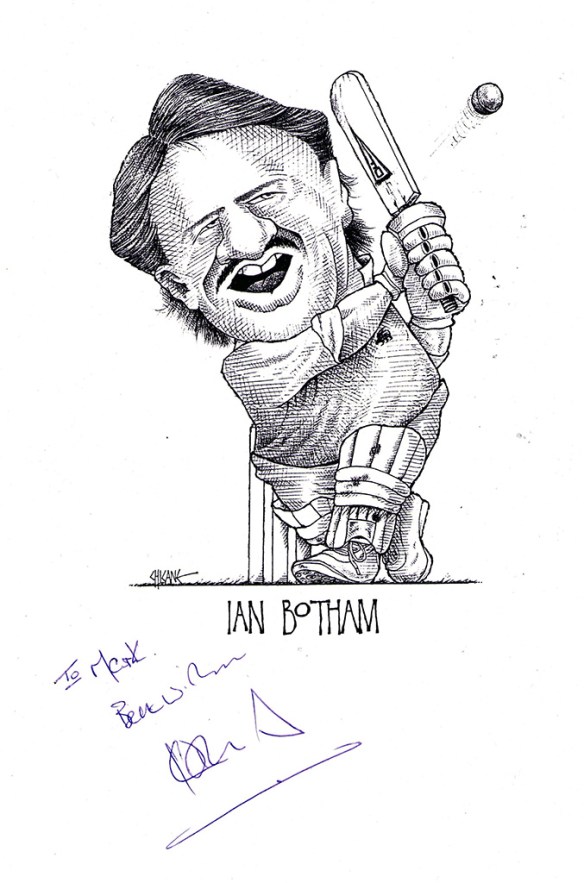
Drawing: All Round Good Guys Part 2 – Khan and Botham

imran khan001

Imran Khan is Pakistan’s most successful captain, in a career that spanned almost twenty years from 1971-1992. In 88 Test matches he scored 3807 runs, including six centuries, taking 382 wickets.

He is one of only eight players to achieve the all-rounders Test triple – 3000 runs and 300 wickets . He did so in 75 matches, second fastest behind Sir Ian Botham (72).

He retired twice. First after the 1987 World Cup, but due to popular demand he was requested by President Zia ul Haq to return to Captain the team again. At 39, he lead Pakistan to World Cup glory, winning the 1992 Championship, beating England at the Melbourne Cricket Ground in the final, then retired again.

An alma mater of Oxford University, Khan entered politics and was a member of the National Assembly (2002-2007). He is also known for his philanthropy, building cancer hospitals and research centres.

In 1996 he faced libel action taken against him by Sir Ian Botham, surrounding ball tampering and associated derogatory comments.

Sir Ian ‘Beefy’ Botham was a genuine all-rounder – a big hitting batsman with a classical straight bat style and a medium paced swing bowler. A controversial figure both on and off the field, Beefy was involved in a number of well-publicised incidents, including a suspension from the National team for smoking cannabis. He also captained England in 12 Tests. His right arm medium bowling resulted in 383 wickets in 102 Tests, accumulating 5,200 runs. He has taken five wickets and scored a century in an innings of a same Test match on five occasions. He still holds the record for the highest number of wickets taken by an English bowler.

A prodigious fund-raiser, he is renowned for his Charity Walks and has raised over £12 million for Leukaemia Research. Sir Ian became Sir Ian in 2007, knighted for services to cricket and cancer charity work.

Imran signed my caricature during Pakistan’s 1988/89 tour of New Zealand. Sir Beefy graphed his in Wellington, when England played New Zealand in the 1992 World Cup at the Basin Reserve.

beefy botham001

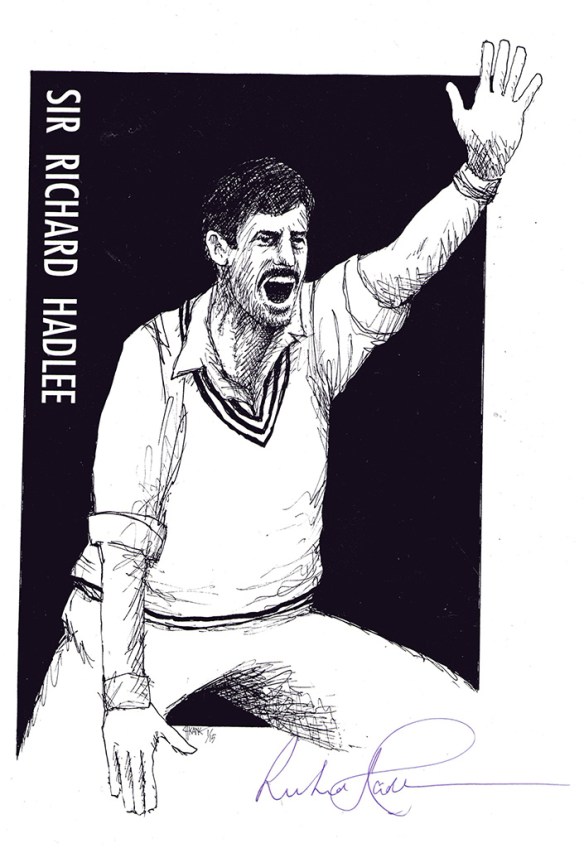
Drawing: All Round Good Guys Part 1 – Hadlee and Dev

hadlee001 Richard Hadlee001

Sir Richard Hadlee, Kapil Dev, Imran Khan and Sir Ian Botham were the top four cricket all-rounders of the 1980’s and early 90’s. They are all inductees into the ICC Cricket Hall of Fame. New Zealand’s ‘Paddles’ Hadlee is considered one of the great fast bowlers of all time. The 2002 edition of Wisden listed him as the second great test bowler in the history of the game. ESPN named him as the 12th Best Cricketer of all time in its Legends of Cricket selection.

Playing for the Black Caps from 1988-1994, his right-arm bowling was initially extremely fast, with devastating control. Over time his pace reduced but he gained more accuracy and movement off the wicket. The master of conventional ‘swing’ batting, he was the original ‘Sultan of Swing’, with his most potent delivery the unplayable outswinger. He was the first player to take 400 Test Wickets and after 86 Matches, ended his career with 431 at an average of 22.29. He scored 3,124 test runs, with two centuries including 151 not out. He was Knighted in 1990.

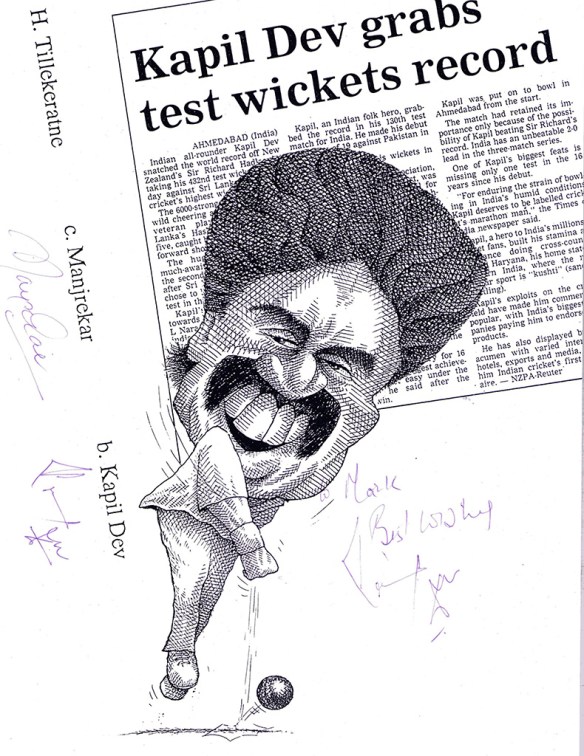
Kapil Dev replaced Sir Richard’s wicket-taking World Record in early 1994 and was  Wisden’s Indian Cricketer of the Century (2002). Known for his grace and pace (involving a majestic leap at the crease) his right-arm outswinger and a potent inswinging yorker enabled him to take 434 test wickets before he retired in 1994. A naturally aggressive batsman, he scored more than 5000 runs in test matches and in ODIs and captained India to the 1983 World Cup Championship, beating the mighty West Indies who were looking for a hat trick of titles at Lords.

‘Paddles’ signed 15 limited edition prints as part of a set of New Zealand’s Best Cricket XI at his home in Christchurch in the mid 1990’s. They were sold for various charities. The caricature was signed at a sporting function in Invercargill in 1989. Kapil Dev signed his caricature on his final visit to New Zealand in 1994 during India’s one-off Test in Hamilton.

Tomorrow: Part 2, Khan and Botham

kapil dev001

Drawing: Shane Warne

shane warne001

Test cricket’s two greatest wicket-takers are ‘spinners’ and aggressive lower order batsmen. Australia’s Shane Warne and Muttiah Muralitharan (he prefers to spell it ‘Muralidaran’ because in Tamil the ‘t’ and the ‘d’ sound the same) from Sri Lanka are widely regarded as the greatest bowlers in the history of the game. ‘Warney’ was a right-arm leg-spin bowler who had the ability to turn the ball prodigiously with unnerving accuracy and variation. His signature delivery was the ‘flipper’ – a back spin ball squeezed out of the front of the hand with the thumb and first and second fingers. It drops slower and travels farther, with the extra pace and change of trajectory causing it to ‘pop’.

‘Murali’ was an off-spinner and a leading exponent of the ‘doosra’, spinning the ball in the opposite direction to a normal off break. His career was plagued with controversy and accusations of illegal bowling with his unique delivery style – an unusual hyperextension of his congenitally bent arm. In plain English, straightening the bowling arm during delivery.

Although the ICC cleared him of any illegality, based on biomechanical analysis, many remained unconvinced, including former Australian PM, John Howard, who called him a ‘chucker’. Australian crowds continually taunted him, yelling “No Ball!” after every delivery. It lead to a statement from Murali that he might skip future tours of the country. A ‘Spin Summit’ in July 2009 decided not to use the ‘doosra’ when teaching young bowlers because it was an illegal delivery.

However, this ‘doosra’ delivery was found to exceed the ICC’s elbow extension five degree limit by nine degrees. After research found that almost 99% of bowlers exceeded the limit, the ICC revised it to 15 degrees, allowing Murali to continue using it in his repertoire.

In spite of that, he became the highest wicket taker in both Test and ODIs, taking his 534th wicket in the latter in April 2011.

He took his 800th Test wicket with hi very last delivery against India in Galle in July 2010. Going into the game he needed 8 wickets to reach the milestone. With seven secured and the last two Indian batsmen at the crease, Murali had Pragyan Ojha caught by Mahela Jayawaedeue to take the final wicket and win the match. He ended taking the most 5 (67) and 10 (22) wicket hauls in a match and is the only player to do so against all Test playing countries.

‘Warney’ finished his Test career with 708 wickets at an average of 25.42 in 145 Tests between 1999 – 2007. In ODIs he took 293 scalps in 194 matches, including a man-of-the-match performance of 33-4 to win the World Cup against Pakistan at Lords in 1999. His career was not without controversy either, but for a number of off the field misdemeanours, including a on year ban from the game for taking a banned diuretic just before the 2003 World Cup.

He was one of five, and the only bowler, to be named in Wisden’s ‘Cricketers of the Century’ (2000). The others were Don Bradman,  Sir Jack Hobbs, Sir Garfield Sobers and Sir Viv Richards. ‘Murali’ didn’t make the list, however in 2002 Wisden named him the greatest ever bowler based on statistical analysis. In 2007, the Warne-Muralidaran Trophy was unveiled for future test series between Australia and Sri Lanka.

Murali narrowly escaped death when a Tsunami struck Sri Lanka on Boxing Day 2004, arriving late to a prize giving ceremony in Seenigama. He immediately established the Foundation for Goodness to raise funds to help survivors rebuild homes, schools, sports facilities and computer centres, raising US$4million in the first three years. The ‘Tsunami ODI Cricket Series’ was one of the fundraising events. Shane Warne captained a World XI which included Murali. They played three games in New Zealand against the Black Caps. Both signed my sketches at the Christchurch match on 22 January 2005 and naturally I made a donation to the Appeal – a small price to pay to see the two greatest wicket-takers blowing in tandem.

muralithiran

Drawing: Sir Garfield Sobers

garry sobers001

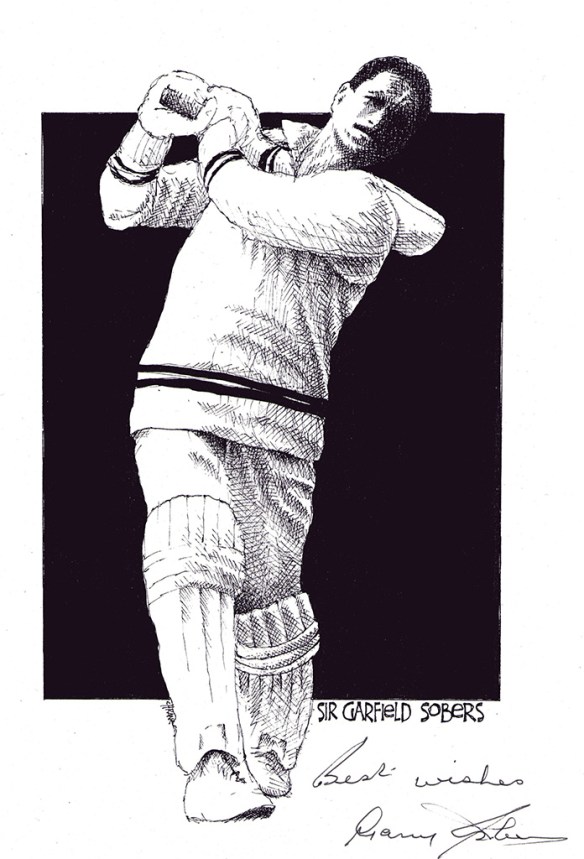
Sir Garfield (also known as Gary or Garry, as the man himself signs) Sobers played for the West Indies cricket team form 1954 -1977 and is considered one of the games great all rounders. His legendary status was secured on 31 August 1968 when he was the first player to hit six 6s in one over of a first class match, captaining Nottinghamshire against Glamorgan in Swansea.

A prolific scorer, but not a great signer. I was keen to obtain a Sobers sig.

I remember discussing this with the great New Zealand opener Glenn Turner, who knew Sir Garry and played in a few invitational XI teams with him. He told me, it just wasn’t in his DNA. While others gladly accommodated the fans, he ignored them. And so, the story begins. Bear with me.

The West Indies were touring New Zealand in the summer of 1994/95. The second and final test match was at Wellington’s Basin Reserve. Glenn was part of the commentary team, alongside one Joseph ‘Reds’ Perreira, the Caribbean commentating icon.

Glenn contacted me to say Reds was a close friend of Sir Garry and could get his autograph on my sketch. All I needed to do was get it to Glenn at the venue. First problem: The West Indies knocked over the Kiwis early, winning a close match by an innings and 322 runs. Reds left for the airport before the courier (who was delayed – but that’s another story) could deliver my package. A kind cricket official raced it out to Wellington airport in time to catch Reds before his flight to Australia. That was 13 February 1995.

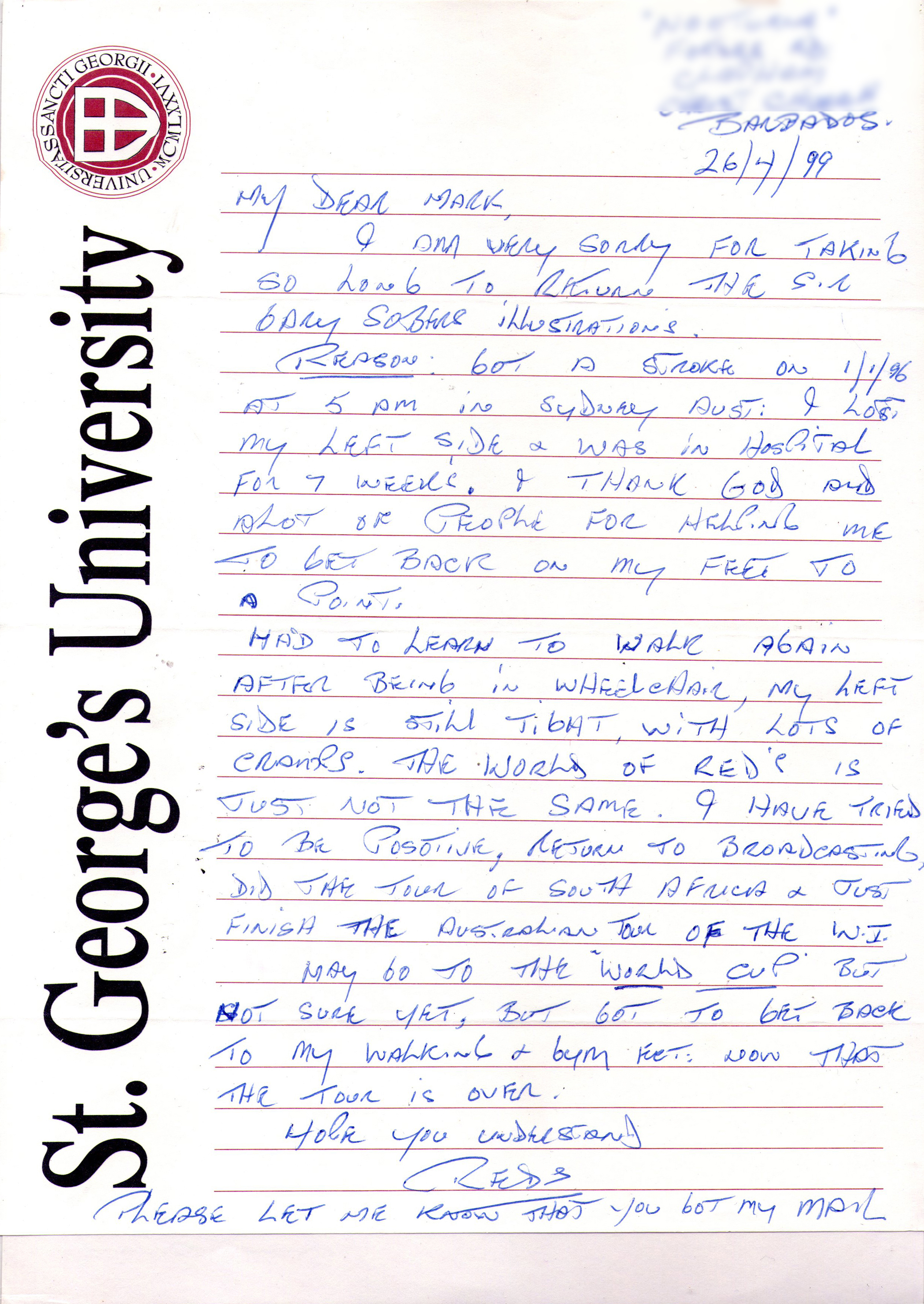
In April 1999, I received my sketch, signed by Sir Garry and the attached letter from Reds, which explained the reason for the lengthy exercise. It was a long innings, but well worth the wait.

Letter from Reds

Drawing: Brian Lara

Brian Lara001

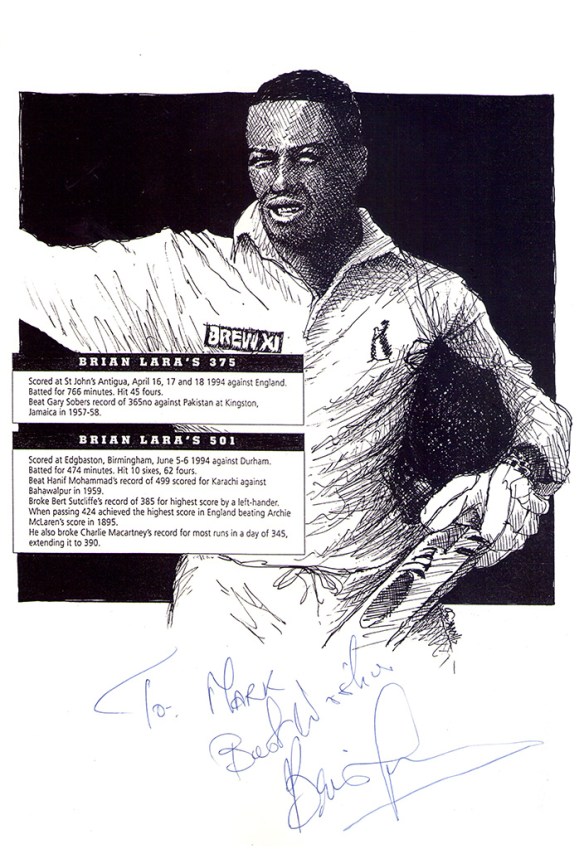
The former West Indian cricketer Brian Lara is arguable regarded as the best batsman of the modern era. He topped the test batting rankings on several occasions and holds several records, including the record for the highest individual score in first class cricket with 501 not out for Warwickshire against Durham at Edgbaston in 1994. He also holds the highest individual score in a test innings with 400 not out against England at Antigua in 2004.

He is the only batsman to have scored a hundred, a double century, a triple century, a quadruple century and a quintuple century in first class games. Lara also holds the test record of scoring the highest number of runs in a single over in a test match when he scored 28 off Robin Peterson of South Africa in 2003.

Lara’s match winning performance of 153 not out against Australia in Bridgetown, Barbados  in 1999 has been rated by Wisden as the second best batting performance in the history of test cricket, next only to the 270 scored by Sir Donald Bradman in the Ashes Test match of 1937.

I sent my sketch to Brian at Warwickshire in 1994, when he was captain of the county side.

Drawing: Australia Vs England Bicentenary Test

Test

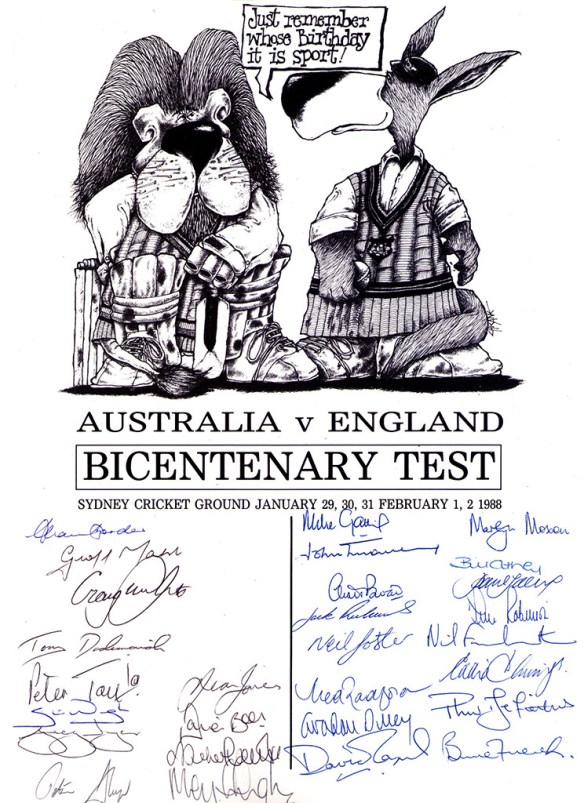
While the Ashes series clicks into gear, I recall the Bicentennial Test between the two great rivals. It was a single, one-off match at the Sydney Cricket Ground in 1988 to celebrate the bicentenary of permanent European settlement in Australia. It was played from 29 January to the 2 February, but was not part of The Ashes series. England were captained by Mike Gatting and the hosts by Allan Border.

The result was a draw… and by some illustrative intuition I ‘drew’ this ‘toon and made up a ‘team sheet’ sending it to the famous ground and hoping both squads members would ‘graph it for me. In those days the cricket fraternity were much more obliging, plus I used a courier who ‘knew a bloke’ on the inside. In fact, he knew a number of blokes with connections, so I used him often. Needless to say, he did manage to see a bit of sport at the same time, and you can’t rush a good delivery, as they say in cricket! It was a mutual relationship that worked well.

Drawing: Sir Don Bradman – The Don

bradman

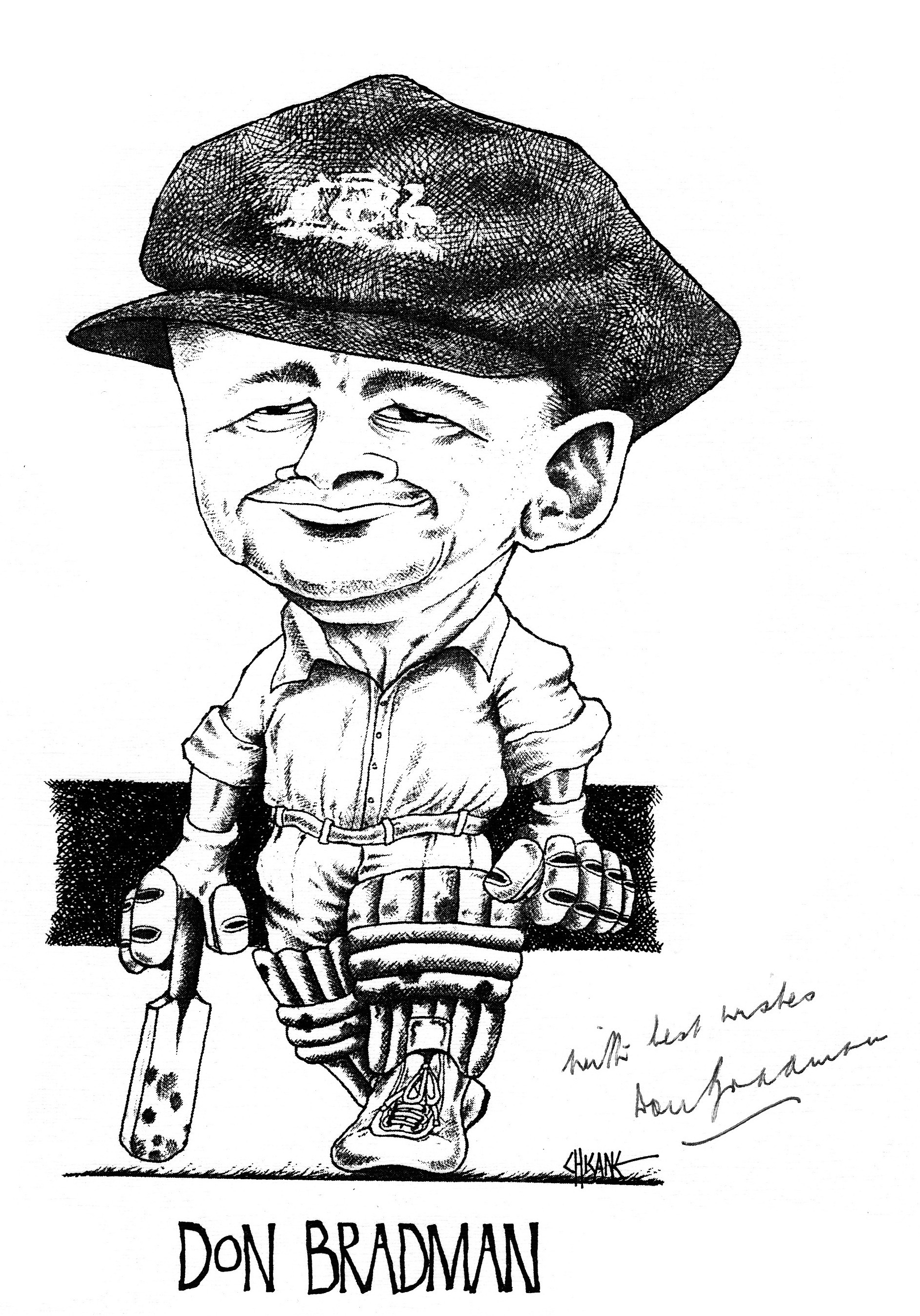
Australian icon Sir Don Bradman’s story of signing autographs is almost as legendary as his cricket feats. ‘The Don,’ widely acknowledged as the greatest batsman of all time and statistically the greatest sportsman in any major sport, finished with a test batting average of 99.94. A ‘duck’ in his final match, just four runs short of a batting average of 100.

During the Great Depression ‘Bradmania’ was responsible for reviving the spirits of a nation. Between scoring centuries and media commitments, he spent hours answering fan mail, often hundreds a day. It was only when he reached 90 years of age did he stop signing en masse.

Among many stories was one when Sir Don was walking to a local shop, a man stopped him and asked if he was ‘Don Bradman’. He confirmed, but neither had a pen or paper for an autograph, so he asked him if he wouldn’t mind waiting so he could go and buy the necessary items to collect his signature. The man returned to find the cricketer still there and he duly signed. That wouldn’t happen with any celebrity these days!

Australian star batsman Doug Walters was part of an invitational team to play a charity match at Queen’s Park, Invercargill, New Zealand, in early 1988. I drew a caricature of him and he signed it at the ground. Later, I copied a few off and numbered them and he signed them at the Kelvin Hotel  that evening. I had an idea of drawing a number of Australian Cricketing legends, including Dennis Lillee, Rod Marsh, Greg Chappell and Allan Border. Doug said most of them were playing in Tasmania the following week, so he would get them signed and returned. They were all currently playing, but the one and only Don Bradman. He had long since retired, but was still included as an administrator and selector. Doug said that Sir Don often visited the Sydney Cricket Ground where Doug had a stand named after him (demolished in 2007). In short, he was able to get Sir Don to sign ten copies of my caricature.

All were signed, dated and numbered. He also signed a run chart of his highest test innings of 334 at Headingly against England in 1930. The items were donated to charity for auction.

With all the fuss I completely forgot to get one for my own collection, so I sent another copy to Sir Don. He not only signed but also personalised it – one of my most treasured items.

Sir Don passed away on 25th February 2001 aged 92 years.

Test Matches

Test matches001

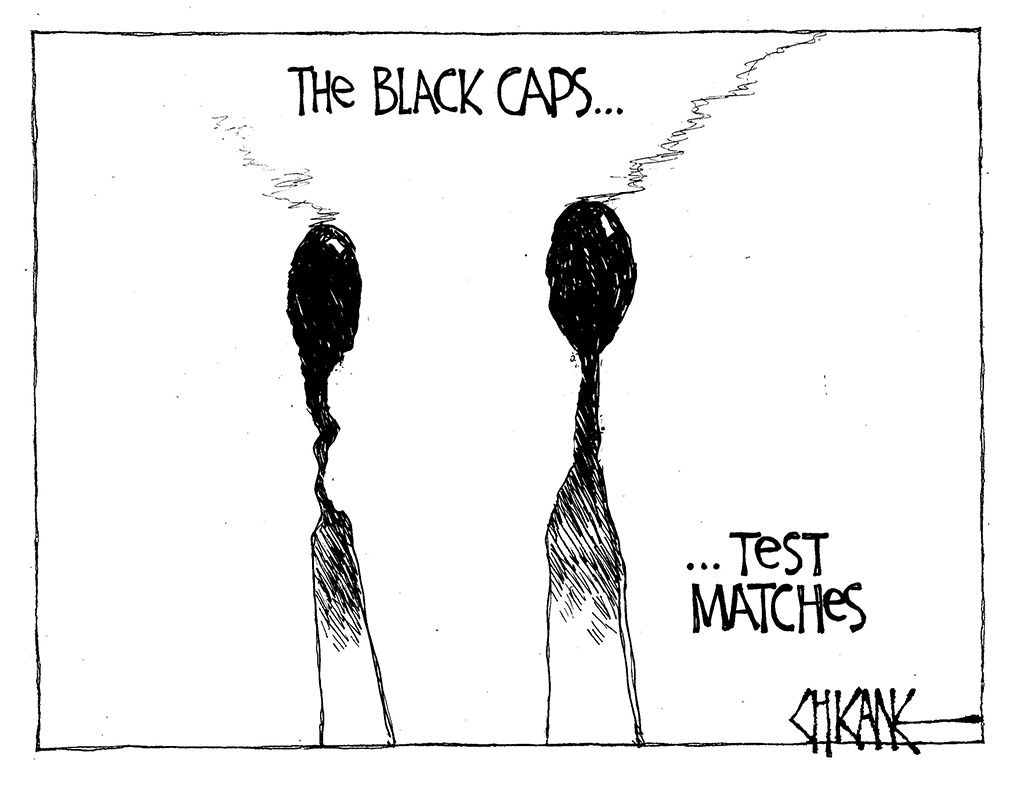
I’ve spent the weekend watching New Zealand vs South Africa in the cricket…