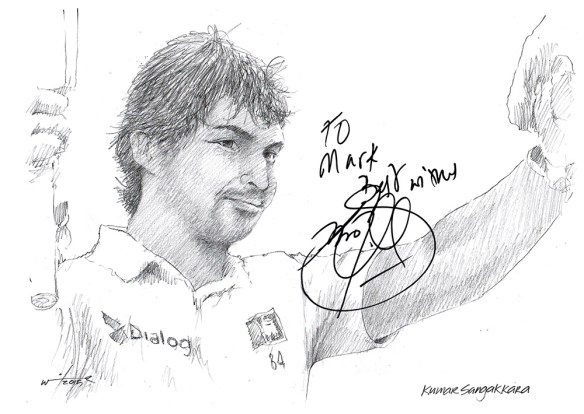
Drawing: Kumar Sangakkara

kumar sangakkara

The current world number one batsman in test cricket is Sri Lankan Kumar Sangakkara, who has just retired from the international arena but has taken up a two year contract with English county Surrey, though some media reports suggest he may be reconsidering his retirement.

He is widely regarded as one of the best batsmen of all time with a Test average of 58.66 and an ODI average of 42. A left-handed top order batsman, he has bowled a few right arm off breaks and is an accomplished wicket-keeper, having the largest number of dismissals in ODI cricket with 449 and the highest number of stumpings, 99 in ODIs.

Kumar’s 11 double centuries in tests is second only to the great Sir Don Bradman (12) and along with fellow Sri Lankan Mahela Jayawardene shares the highest partnership for any wicket – 624 against South Africa in 2006. Kumar scored 287 and Mahela 374.

I not only got to see him play in the opening game of the County cricket season at the Kia Oval last Sunday against Essex, thanks to my friend Dan’s membership and generosity, but also got to meet him after the end of day’s play.

The world’s best batsman was very affable and chatted away awhile happily signing my sketch and a photo for me.

Sketch: Sachin Tendulkar, The Little Master

tendulkar

Indian cricketer Sachin Tendulkar is widely considered as the greatest batsman of all time, or a least the equal of the great Sir Don Bradman. To say that ‘the Little Master (he’s 5′ 5”) is very popular is a massive understatement. His fan following is global and beyond…it’s out of this world, like his batting. He remains the most worshipped cricketer on the planet by some distance. In India they say,”Cricket is my religion and Sachin is my god’.

Sachin holds all the world records. He is the leading run scorer in  both Tests and One Day Internationals and the only player to pass 30,000 runs in all forms of International cricket. He has the most Test centuries (51) and ODI’s (49) in the most Test matches (200) and ODI’s (463).

In November 2013 he retired from all cricket after scoring 74 in his final innings against the West Indies at his home ground in Mumbai. Over the years I have been privillaged to see Sachin play, including in Mumbai. or Bombay as it was called then.I have collected his graph many times. In November last year he was at a book-signing (‘Playing It My Way’) at Waterstones in the Jubilee Place Mall at London’s Canary Wharf. Unprecedented scenes brought the place to a standstill as record crowds stormed the store for Sachin-mania. An scheduled hour session turned into two and a half as he signed books for the never-ending queue, moi included. Because of the obvious time constraints he was only able to autograph the book, so I couldn’t get this sketch signed. Anticipating this, I had it all packed up and gave it to one of his team. it came back from Sachin’s Mumbai address this week. A Little Master-stroke!

I’m not sure if it’s hand-signed or a stamp, because the sig has a ‘fade’ in the middle of it. Given the amount of requests he receives it stands to reason he can’t sign them all. However the ink has bleed through the paper and on the reverse side there are pressure points consistent with a writing instrument being used. the ‘fade’ maybe the result of paper  being placed on top of the graph,absorbing the ink, before it completely dried.

Either way, I was grateful the drawing was acknowledged.

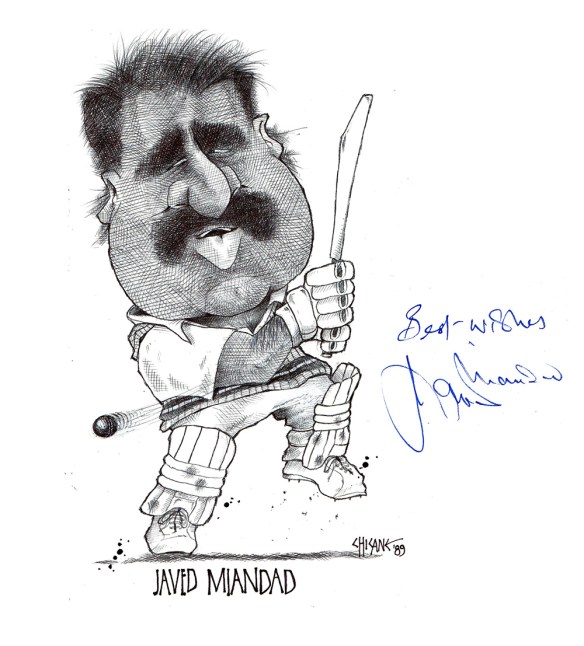
Sketch: Javed Miandad

Javed Miandad

Cricketer Javed Miandad is the greatest batsman Pakistan has ever produced, playing for his country from 1976-1996. Not only is he a national hero, but one of the world’s most ebullient sporting personalities.

In 124 test matches Javed scored 8,832 runs with a batting average of 52.57, including 23 centuries with a top score of 280 not out against India in the second test in Hyderabad in the 1982-83 series. Captain Imran Khan declared the innings, stopping him from possibly breaking the individual Test record of Sir Garfield Sobers.

Javed also played 233 One Day Internationals (ODIs) scoring 7,381 runs with 8 centuries and 50 half centuries. In fact he holds the record for the maximum number of consecutive half centuries in ODIs .

In his debut Test against New Zealand in Lahore in 1976 he became the youngest batsman to score a century on debut at the age of 19 yard and 119 days. I the third test he scored 206 runs, breaking George Headley’s 47 year recored, becoming the youngest player to score a double century.

Javed signed this sketch when he toured New Zealand in the 1988-89 after scoring 271 in the third test at Eden Park in Auckland.

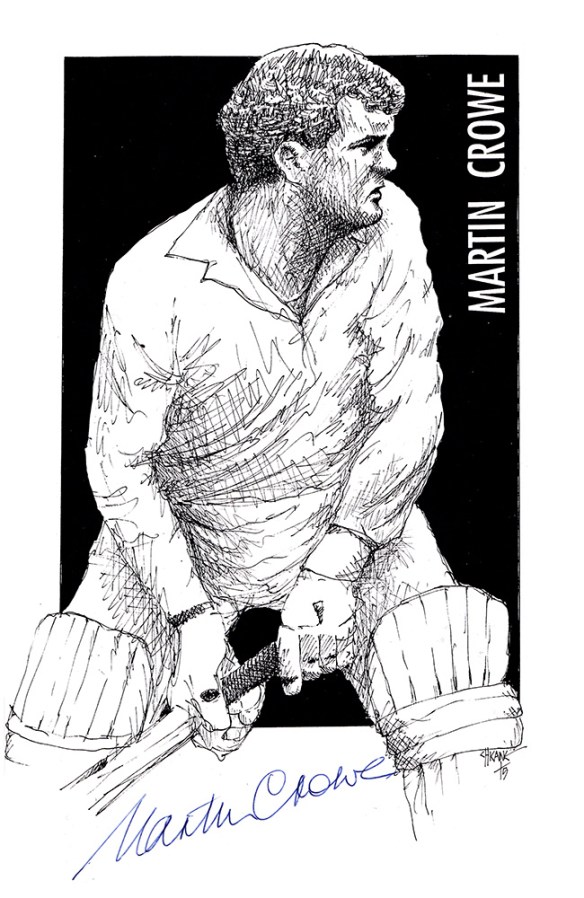
Drawing: Martin Crowe

martin crowe

Martin Crowe is considered one of New Zealand’s best batsmen, and by many to be the finest. He played for the Black Caps from 1982 – 1995 captaining both the test and one day sides in the early nineties. He was Wisden’s Cricketer of the year in 1985.

In 77 test matches for New Zealand he averaged 45.65, including 17 centuries. Martin also played 143 One Day Internationals, averaging 38.55 with four centuries!

In 1991 he shared a 467 run against Sri Lanka partnership with Andrew Jones, the highest at the time. Martin was agonisingly close to a triple century, being dismissed on 299. Until this year, when the current Kiwi captain Brendon McCullum scored 302 against India, it was the highest test score by a New Zealander.

Martin was considered to be an imaginative leader, known for many innovations, opening with spin, bowlers and using pinch hitting batsmen in the limited form of the game, and a variation called ‘Cricket Max’.

Marlk

Martin h

Drawing: Sir Vivian Richards, The Master Blaster

viv richards

West Indies cricket legend Sir Isaac Vivian Alexander Richards, popularly known as ‘Viv’ is regarded as one of the greatest batsmen of all time. Nicknamed the ‘Master Blaster’, he was voted on of the five cricketers of the century by a 100 member panel in 2000, along with Sir Don Bradman, Sir Garfield Sobers, Sir Jack Hobbs and Shane Warne.

Wisden chose Sir Viv as the greatest One Day International (ODI) batsman of all time and the third greatest test batsman, afar ‘the Don’ and Sachin Tendulkar.

Considered by many to be the best every batsman against genuine fast bowling, he played his entire 17 year career without a helmet. In 121 Test matches he scored 8,540 runs at an average of 50.23 with 24 centuries and a top score of 29.1 against England at The Oval in 1976,

Sir Viv gave “swagger” new meaning in cricket, he was the most destructive batsman of his era. Apart from having the privilege to see the Master Blaster apply his trade live on a few occasions and signing my sketch, my only other connection with the great man is that I taught his niece at a London school a couple of years ago.

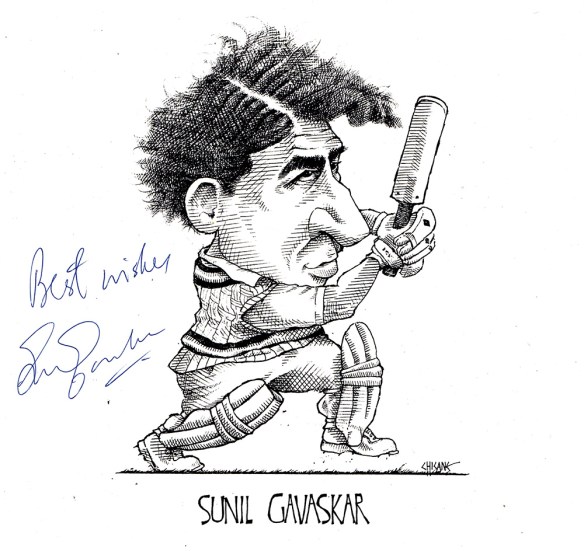
Drawing: Sunny Gavaskar

Sunil Gavaskar

The diminutive Indian batsman Sunil ‘Sunny’ Gavaskar is regarded as one of, if not the greatest, opening batsmen in cricket history. He was certainly the most successful in the 1970s and 80s.

During his career he set world records for the most test runs and the most test centuries scored by a batsman. In 125 test appearances he scored 10,122 runs at an average of 51.12 and in 108 ODIs he reached 3,092 runs. He has compiled 34 test centuries with a top score of 236 not out against the West Indies in Madras. It was his 30 ‘ton’ in his 99th match, overtaking the great Don Bradman‘s 29 test centuries record. Subsequently the other ‘little master’ Sachin Tedndulkar has passed him with 51. His style was technical correctness over flair, which is suited for test matches rather than the shorter versions of the game. He was particularly skilled at playing fast bowling with immaculate defence and hooking and pulling in equal measure.

Drawing: Shoaib Akhtar “The Rawalpindi Express”

Shoaib Akhtar

Pakistani former quick Shoaib Akhtar is regarded as the fastest bowler in the history of cricket. He is officially recorded as bowling the fastest delivery at 161.3kph against New Zealand in 2002 and was the first of only three cricketers to have been recorded bowling over 100mph.

The mercurial Shoaib’s career could be summed up in three words: speed, scandal and showmanship. His stellar success has been marred by several controversies and consistent injuries, including bans for failed drugs tests, subsequent acquittals, criticising authorities, abusing match officials and players, poor attitude, fighting with team mates and management, and ball tampering.

He finished his 46-match test career in India in 2007 with 178 wickets. His 163rd and last ODI was against New Zealand at Pallekele in March 2011. He finished with 247 dismissals.

Known for his bowling, Shoaib actually holds a batting world record for remaining not out in 12 successive ODI innings.

He signed my sketch at the Westpac stadium in Wellington during the 5th ODI against New Zealand on 17th January 2004.

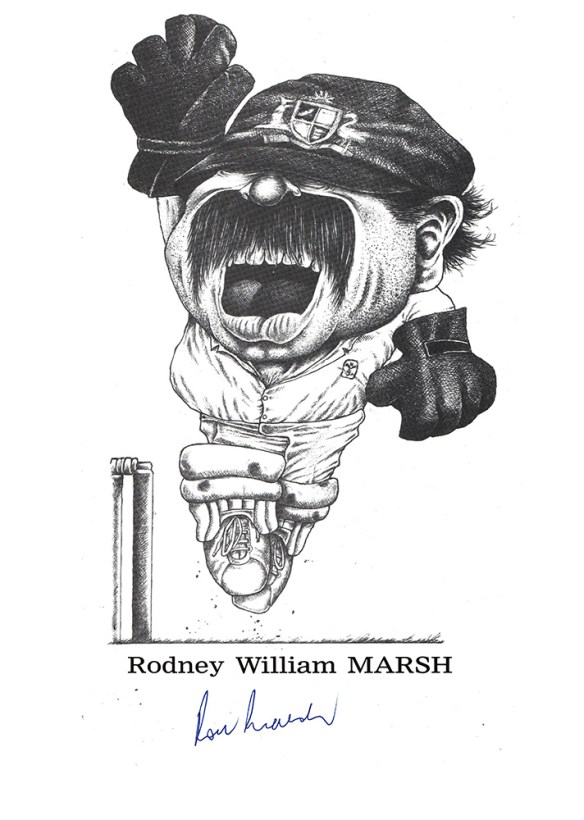
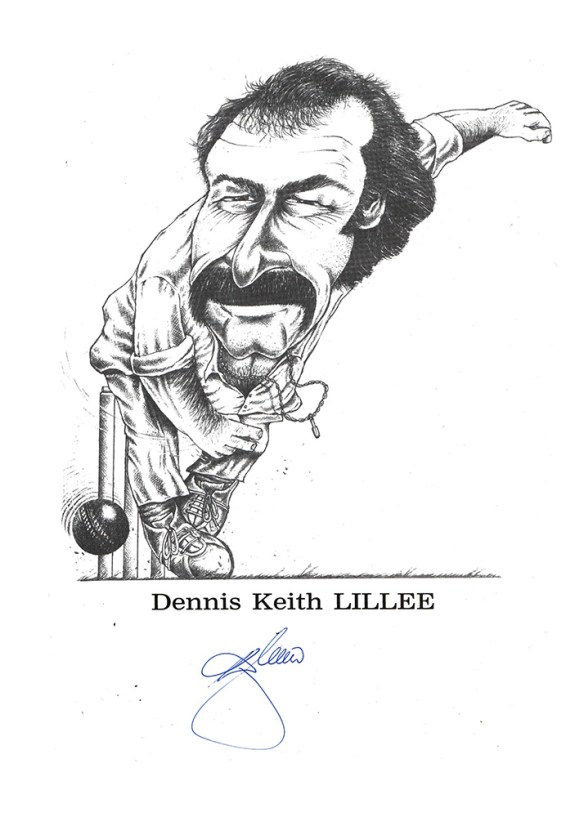
Drawing: Caught Marsh, bowled Lillee (Dennis Lillee and Rod Marsh)

Rod Marsh

‘Caught Marsh, bowled Lillee’ became a very familiar scoreboard entry during the 1970s and early 1980s. It appeared 95 times in Test matches, which is a partnership record between wicket-keeper and bowler that is yet to be broken. Dennis Lillee and his Western Australian teammate Rod Marsh continued their State success in the international arena that would cement the two in Australian cricketing folklore.

Wisden stated, “Few partnerships between bowler and wicket-keeper have had so profound an impact on the game.”

Dennis began his career as a tearaway fast bowler but back injuries fired him to remodel his bowling action and he returned more accurate and dependable, ending his career as the leading Test wicket-taker, taking the 355th off his final ball against Pakistan in Sydney in January 1984. Coincidentally, rod ended his career with a world record 355 Test dismissals – 343 catches and 12 stumpings.

Rod raised the role of wicket-keeper with his acrobatic diving and raucous appeals. he once commented on his understanding with Dennis: “I’ve played with him so much now that most of the time I know what he is going to do before he has bowled.”

In the 1974-75 Ashes series he and fellow quick Jeff Thomson formed on elf the most potent opening bowling combinations in Test cricket to steer Australia to an emphatic 4-1 victory. “Ashes to Ashes, dust to dust, if Thomson don’t get ya, Lillie must,” was the caption The Sunday Telegraph used. Even though he had cut his pace and length of run up , relying more on seam movement, Dennis bowling was still timed at 154.8km/h

The both signed a limited edition run of 10 prints of my caricatures for charity.

Dennis Lillee

Drawing: Waqar Younis and Wasim Akram “Sultans of Swing”

Waqar Younis Wasim Akram

The Pakistan cricket team possessed the most feared bowling attack in the world during the 1990s with the demon duo of Wasim Akram and Waqar Younis – nicknamed the ‘Sultans of Swing’.

Regarded as two of the greets fast bowlers in the history of the game, their trademark deliveries were their variation of swing bowling at great pace, particularly the reverse swing of the ball.

Right handed Waqar, known as the ‘Burewala Express’ or ‘Toe Crusher’ took 373 test and 416 ODI wickets and has the best strike rate for any bowler over 350 test scalps. His fastest delivery was clock at 153km in South Africa in 1993.

South paw Wasim is considered one of the founders of and the finest exponent of reverse wing bowling. He is the only bowler to this day who could produce the ‘double sings’, moving the ball twice in one delivery. His speciality was the lethal inswinging yorker. In a sixteen year career he took 414 test and 502 ODI wickets. Wisden selected him in the all-time World XI to mark the 150th Anniversary of its famous cricketing almanack.

Good team mates? Hardly! The relationship between the two greats was not convivial, with  neither speaking to each other on or off the field. Their rivalry was so intense that, “every time Waqar took a wicket, I too would get charged up to do the same,” Wasim said after they both retired. “It was the opponents who suffered from the rivalry, not the Pakistan cricket team,”  he claimed.

Time has softened the conflict. They are good friend snow and both have been inducted into the Cricket Hall of Fame.

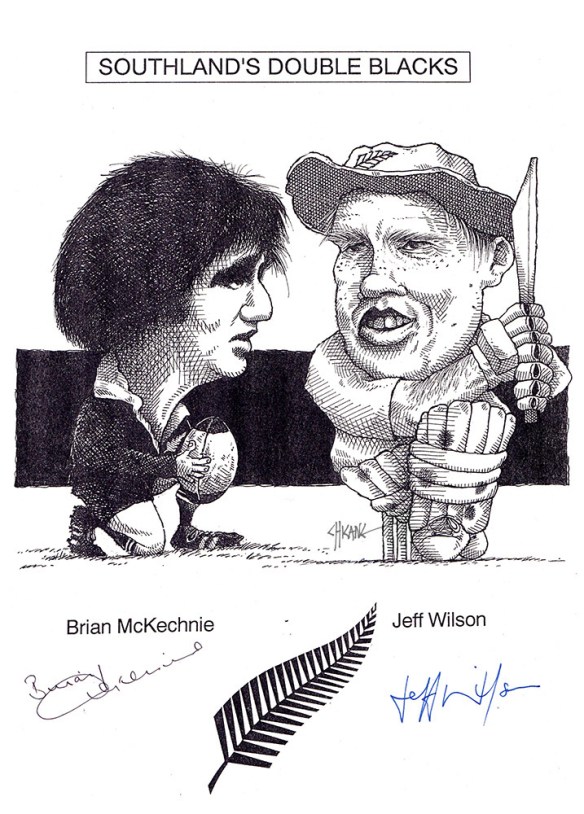
Drawing: Colt and Goldie (Brian McKechnie and Jeff Wilson)

Double Blacks

Only seven men have played both rugby union and cricket for New Zealand. The last two – Brian McKechnie and Jeff Wilson – are both from my home province of Southland and likely to be the last dual internationals dubbed “Double All Blacks”. It is a rare achievement from a forgotten era unlikely to be repeated because rugby has morphed into a year round code.

Jeff, nicknamed Goldie, played four ODIs as a 19 year old all rounder against Australia before turning his attention to rugby where he became an All Black legend with 44 tries in 60 appearances on the wing. After retiring from footy he returned to cricket after a 12 year gap and played two more ODIs and a one off Twenty20 in 2005.

Brian, known as Colt, was an unwilling participant in controversies in both sports. In 1981 he was the batsman on the receiving end of Trevor Chappells’ infamous underarm delivery  at the end of the third final in the World Series against Australia at the MCG. Oz captain Greg Chappell ordered his brother to bowl the controversial final ball to prevent a six being hit to tie the match. It was an incident he later described as the biggest regret of his career.

Three years earlier McKechnie kicked a late penalty that gave the All Blacks a 13-12 win over Wales at Cardiff, securing the ‘Grand Slam’. Andy Haden’s ‘dive’ from a line out near full time was thought to be the reason for the penalty, but years later the referee said it was a completely separate incident – which video footage clearly verifies.

An economical right-arm pace bowler and useful lower-order batsman, McKechnie played 14 ODIs for the Black Caps. The underarm incident was his final match. He played 26 matches for the All Blacks at first five-eigth (fly half) and full back, between 1977-1981.

I drew these two caricatures of Colt and Goldie sometime in the 1990s. Twenty five prints were signed by both as part of a fundraiser for charity.