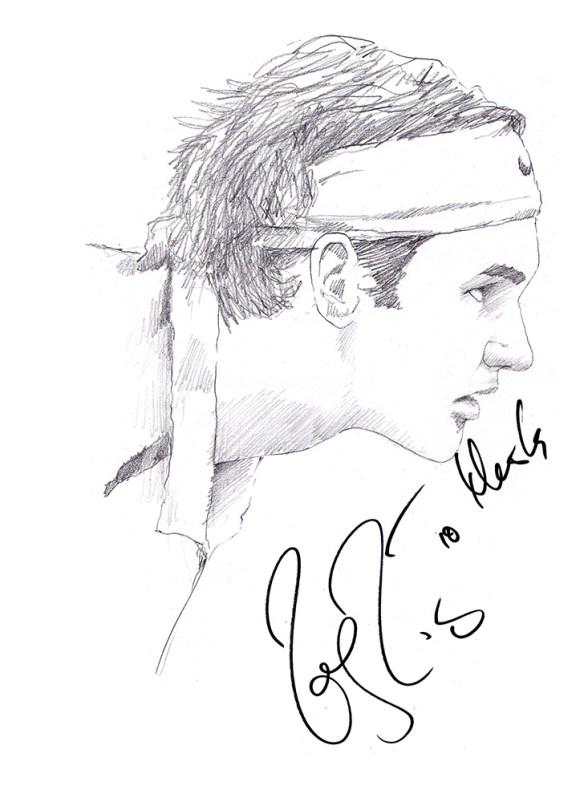
Drawing: Roger Federer

roger federer

Regarded by most as ‘the greatest tennis player of all time’, Swiss maestro Roger Federer entered the ATP World Tour Finals this week ranked 2nd, chasing Novak Djokovic for the year the year end top position.

After his first round win against Canadian giant Milos Raonic he was presented with the ATP World Tour Fans’ Favourite Award, which he’s won for a record 12 times straight since 2003 and the Stefan Edberg Sportsmanship Award (voted by the players) for a record tenth time.

His achievements are to numerous to mention here, but he will get to add a missing one when he represents Switzerland against France in the Davis Cup Final after WTF extravaganza.

Roger was leaving the O2 on Friday evening with the other seven men making up the field. Security did warn us they were in a hurry to board the Thames Clipper boat to go to the WTF launch gala, but when I asked Roger, he said, “walk with me,” and kindly signed and dedicated my sketch.
Drawing: Novak Djokovic

novak djokovic

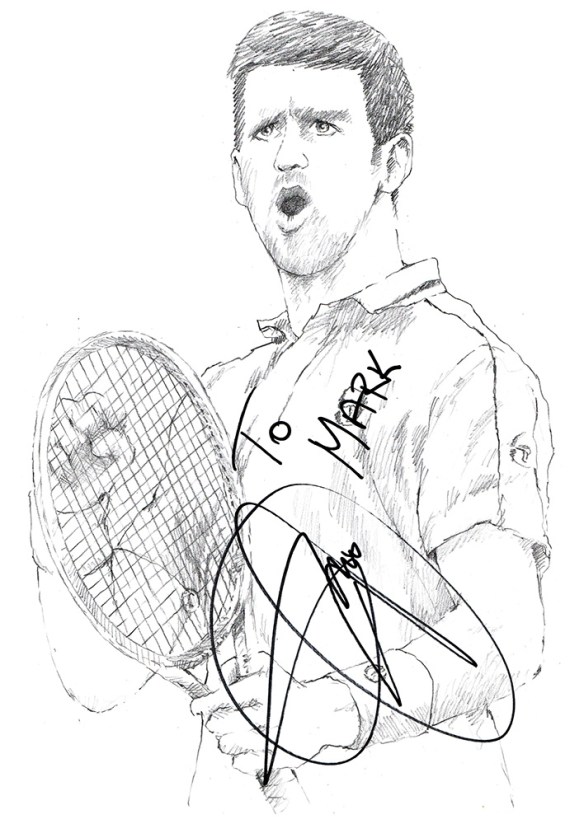
Current world number one Novak Djokovic is planning to hold on to that title at the ATP World Tour Tennis Finals at London’s O2 this week. He needs to win all his round robin matches to head off Roger Federer, who has won more tour matches than any other player this year, be it not a Grand Slam title.

Novak has won seven slams, including this year’s Wimbledon and he’s held the No 1 spot in the ATP ranks for a total of 119 weeks. His current doubles ranking is 554 – obviously not a priority for him!

He does however have an Olympic medal, winning bronze for Serbia in the singles at Beijing.

Novak is excellent with his supporters and always takes time to stop, sign, smile for snaps. He has always been very complimentary about my sketches and really liked this one, showing it to his support staff before signing it on the opening Sunday at the O2. “You have a rare talent, Sir,” he said.

Drawing: Ian Thorpe, “The Thorpedo”

ian thorpe

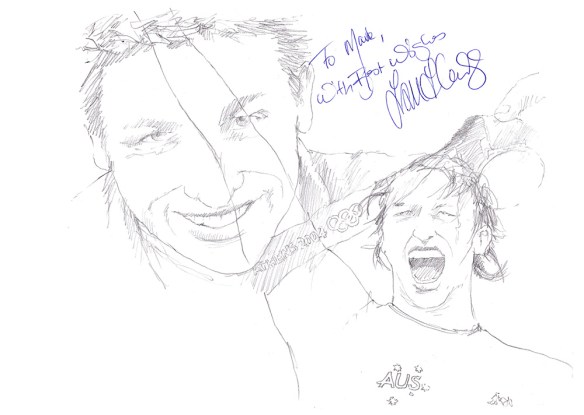
Ian Thorpe is one of the greatest swimmers of all time. Predominantly a freestyler, he won five Olympic gold medals, the most won by any Australian. He was the highest achieving athlete at the 2000 games in Sydney with 3 golds and 2 silvers.

AT the 2001 World Aquatics Championships he became the first person to win six gold medals in one meet. In total he has won eleven World Golds, the second highest of any swimmer. Three years later at the Athens Olympics he won the 200m and 400m freestyle titles.

He attracted a legion of viewers for his gentle admonishments and thoughtful insights as a swimming pundit for the BBC during the 2012 London Olympics and Australia’s Channel 10 at this years Commonwealth Games in Glasgow. One reporter label him the “philosopher King of the BBC sofa”. He refused to give pat answers and has a dry wit. When a fellow commentator said, “unlucky lane five”, he deadpanned, “there is water in every lane, so it is ok”.

Ian retired in 2006, but returned to swimming with the aim of making the Australian team for the London Olympics. He competed at the Olympic trials but missed out. A shoulder injury scuttled plans to target qualification for the World Champs in Barcelona and this year’s Glasgow Games. He did however make it to Scotland in his commentary capacity and signed my sketch.

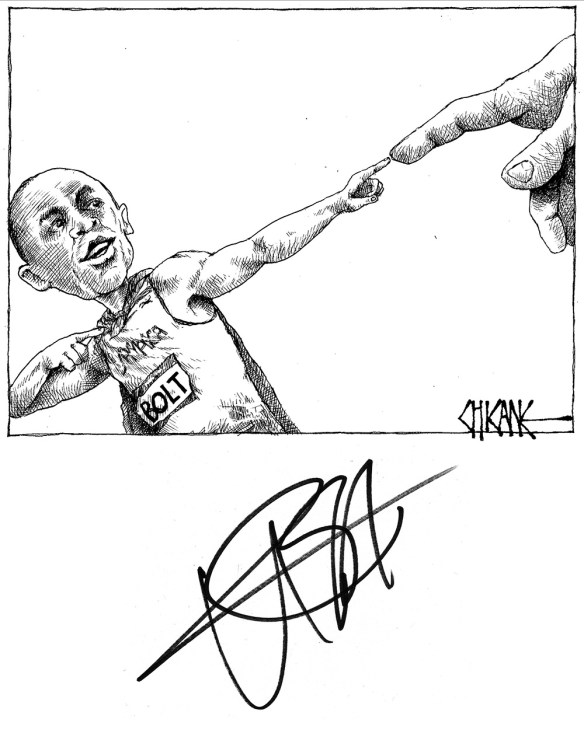
Drawing: Usain Bolt

Usain Bolt

Sprint sensation Usain St Leo Bolt is considered to be the fastest person ever. The Jamaican sporting phenomenon nicknamed ‘Lightning Bolt’ for obvious reasons, including his famed victory stance, is undoubtably track and field’s most electrifying star.

The first man to hold both the 100 and 200 metre world records since fully automatic time measurements became mandatory in 1977. Both were secured in Berlin, in August 2009, running the 100 in 9.58 seconds and the 200 in 19.19 seconds.

Add to that the “double triple” at the Olympics, winning gold in the 100, 200 and 4×100 relay at both Beijing (2008) and London (2012).

Known for his relaxed approach, Usain famously fed on chicken nuggets before winning the 100 at Beijing. He didn’t have breakfast and woke up at 11, watched some TV then had some chicken nuggets, slept for 2 more hours, then went back for more nuggets!

After winning the 100 metres in London he celebrated back in his room in the Olympic VIllage til 3am, with three members of the Swedish women’s handball team, before running the heats of the 200 later that day. Despite losing all five of their matches and finishing  bottom of their group, the handballers; Gabriella Kain, Isabelle Gullden and Jamina Roberts asked for “special accreditation” to meet their idol.

A week later he was a guest on the Jonathan Ross show at the ITV studios on London’s Southbank. Hunters, including moi, lined the railings opposite the back entrance to catch a glimpse or possibly a ‘graph. While waiting for his car to arrive, he signed for us through the gaps. As you could imagine, the crowd was a huge crush, and I was left with the impression of a railing on my face for a couple of hours afterwards. But worth it.

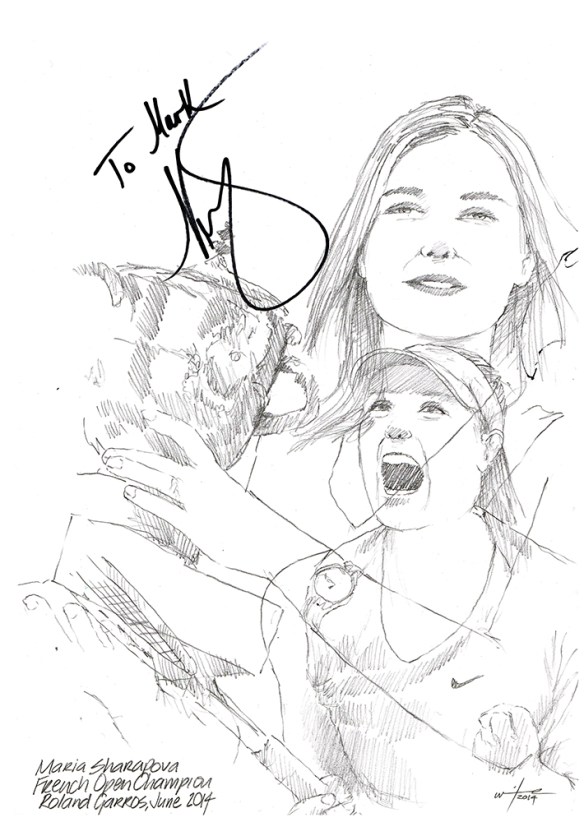
Drawing: Maria Sharapova

Maria Sharapova

Maria Sharapova won her fifth Grand Slam title this year, beating Simona Halep in three sets in the French Open final at Roland Garros. In a match lasting three hours, it was the first time since 2001 that a third set was contested, and it was described as one of the best women’s finals in recent years.

By winning the 2012 French open she became only the sixth woman in the Open Era to complete the Career Grand Slam in singles. Maria also won the silver medal at the London Olympics in the same year.

She won Wimbledon as a 17 year old in 2004, the US Open in 2006 and the Australian Open in 2008. Maria has been forced out of the game twice due to shoulder injuries. Between late 2008 until May 2009 she did not play, but came back to win the French Open in 2012. After her second layoff in mid 2013 she once again rebounded to win the 2014 French Open. She was also runner up in the intervening year.

Maria’s game is based on power so her preferred surfaces early in her career were the fast playing hard and grass courts. Initially the slower clay courts such as Roland Garrros did not suit her. She once described her self as a “cow on ice” on the ‘red dirt’ due to her ability to slide. Since her injury it’s now her best surface, winning 9 out of her last 11 titles on it.

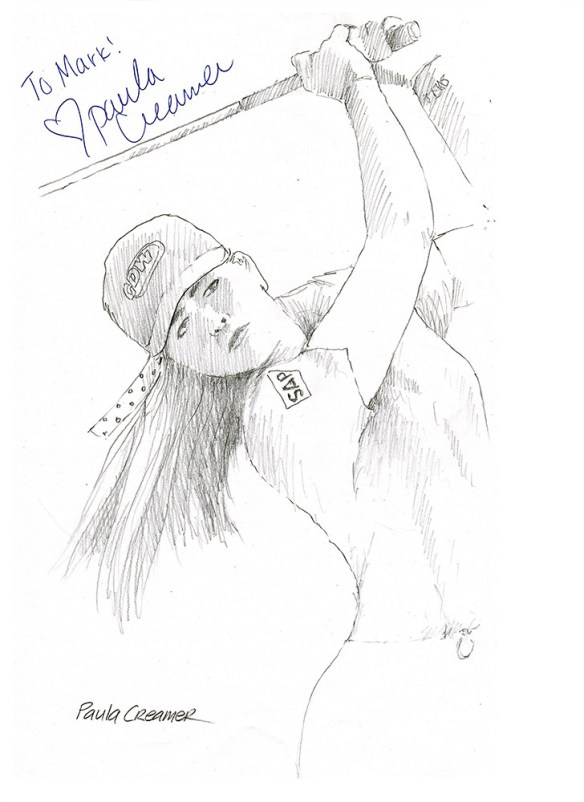
Drawing: Paula Creamer “The Pink Panther”

Paula Creamer

American golfer Paula Creamer has won 12 tournaments, including 10 LPGA Tour events since her rookie year in 2005. That included the 2010 US Women’s Open.

Nicknamed ‘The Pink Panther’ due to her fondness for wearing pink, Pink Panther club covers and sometimes playing with pink balls, Paula has been as high as number 2 in the Women’s World Golf Rankings.

She recently competed in the final major the year – the Evian Championship at the Evian Resort Club in Evian-les-Banis, finishing seventh after a strong finish wit a bogey-free 66 in the final round. The former champion (2005) signed my sketch at the resort last week… in blue, not pink.

Oh yes, and the other thing, she travels with her dog, a Coton de Tulear called Studley.

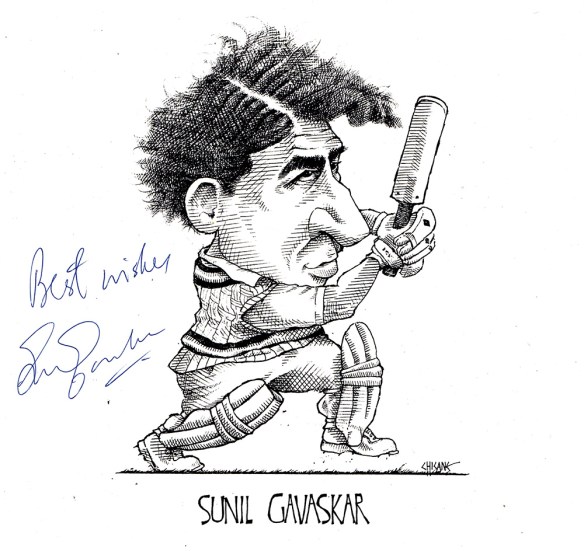
Drawing: Sunny Gavaskar

Sunil Gavaskar

The diminutive Indian batsman Sunil ‘Sunny’ Gavaskar is regarded as one of, if not the greatest, opening batsmen in cricket history. He was certainly the most successful in the 1970s and 80s.

During his career he set world records for the most test runs and the most test centuries scored by a batsman. In 125 test appearances he scored 10,122 runs at an average of 51.12 and in 108 ODIs he reached 3,092 runs. He has compiled 34 test centuries with a top score of 236 not out against the West Indies in Madras. It was his 30 ‘ton’ in his 99th match, overtaking the great Don Bradman‘s 29 test centuries record. Subsequently the other ‘little master’ Sachin Tedndulkar has passed him with 51. His style was technical correctness over flair, which is suited for test matches rather than the shorter versions of the game. He was particularly skilled at playing fast bowling with immaculate defence and hooking and pulling in equal measure.

Drawing: Shoaib Akhtar “The Rawalpindi Express”

Shoaib Akhtar

Pakistani former quick Shoaib Akhtar is regarded as the fastest bowler in the history of cricket. He is officially recorded as bowling the fastest delivery at 161.3kph against New Zealand in 2002 and was the first of only three cricketers to have been recorded bowling over 100mph.

The mercurial Shoaib’s career could be summed up in three words: speed, scandal and showmanship. His stellar success has been marred by several controversies and consistent injuries, including bans for failed drugs tests, subsequent acquittals, criticising authorities, abusing match officials and players, poor attitude, fighting with team mates and management, and ball tampering.

He finished his 46-match test career in India in 2007 with 178 wickets. His 163rd and last ODI was against New Zealand at Pallekele in March 2011. He finished with 247 dismissals.

Known for his bowling, Shoaib actually holds a batting world record for remaining not out in 12 successive ODI innings.

He signed my sketch at the Westpac stadium in Wellington during the 5th ODI against New Zealand on 17th January 2004.

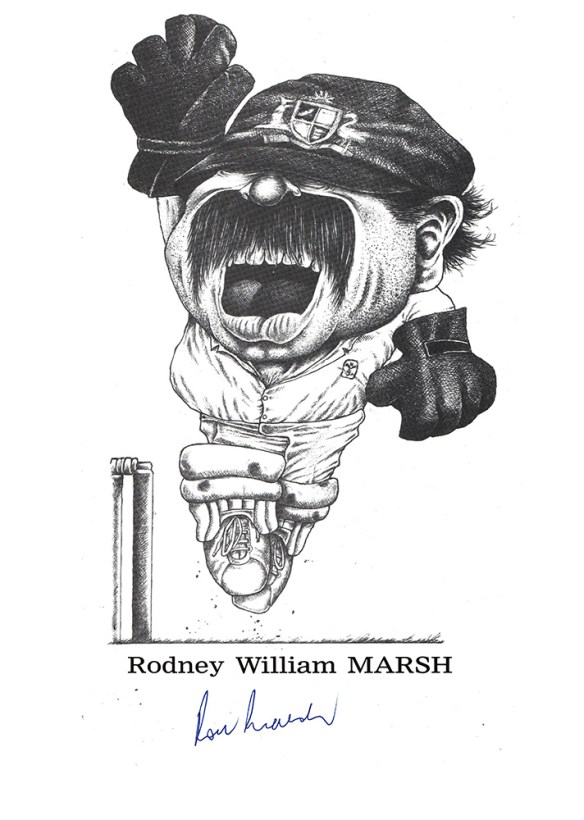
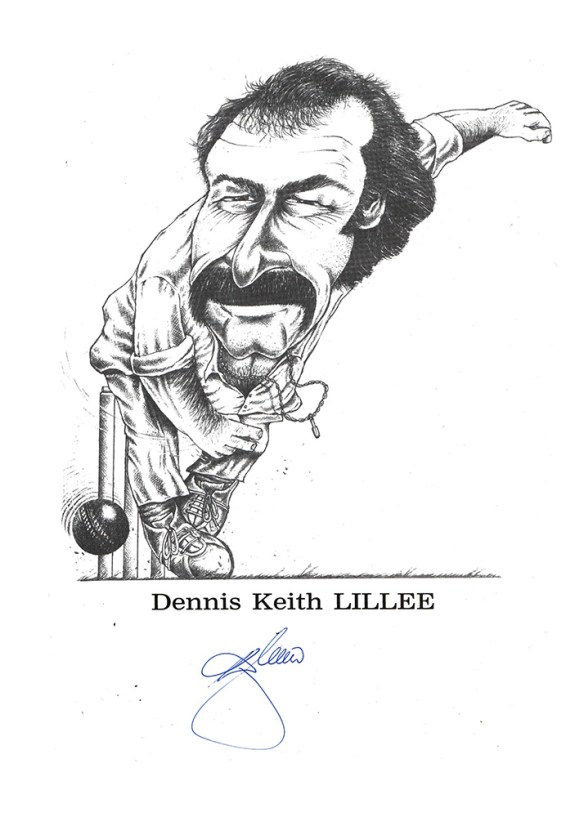
Drawing: Caught Marsh, bowled Lillee (Dennis Lillee and Rod Marsh)

Rod Marsh

‘Caught Marsh, bowled Lillee’ became a very familiar scoreboard entry during the 1970s and early 1980s. It appeared 95 times in Test matches, which is a partnership record between wicket-keeper and bowler that is yet to be broken. Dennis Lillee and his Western Australian teammate Rod Marsh continued their State success in the international arena that would cement the two in Australian cricketing folklore.

Wisden stated, “Few partnerships between bowler and wicket-keeper have had so profound an impact on the game.”

Dennis began his career as a tearaway fast bowler but back injuries fired him to remodel his bowling action and he returned more accurate and dependable, ending his career as the leading Test wicket-taker, taking the 355th off his final ball against Pakistan in Sydney in January 1984. Coincidentally, rod ended his career with a world record 355 Test dismissals – 343 catches and 12 stumpings.

Rod raised the role of wicket-keeper with his acrobatic diving and raucous appeals. he once commented on his understanding with Dennis: “I’ve played with him so much now that most of the time I know what he is going to do before he has bowled.”

In the 1974-75 Ashes series he and fellow quick Jeff Thomson formed on elf the most potent opening bowling combinations in Test cricket to steer Australia to an emphatic 4-1 victory. “Ashes to Ashes, dust to dust, if Thomson don’t get ya, Lillie must,” was the caption The Sunday Telegraph used. Even though he had cut his pace and length of run up , relying more on seam movement, Dennis bowling was still timed at 154.8km/h

The both signed a limited edition run of 10 prints of my caricatures for charity.

Dennis Lillee

Drawing: Waqar Younis and Wasim Akram “Sultans of Swing”

Waqar Younis Wasim Akram

The Pakistan cricket team possessed the most feared bowling attack in the world during the 1990s with the demon duo of Wasim Akram and Waqar Younis – nicknamed the ‘Sultans of Swing’.

Regarded as two of the greets fast bowlers in the history of the game, their trademark deliveries were their variation of swing bowling at great pace, particularly the reverse swing of the ball.

Right handed Waqar, known as the ‘Burewala Express’ or ‘Toe Crusher’ took 373 test and 416 ODI wickets and has the best strike rate for any bowler over 350 test scalps. His fastest delivery was clock at 153km in South Africa in 1993.

South paw Wasim is considered one of the founders of and the finest exponent of reverse wing bowling. He is the only bowler to this day who could produce the ‘double sings’, moving the ball twice in one delivery. His speciality was the lethal inswinging yorker. In a sixteen year career he took 414 test and 502 ODI wickets. Wisden selected him in the all-time World XI to mark the 150th Anniversary of its famous cricketing almanack.

Good team mates? Hardly! The relationship between the two greats was not convivial, with  neither speaking to each other on or off the field. Their rivalry was so intense that, “every time Waqar took a wicket, I too would get charged up to do the same,” Wasim said after they both retired. “It was the opponents who suffered from the rivalry, not the Pakistan cricket team,”  he claimed.

Time has softened the conflict. They are good friend snow and both have been inducted into the Cricket Hall of Fame.