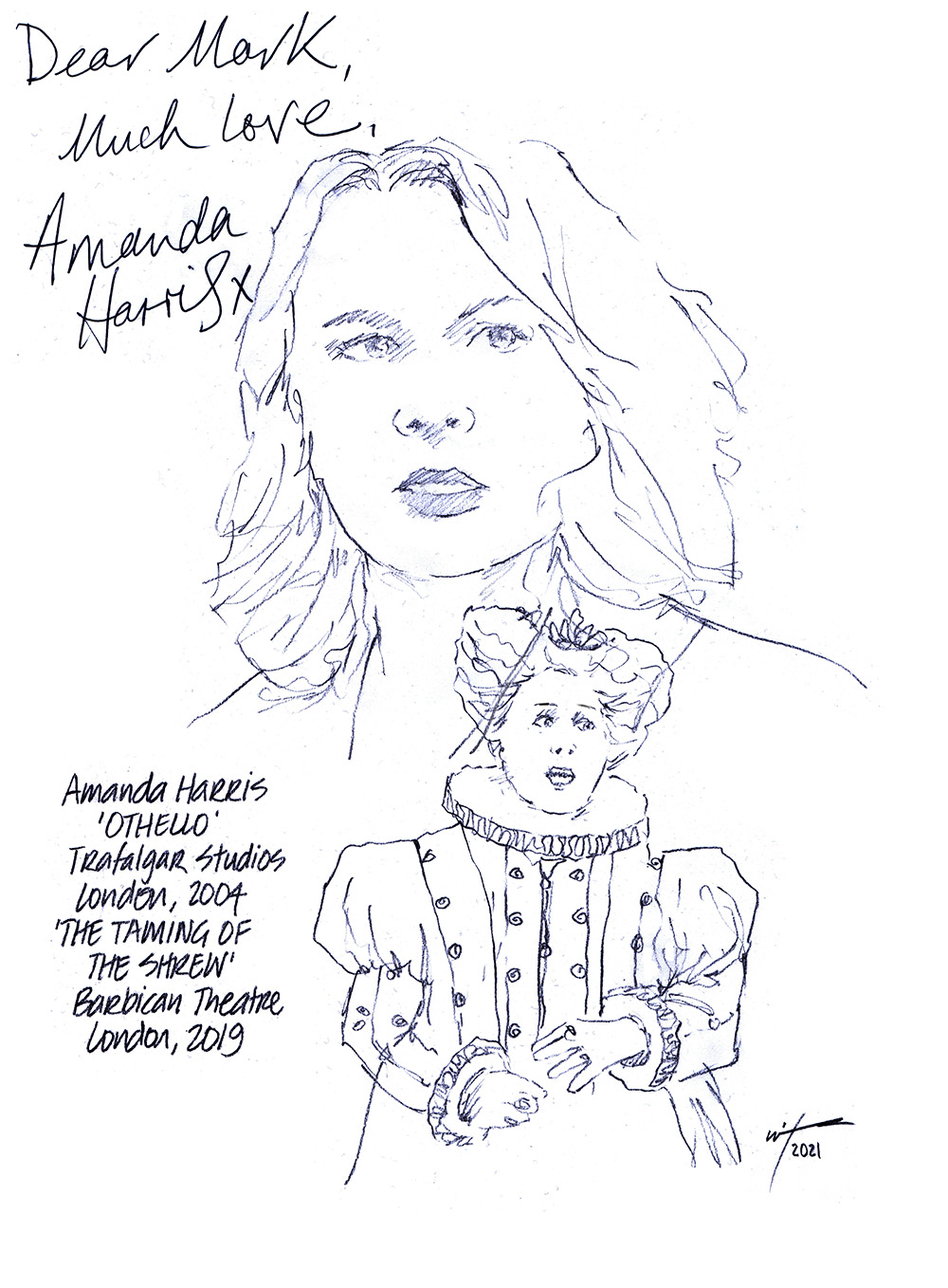
Shakespearean stalwart Amanda Harris won the Best Performance in a Supporting Role Olivier Award in 2005 for her portrayal of Emilia, the wife of the evil Iago (played by Anthony Sher) and Desdemona’s maidservent in the 2004 Royal Shakespeare Company’s production of OTHELLO, directed by Gregory Doran. After its initial staging in Stratford-upon-Avon, followed by a tour of Japan it returned to England and opened the larger of the two theatres at the Trafalgar Studios in London in June.
My wife and I were fortunate to see Amanda in the RSC’s staging of THE TAMING OF THE SHREW at the Barbican Theatre in London in 2019 as part of our annual Shakespearean tradition to celebrate our wedding anniversary. The production switched the genders for every role with Amanda playing Minola Baptista, one of the wealthiest ‘men’ in Padua and ‘father’ of Kate, the ‘shrew’ of the play’s title and Bianca.
Her screen credentials include appearances in all the popular British TV programmes, including MIDSOMER MURDERS, THE BILL, A TOUCH OF FROST and HEARTBEAT. Amanda has taught drama and Shakespeare at the University of Alicante in Spain and is an Associate Artist at the RSC, where I sent this Emilia/Baptista sketch of her as for her to sign, which she kindly did and returned with a nice complementary note.
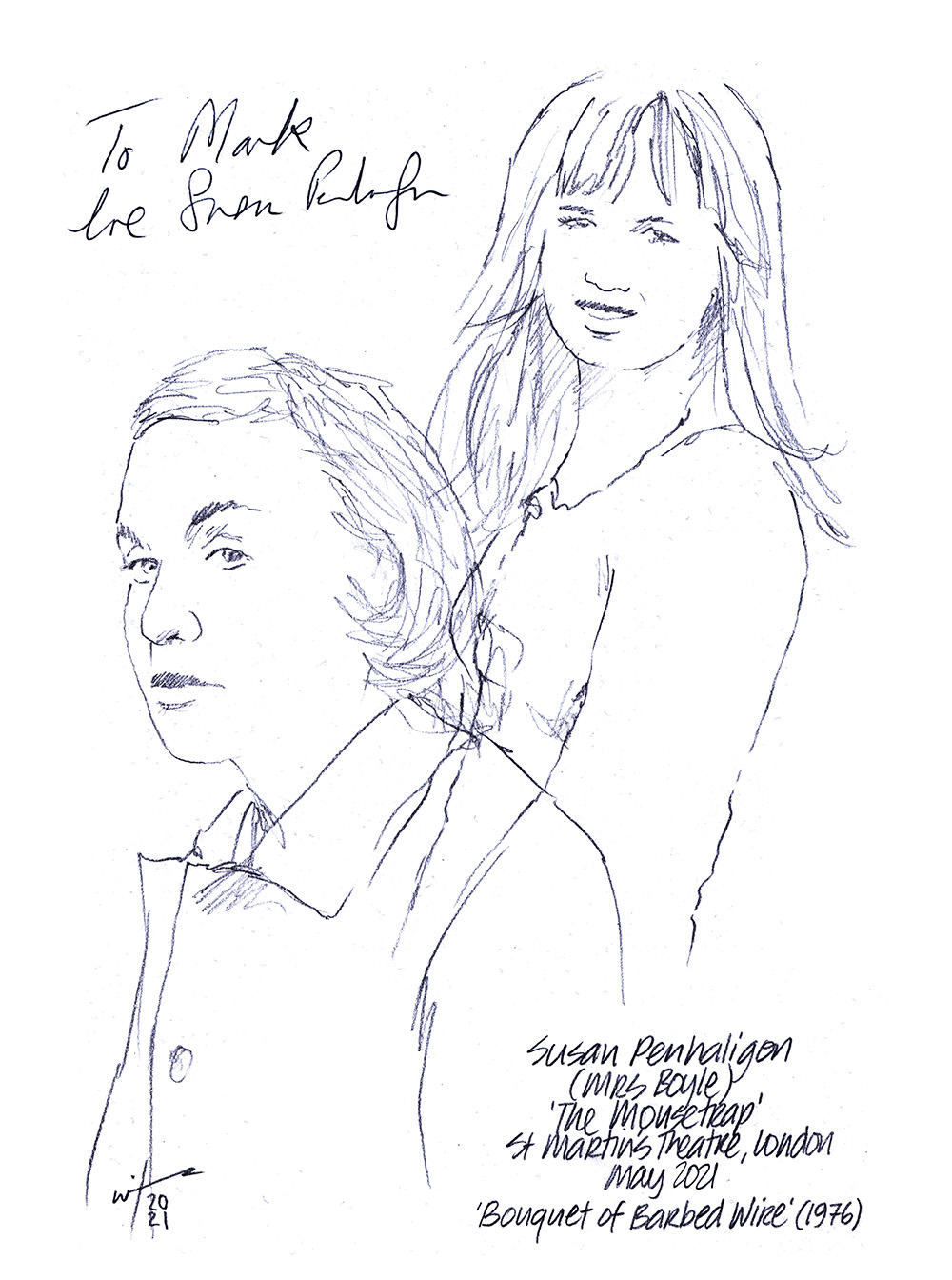
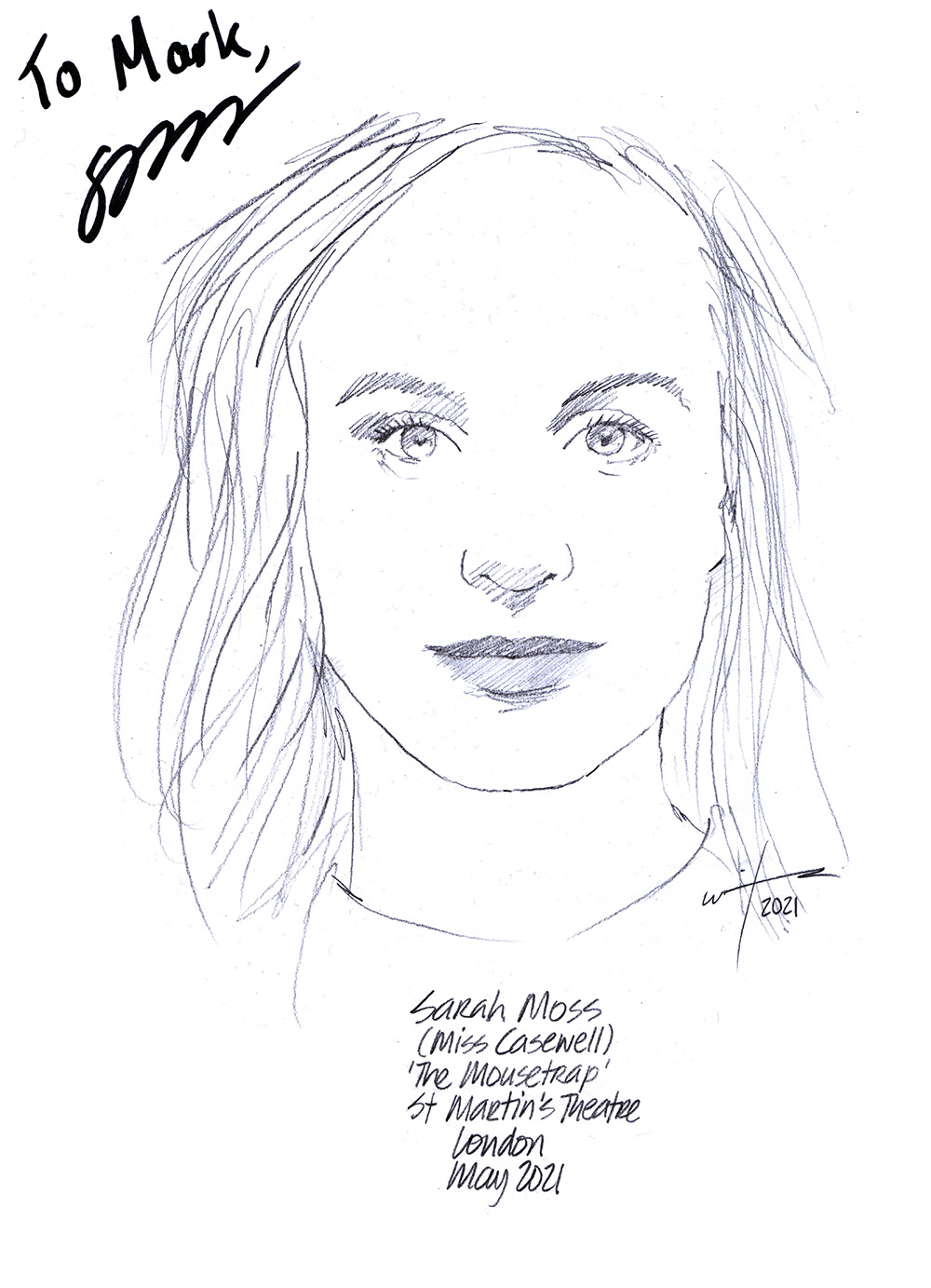
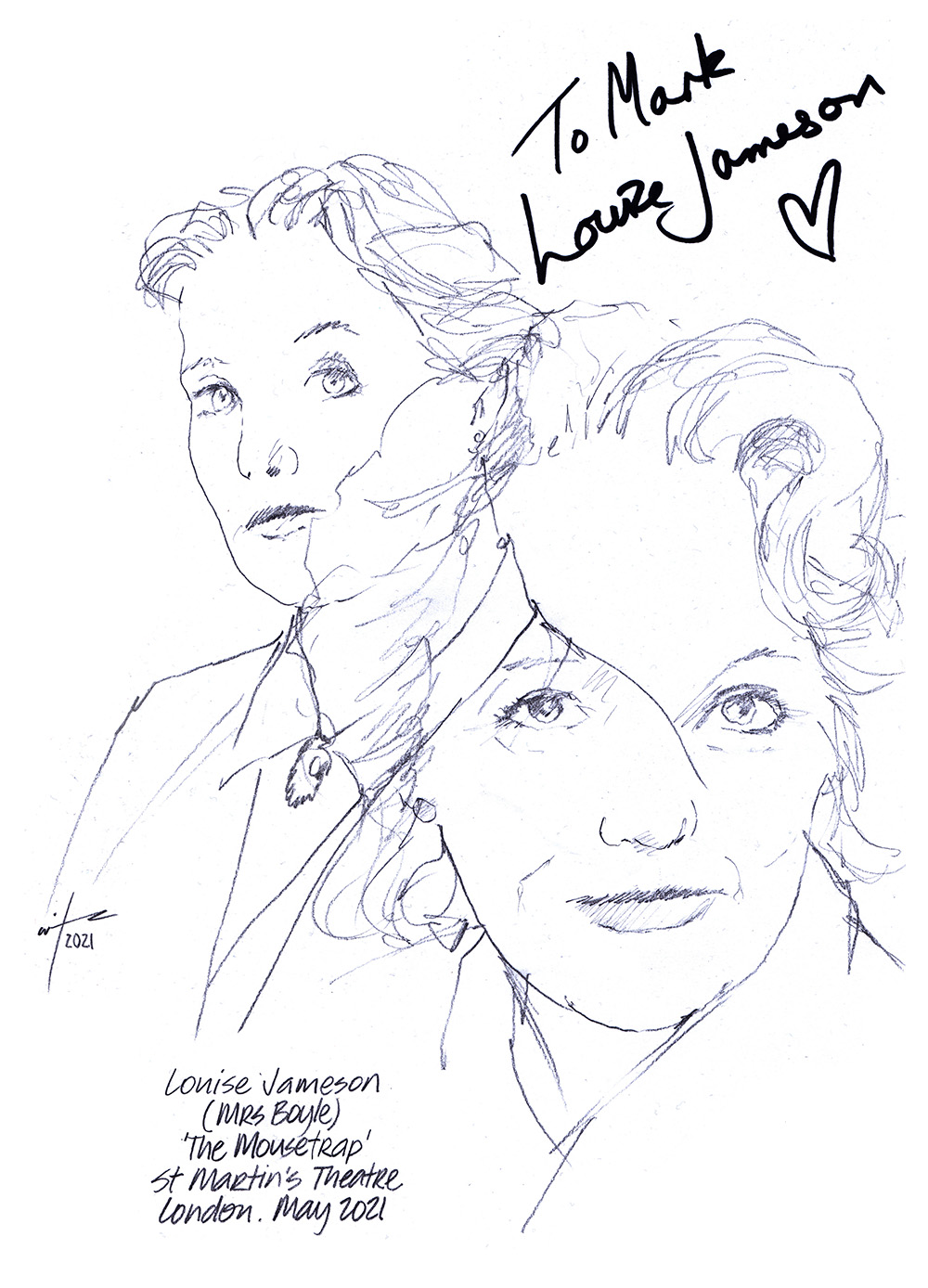
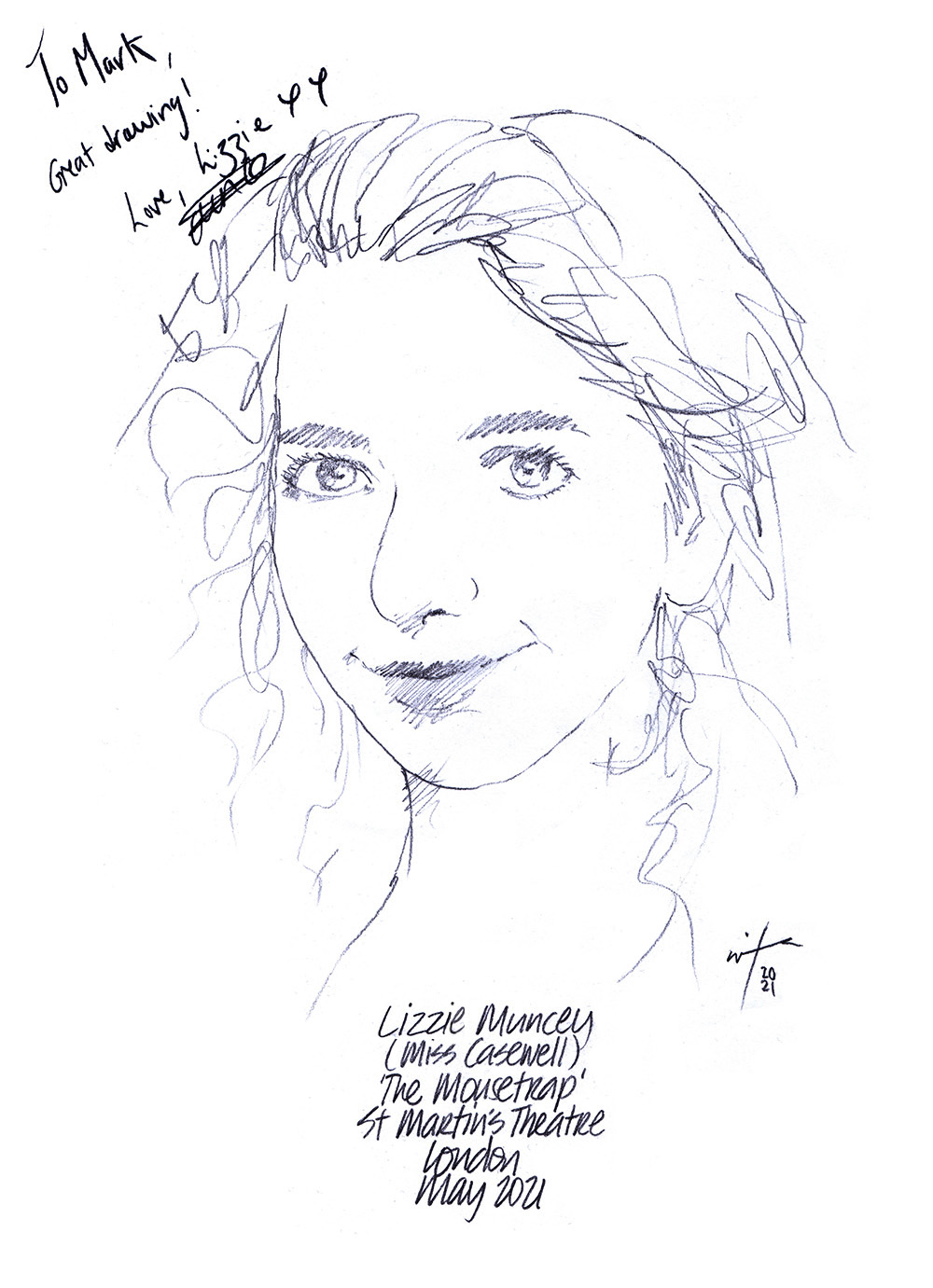
Agatha Christie’s genre-defining murder mystery play THE MOUSETRAP opened on the West End in 1952 and ran continuously until 16 March 2020, when it was discontinued as all London’s theatres went dark due to the Covid-19 pandemic, ending the longest initial run of any play in theatrical history. It will hopefully celebrate its 70th anniversary next year. As restrictions eased in England, the classic whodunnit resumed at St Martin’s Theatre on 17 May this year with two separate casts alternating each week.
As news spreads of a murder, a group of strangers find themselves snowed in at Monkswell Manor, a stately countryside guesthouse outside of London. When a police sergeant arrives, the guests discover that a killer is in their midst. Who will be the next victim? Two of the characters are Mrs Boyle, a pompous, pretentious critical older women who is a former court magistrate played by Susan Penhaligon and Louise Jameson and Miss Casewell, a strange, aloof, masculine woman who speaks off-handedly about her horrific childhood experiences was portrayed by Lizzie Muncey and Sarah Moss.
To mark the welcome return, I drew these sketches of the four cast members and left them at the theatre prior to The reopening, which they all kindly signed and returned. I added an additional image on Susan’s drawing of her as university student Prue Sorensen in ITV’s 1976 drama series BOUQUET OF BARBED WIRE.
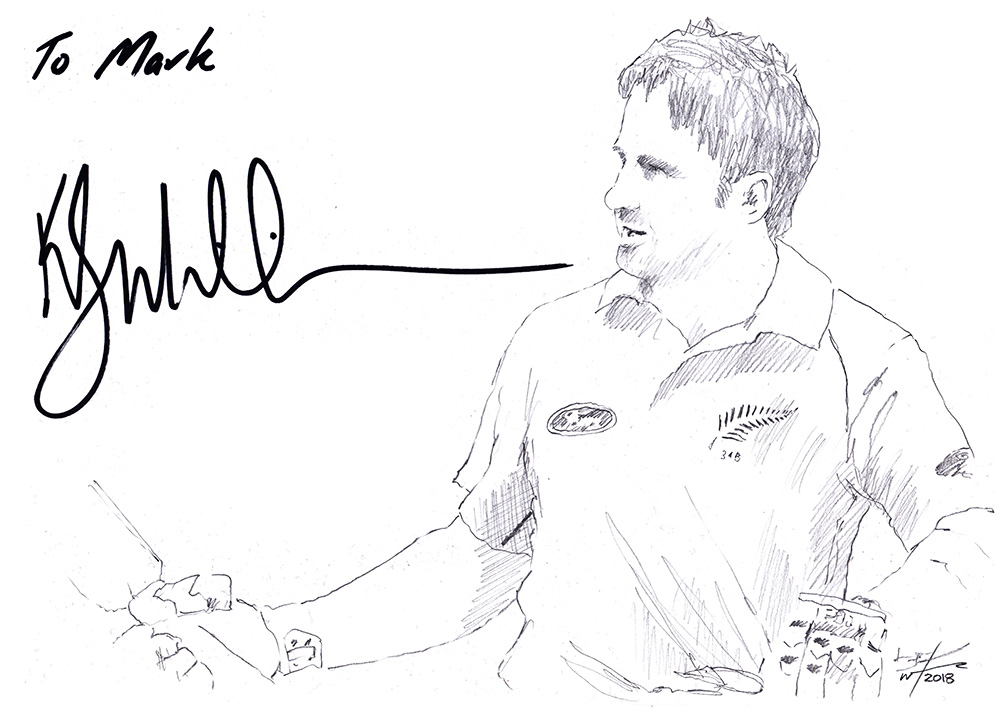
It’s a great time to be a Black Caps supporter and a proud Kiwi. The New Zealand men’s cricket team are ranked No 1 in the world, having beaten India in an absorbing World Test Championship Final in Southampton last month. Central to that victory was Captain Kane Williamson, who appropriately lead his team to victory with an unbeaten half century on the final day.
Not only did his team reach the panicle, he himself returned to the top as the world’s number one test batsman. Kane became the kiwi captain in all forms of the game – test, ODI and T20, in March 2016, after the retirement of Brendon McCullum. New Zealand is also the number 1 side in ODI’s and is the third ranked team in T20 Internationals. Since his test debut in November 2010 against India at Ahmedabad, Kane has scored 7,230 runs in 85 test matches, averaging 53.95, including 24 centuries, the most by a New Zealander and 33 half centuries with a top score of 251. He’s also a useful spin bowler, taking 30 wickets at an average of 44.23. In 151 ODI’s he has scored 6,173 runs with a highest score of 148 and 1805 runs in 67 T2O Internationals.
“Of all the top players, Williamson seems to have the most ideal temperament. His batting is minimalist and his mind calm – as if the zen is given. He rarely plays a shot in anger”, wrote English cricket commentator Mark Nicholas.
Kane signed (with his left hand, despite batting and bowling right-handed ) my sketch at the Headingley Cricket Ground in Leeds, while he played for Yorkshire in the 2018 County Cricket Championship.
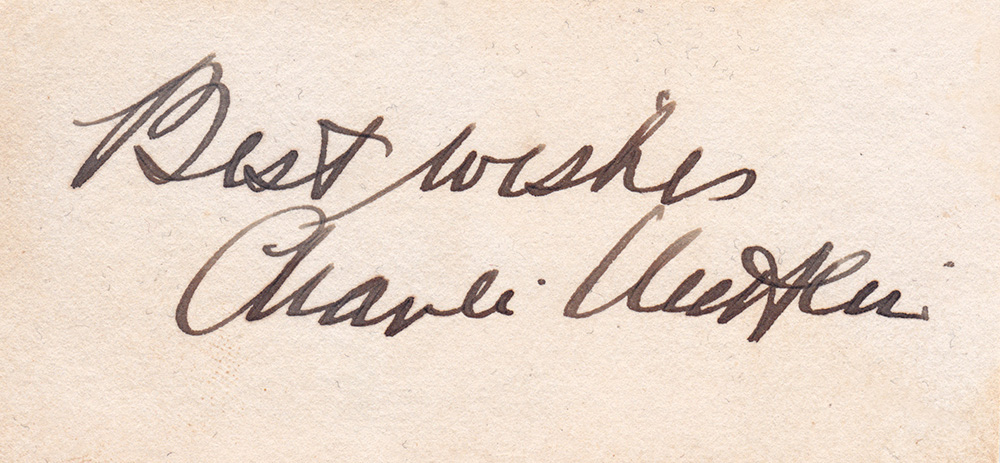
I never met Charlie Chaplin. Neither, to the best of my knowledge, did Alfred Goldschlager, but he did acquire his signature. Alf started the collecting journey, begging opera singers for autographs as a teenager in his home town of Vienna before he fled the Nazi regime in 1938, bound for Australia via South America. It was an unfortunate detour, having his extensive and impressive collection, which included such notaries as Sigmund Freud, stolen in Paraguay. After establishing a successful timber business down under, Alf rekindled his interest in collecting.
In 1992, I was attending a Graphic Design conference in Melbourne. During a break, I wandered down Flinders Lane and came upon a quaint little shop full of historical documents, signed books, autographs and other curiosities. Inside I met Alf. He looked just like Geppetto, the woodcarver… maybe he was. He asked me if I was searching for anything in particular. I mentioned a handful of names, but would love a Charlie Chaplin. He had one, at home in his private collection, but was willing to sell it to a suitable buyer.
Nirvana moment. I returned the next day, saw the Chaplin and a deal was done. I was now the custodian of a very precious piece, Charlie’s signature.
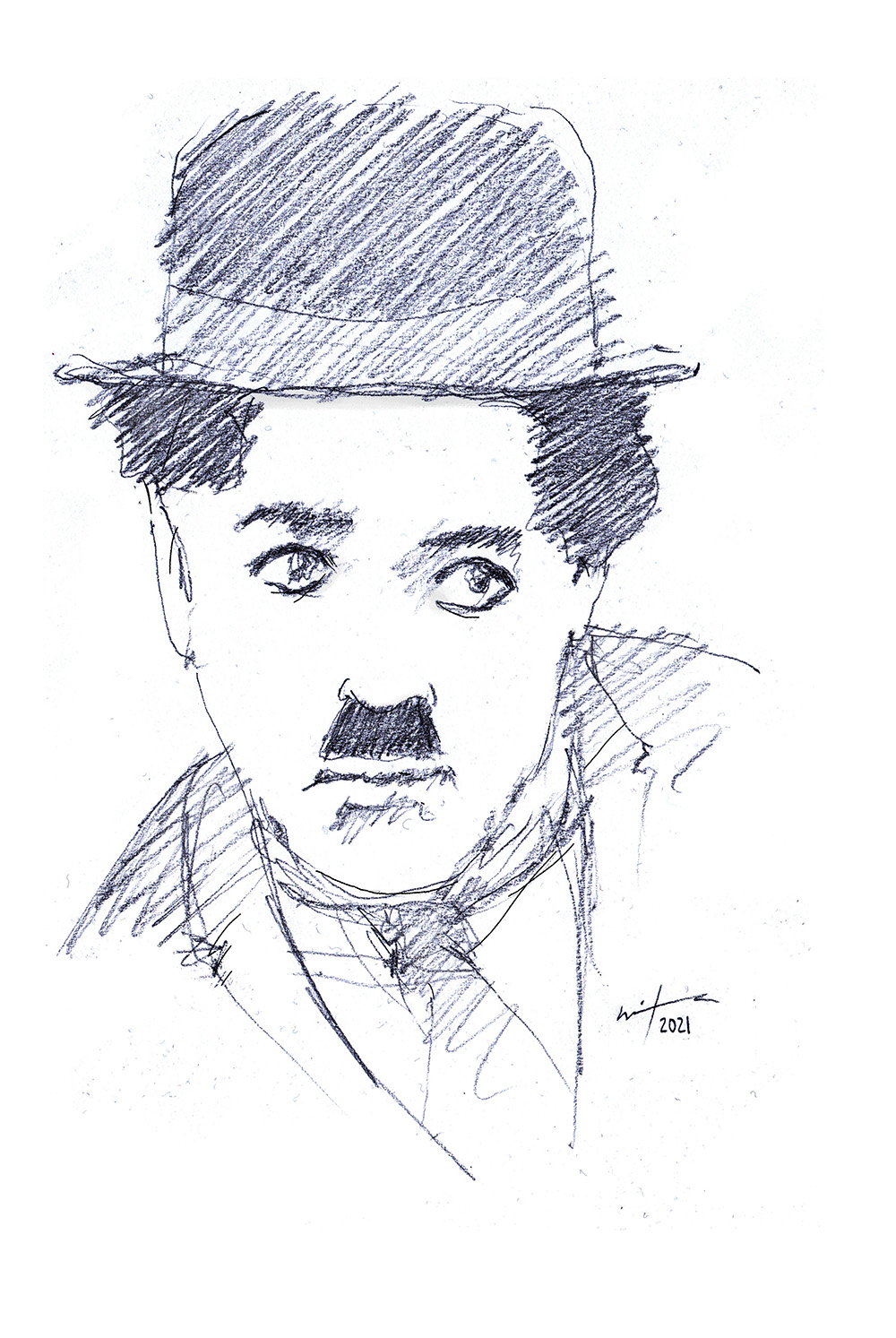
Charlie’s signature is written in fountain pen, the providence of which escaped me, but it looks 1920-30’s. He would often add a quick ‘Tramp’ doodle in those days. Alf closed his shop in 2006 when he turned 88 – the same age Charlie reached before he passed away in 1977. His iconic ‘tramp’ persona was a global phenomenon and is considered one of the most important figures in the history of the film industry.
Poverty and hardship dominated Charlie’s early life in London, where he started acting in music halls at a young age. At 19 he signed with the prestigious Fred Karno Company and travelled to America to begin working for the Keystone Studies. The rest as they say is history. He was a true auteur, who not only acted, but wrote the script and music, directed, produced and distributed most of his films, which are characterised by slapstick, mixed with pathos as the tramp struggles against adversity, often including social and political themes and autobiographical elements.
He received three Academy Awards, two Honorary and his only competitive Oscar for Best Original Score in 1973 for LIMELIGHT, twenty years after the film’s initial release. The previous year the Academy honoured him for, ‘The incalculable effect he has had in making motion pictures the art form of this century.’ He also received a Special Oscar at the first Academy Award ceremony in 1929 for acting, writing, directing and producing THE CIRCUS.
Since there is no tramp doodle with this signature, I drew a quick sketch of the Tramp to accompany Sir Charlie’s fine graph and inscription, as a tribute to his genius and this post as a thank you to Alf, who passed away in 2011.
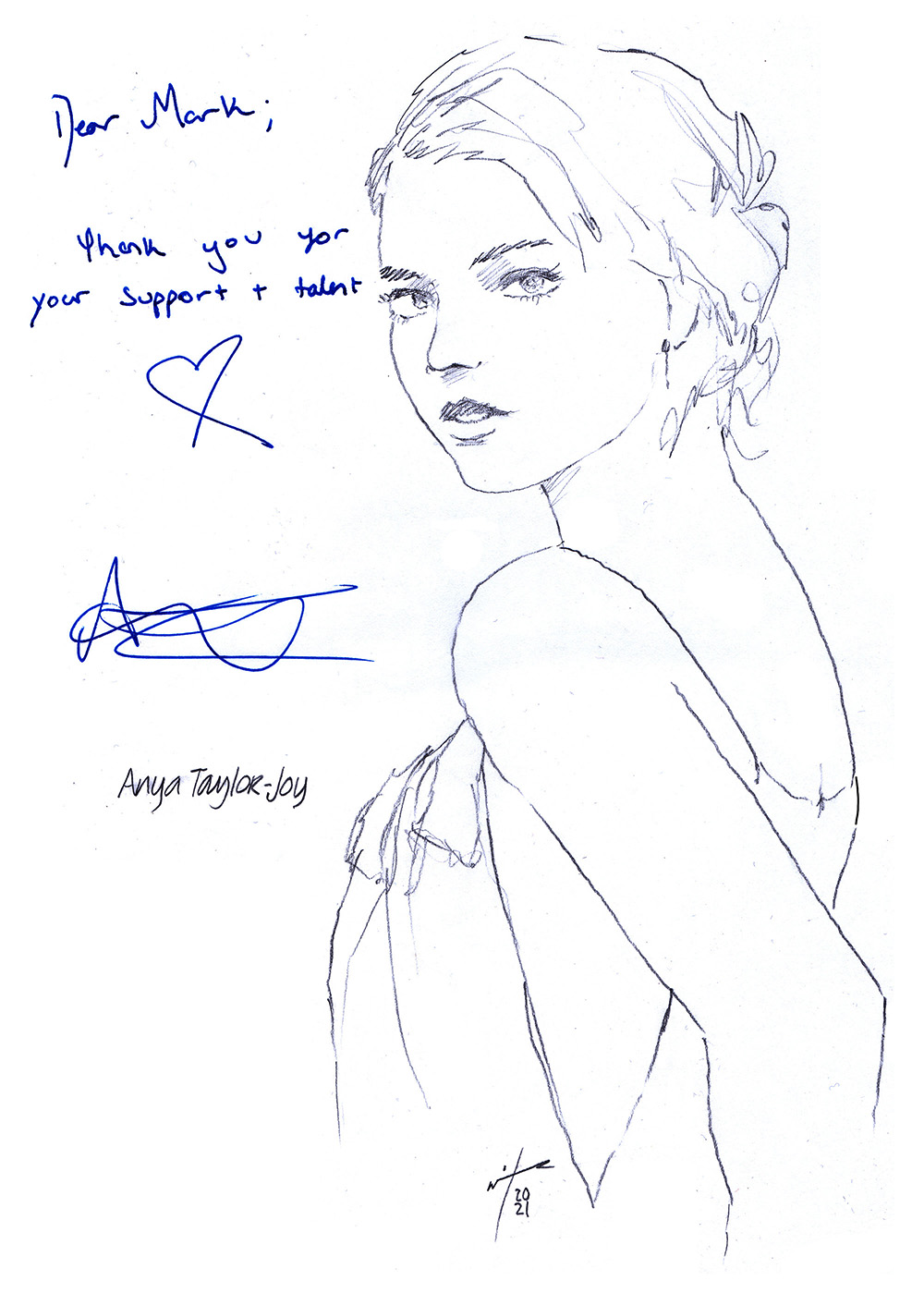
Autographed drawing of actress Anya Taylor-JoyAutographed drawing of actress Anya Taylor-Joy
After 28 days since its release in October last year, THE QUEEN’S GAMBIT became Netflix’s most-watched limited series, amassing a staggering 62 million views. Headlining the miniseries was 25 year-old Argentine-British actress Anya Taylor-Joy, playing orphan Beth Harmon, a chess prodigy struggling with drug and alcohol addiction as she strives to becomes the world’s greatest player. As most countries grappled with the global Covid pandemic, with its enforced lockdowns and restrictions, many people turned in droves to watch the seven-episode drama based on the 1983 novel of the same name by Walter Tevis.
It was a stellar year for Anya. She also starred in the title role as Emma Woodhouse in the comedy-drama EMMA, a film adaption of Jane Austen’s 1815 novel. TIME magazine listed her in the 100 most influential people of 2021. Anya came to prominence as Thomasin in the supernatural horror film, THE WITCH in 2015, receiving the Trophee Chopard at the Cannes Film Festival two years later. She also received a BAFTA Rising Star Award nomination.
This year she received Golden Globe nominations for both her Beth and Emma portrayals, winning for the former. She also won the Screen Actors Guild Award for the same role. Anya kindly signed and inscribed my sketch, which I posted to her in London earlier this year.
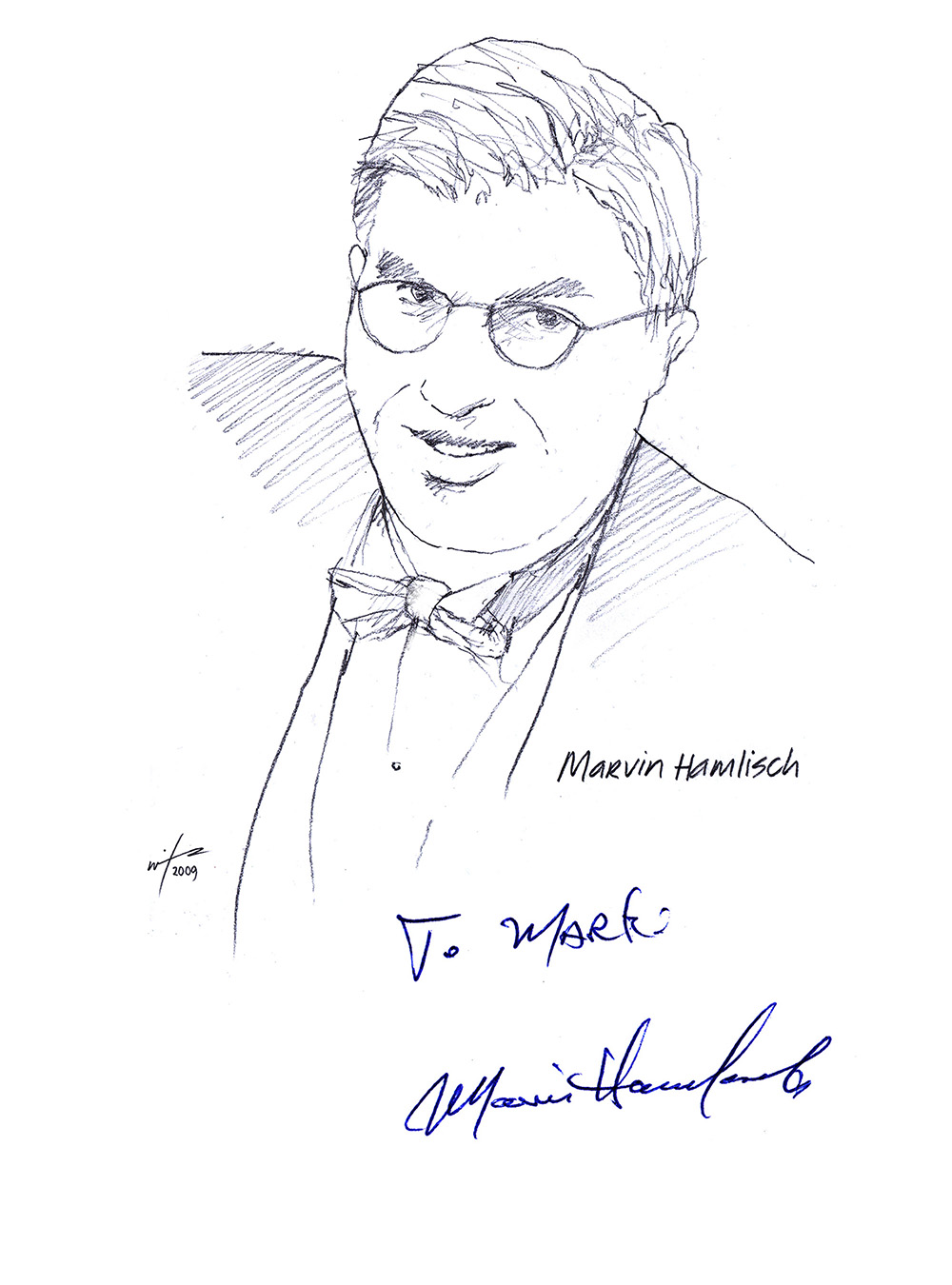
The late Marvin ‘Mr Showbiz’ Hamlisch remains one of the most decorated composers in entertainment. One of sixteen people to have won the E.G.O.T.; an Emmy, Grammy, Oscar and Tony Award, only he and Richard Rodgers have added the Pulitzer Prize to this distinguished set of American awards. His 50 plus movie scores range from spoofs such as NAKED GUN to tearjerkers like SOPHIE’S CHOICE and include a memorable Bond tune, ‘Nobody Dies It Better’ from THE SPY WHO LOVED ME (1977). With a dozen nominations, Marvin’s three Academy Awards were all won in 1973, two for THE WAY WE WERE and one for THE STING. His 1975 musical, A CHORUS LINE won two Tony Awards, including Best Musical, a Pulitzer for Drama and a Best Musical Olivier for the London production a year later. His four Grammy Awards were also won in 1975, collecting Best New Artist, two for THE WAY WE WERE soundtrack and title song and one for his adaptation of Scott Joplin’s ‘The Entertainer’, which featured in THE STING.
After a short illness Marvin passed away in 2012, aged 68. He was in London three years earlier for a two-date gig (“too brief to be called a ‘whirlwind’, he quipped) at the PizzaExpress Jazz Club in Soho in August 2009, where he signed for me.
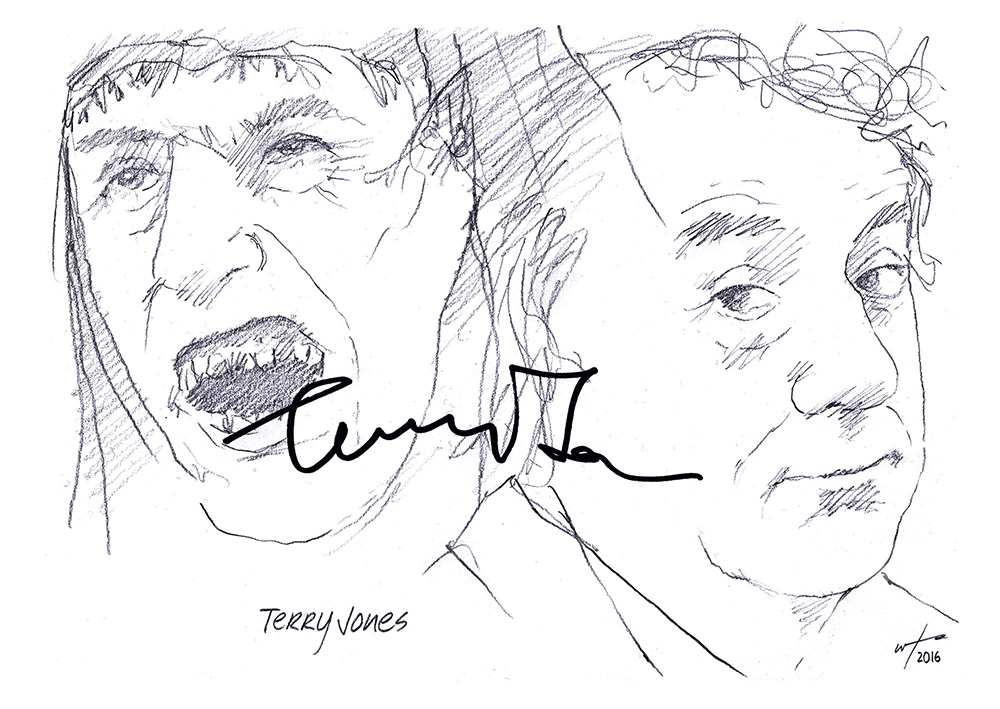
The infamous line, listed in various polls as the funniest ever in film, uttered by Brian Cohen’s mother, Mandy to the gathering crowd, after her son, born on the same day as their neighbour Jesus, is subsequently mistaken for the Messiah in the cult 1979 religious farce MONTY PYTHON’S LIFE OF BRIAN.
Regarded as the British comedy troupe’s masterpiece, and by a number of critics as the best comedy film of all time, the cutting-edge, controversial movie was banned in Ireland, Norway and several parts of Britain, securing its a place in cinematic history. It was directed by the late Python, Welsh genius Terry Jones, who also appeared as Mandy, as well as various other roles including a saintly passer-by, and an alarmed crucifixion assistant.
Sadly we lost Terry last January at the age of 77. In early 2016 he directed the world premiere of JEEPERS CREEPERS , Robert Ross’ play about the life of comedian Marty Feldman at the Leicester Square Theatre in London. After drawing this quick portrait sketch of Terry and as Mandy Cohen, I caught up with him at the venue during rehearsals, where he was happy to sign.
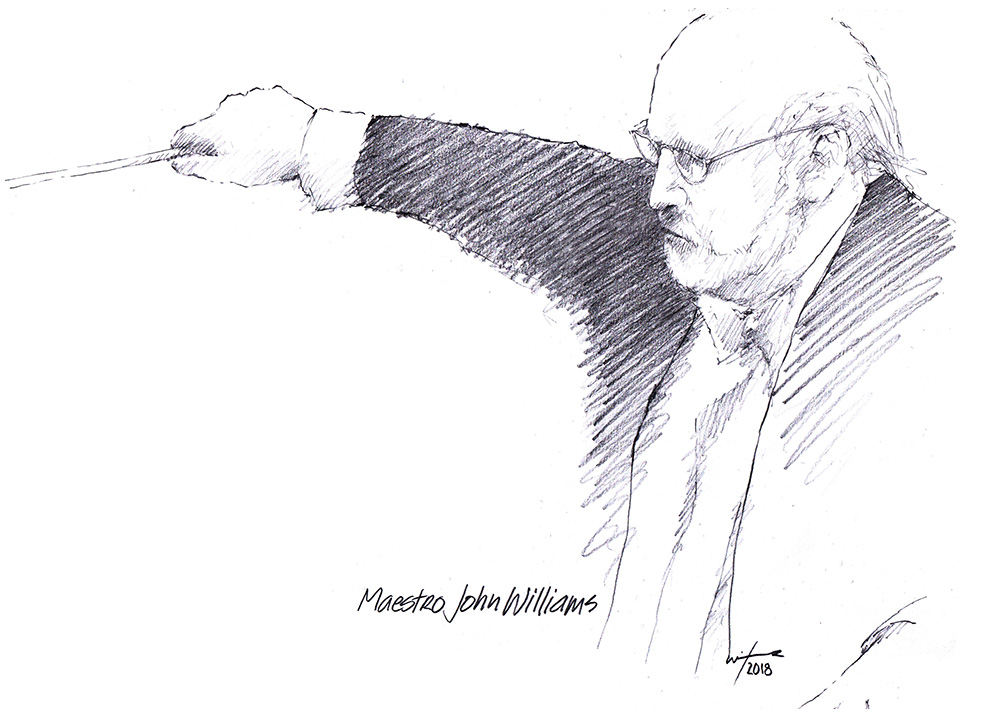
The 89 year-old maestro, John Williams, considered one of the greatest and most influential film composers of all time, producing the most popular, recognisable and acclaimed movie scores over the past seven decades (including JAWS, the STAR WARS sagas, CLOSE ENCOUNTERS OF THE THIRD KIND, ET, THE EXTRA TERRESTRIAL,the INDIANA JONES and JURASSIC film franchises and SCHINDLER’S LIST to name only a handful). He has won 25 Grammys, five Oscars, seven BAFTAs, four Golden Globes, three Emmys and a myriad of other accolades, which sums up his spectacular contribution to film music. His 52 Academy Award nominations are the second most by an individual, behind Walt Disney. He has had a long association with Steven Spielberg since 1974 scoring all but five of his feature films.
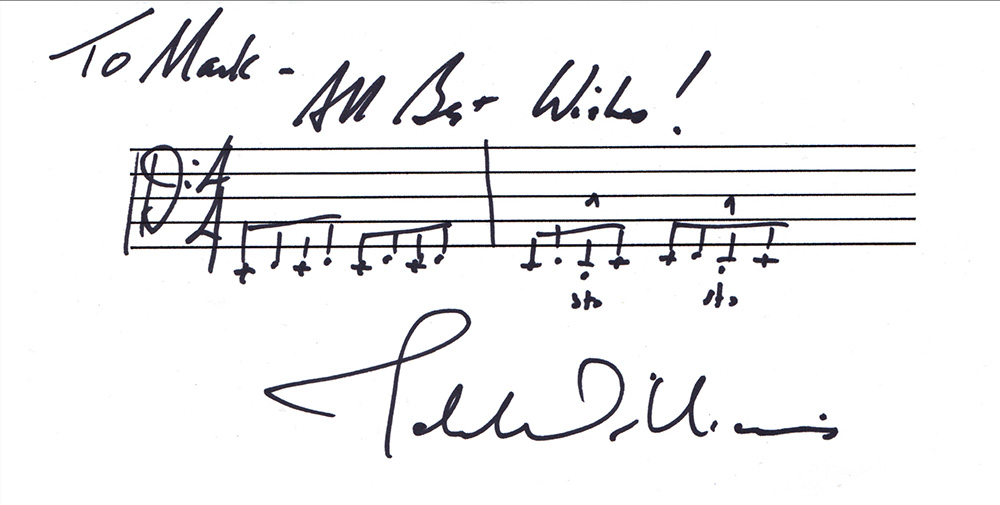
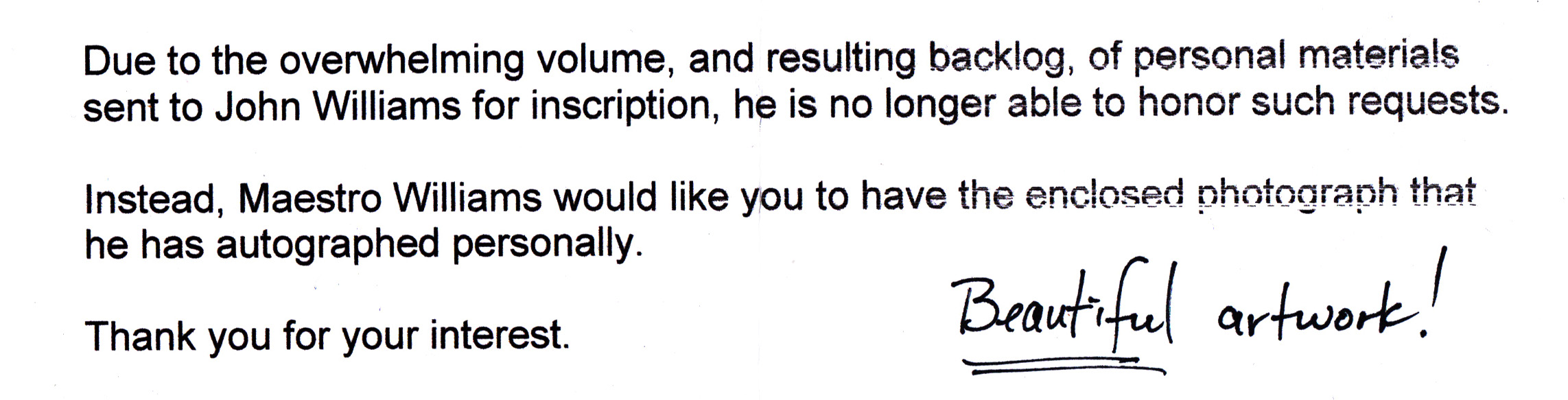
I’ve had the privilege of meeting the maestro once, when he and George Lucas were at ShoWest in Las Vegas in the 1990s. He was conducting the local symphony orchestra performing a number of STAR WARS medleys. From 1983 to 1993 John was principal conductor of the Boston Pops succeeding Arthur Fiedler. While there he signed a card for me adding the opening few bars of the infamous dum dum dum dum Intro to JAWS. A few years ago I sent this sketch to his agent hoping to get it signed, but unfortunately it wasn’t possible.
John was scheduled to conduct the London Symphony Orchestra in October 2018 which gave me an opportunity to get the drawing signed in person, but due to a last minute illness he was unable to attend.
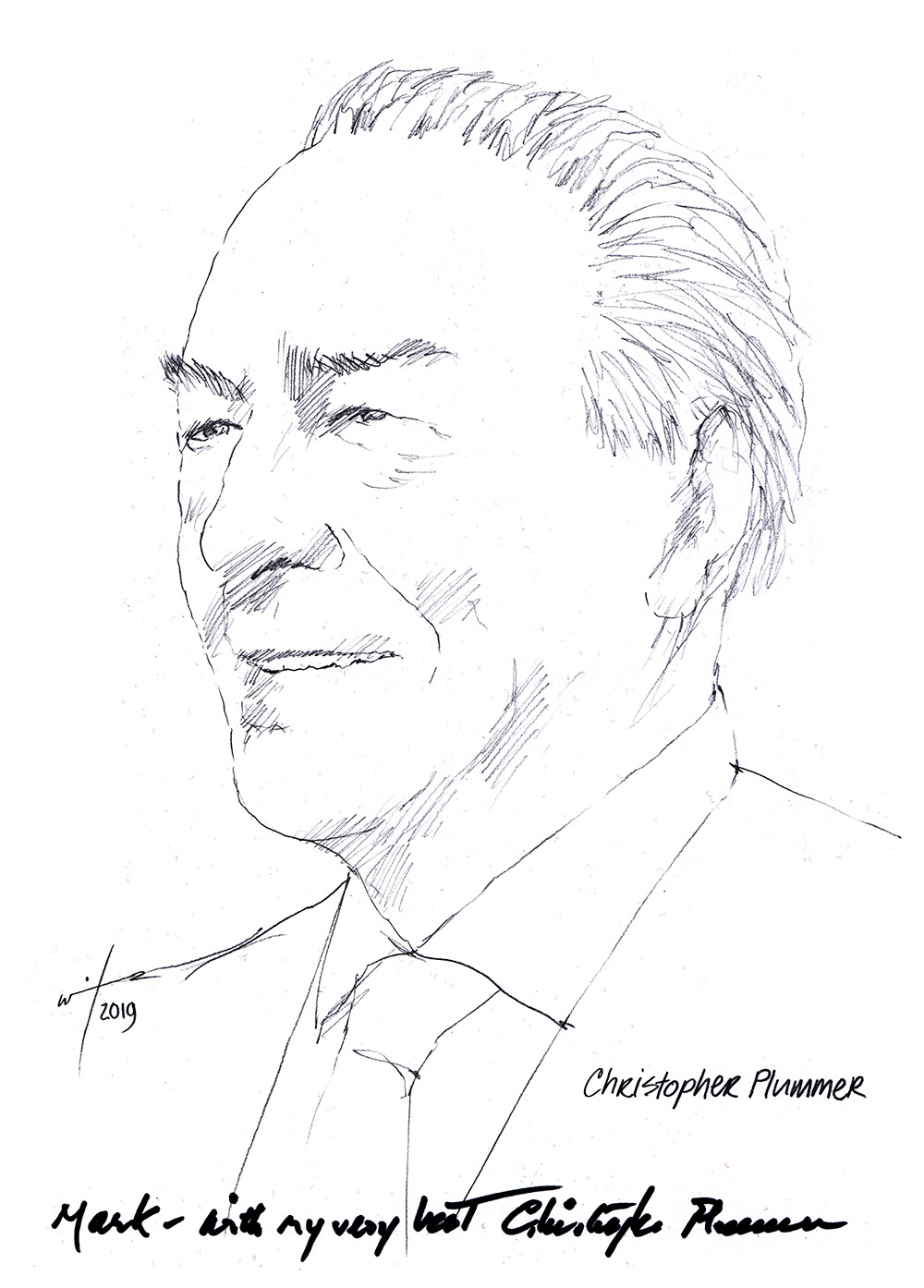
The ‘dazzlingly versatile’ Canadian actor, Christopher Plummer, who passed away on Friday at the age of 91 once said, “I just can’t tell you what fun I’ve had being a member of the world’s second oldest profession. I’ve had a wonderful life, seeing the world and they’ve paid for it.” Few acting careers, which straddled seven decades, have had such longevity and impact.
After his cinema debut in Sidney Lumet’s theatre drama STAGE STRUCK with Henry Fonda in 1958, Christopher featured in over 120 movie productions. His biggest hit and arguably best-known role was the singing Austrian widower and retired anti-Nazi naval Captain Georg von Trapp in Robert Wise’s 1965 classic musical THE SOUND OF MUSIC, with Dame Julie Andrews. Although it proved to be his breakthrough performance to stardom, he always felt uneasy. Initially reluctant to take on the role, his open distaste for the film has mellowed over time. “I’ve made my peace with it”, he said in a 2018 Guardian interview.
Christopher first appeared on Broadway in 1953 in THE STARCROSS STORY, a play that closed on opening night. However after such an inauspicious start, he finished with seven Tony Award nominations, winning for the title roles in CYRANO DE BERGERAC (1974) and BARRYMORE (1997). In 1961 he made his West End debut as King Henry II in BECKET for the Royal Shakespeare Company at London’s Aldwych Theatre, later transferring to the Globe. For his performance, he won the Evening Standard Award.
While he gained recognition for his film, television and theatre performances throughout his distinguished career, it wasn’t until 2010 that Chris received his first Academy Award nomination for his portrayal of Leo Tolstoy in THE LAST STATION and like the proverbial London bus, followed by two more in quick succession. “Well, I said it’s about time. I’m 80 years old for God’s sake. Have mercy”, he said after the nomination announcement. He didn’t win on that occasion, but was successful on the second attempt, two years later for Best Supporting Actor as Hal Fields, who comes out gay in his senior years, becoming the oldest recipient of the Oscar. He also won the BAFTA, Golden Globe and SAG awards. In 2018 he continued to break the records when, at 88 he became the oldest nominee for his performance as multi-billionaire oil tycoon J.Paul Getty in Ridley Scott’s crime thriller ALL THE MONEY IN THE WORLD (2017). “There’s not that many old actors.They all died. I’m one of the last men standing,” he quipped.
With over seventy small screen appearances, Chris has also been nominated for seven Emmy Awards, winning twice for his work on the miniseries THE MONEYCHANGERS and his narration of the children’s TV series MADELINE (1994).
I found a final quote, “I’m too old-fashioned to use a computer. I’m too old-fashioned to use a quill,” but he did use a black sharpie to kindly sign a couple of portrait sketches I sent to him at his home in Weston, Connecticut a couple of years ago.
As George Takei, Christopher’s co-star in STAR TREK Vl (1991)” said in his tribute, “Rest in eternal music.”
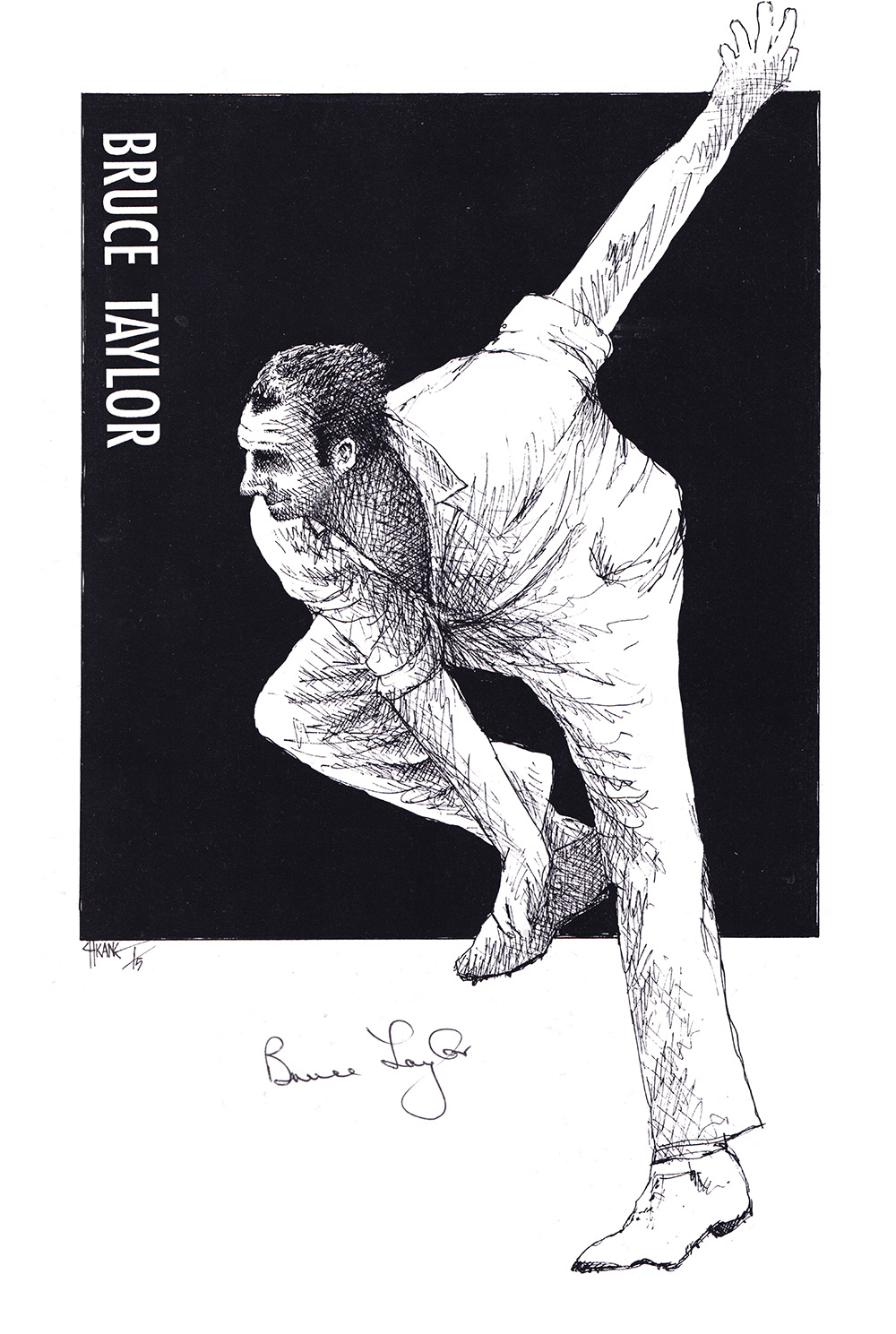
After only a handful of first class matches the young Bruce Taylor found himself elevated to the New Zealand national cricket team and on a plane to India with many of his boyhood heroes. It was 1965 and the ‘quintessential tall all-rounder’ was selected for the Second Test at Eden Gardens in Calcutta, after a late call up when Barry Sinclair fell ill. It was a stellar start to his international career, scoring 105 coming in at #8 and taking five wickets for 86 runs.
Fifty-five years on he is still the only player in test cricket to have achieved the debutant double-a century and a ‘fifer’ in their first test. He would go on to play a further 29 Tests, scoring nearly 900 runs at an incredible strike rate of 488 and taking 22 wickets at an average just over 20 plus two ODI’s before retiring in 1973. An aggressive left-hand batsman and right-arm fast medium bowler with a high arm action than made him a very dangerous attack weapon, generating seam movement and bounce. His highest test score was 124 off 83 balls against the formidable West Indies side at Eden Park in Auckland in July 1973, going from 38 to 50 in two hits, straight driving the legendary Garry Sobers into the big stand twice in a row. After his playing days were over he became a selector for Wellington, Otago and the national teams.
Sadly, Bruce died today at the age of 77.
Cricket New Zealand, in acknowledging his passing, described him as a ‘force of nature’ and the many media obits referred to him as a ‘genius’ and one of New Zealand’s great cricketers. I drew this sketch of ‘Tails’ as part of a Best NZ XI series sometime in the 1990s, which he signed.
 ChicanePictures