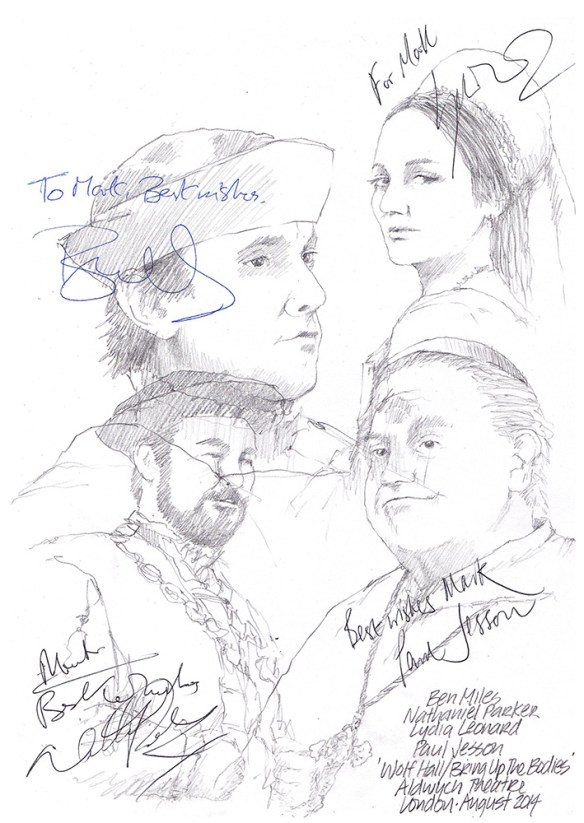
Drawing: Ben Miles, Nathaniel Parker, Lydia Leonard and Paul Jesson in Wolf Hall / Bring Up The Bodies

Wolf Hall Bring Up The Bodies

After selling out its RSC premiere at Stratford, acclaimed productions of Hilary Mantel’s novels Wolf Hall and Bring Up The Bodies made their London transfer to the Aldwych Theatre in May. Both plays are running in repertory until September.

The double bill, adapted by dramatist Mike Poulton and directed by Jeremy Herrin, tell the compelling story of the political rise to power of Thomas Cromwell, in the court of Henry VIII. He was Britain’s original working class hero, according to the author.

The adaptions compress 1,246 pages of print into five and a half hours of stage time with the complex interactions of 70 characters, seven of whom are annoyingly called Thomas.

Hilary won the 2009 Man Booker Prize for Wolf Hall, and repeated the success with Bring Up The Bodies in 2012. They are the first two parts of Hilary’s projected trilogy of Henry’s fixer – the third, The Mirror and the Light is currently being written “at haste”, as you read this.

Ben Miles plays Cromwell, Lydia Leonard is Anne Boleyn, Nathaniel Parker as Henry VIII and Paul Jesson as Cardinal Wolsey.

Mark Lawson in The Guardian says: “English ecclesiastical reform was driven by the King’s soul as well as his penis… Henry’s succession needs gave an opening to Protestant plotters in his court.”
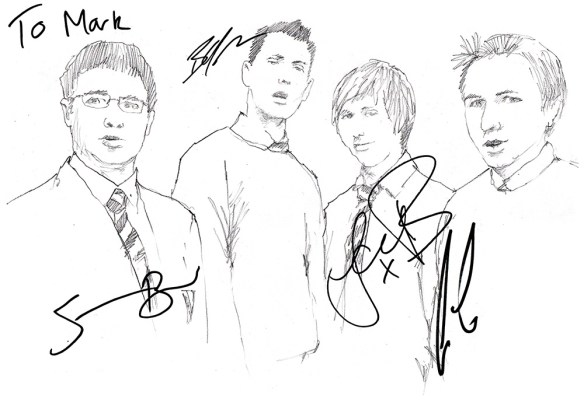
Drawing: The Inbetweeners

INBETWEENERS

The boys are back for their final instalment. The Inbetweeners 2 movie had its London Premiere at the Vue Cinema yesterday and the Rudge Park Comprehensive quartet of Will, Simon, Jay and Neil all attended masquerading as actors Simon Bird, Joe Thomas, James Buckley and Blake Harrison. After the award winning TV series and the first movie in 2011 the lads have reached cult status.

The quickest of quick sketches just to capture their likeness. It was a last minute decision to attend with half and hour to draw, race to the train, (which was cancelled), get the re-scheduled service which chugged into town. Made it to a public pen near the drop off point, six rows deep, thinking this is not a good idea. Getting one siggy, let alone four, looked like mission impossible. Minutes later a big black car arrives and all four slip out, doing the obligatory group photo, then move around the line. Blake slipped past first, and if it wasn’t for Robert (a fellow grapher) grabbing my sketch and hurtling himself to the front, accompanied by a shrill, “Blake Blake Blake!” I would have missed. A young guy in front of me wanted to high five them, so I said to him, “As you do that could you also point to this sketch,” which I conveniently held up next to him. It worked and I got all four – Simon even dedicated. Mission accomplished.

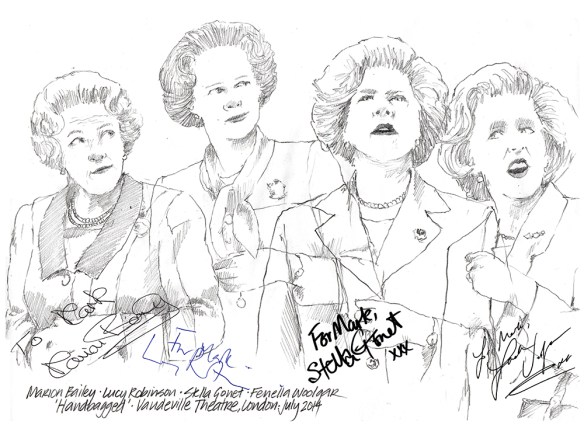
Drawing: Handbagged at the Vaudeville Theatre

handbagged

Undoubtably one of the theatrical highlights of the past year was Handbagged, Moira Buffin’s latest play tells the tales of the Queen’s weekly meetings with Margaret Thatcher. Premiering at the Tricycle Theatre in October 2013, the sold out run won an Olivier Award and transferred to the West End. It was commissioned by the Tricycles new artistic director Indu Rubasingham.

The play arrived at the Vaudeville Theatre with the cast more or less in tact; only Clare Holman was substituted as the younger monarch by Lucy Robinson. As the slogan stated “Liz. Maggie. Tea at four. Handbags at dawn.”

Two enduring icons of the 20th Century, born six months apart – what did the world’s most powerful women talk about? It’s a shrews piece that cleverly explores what might have gone on behind closed doors.

The play’s runaway success, and unanimous critical acclaim, depended in large on the brilliant performances of its four actresses who play older and younger versions of the two leaders. Marion Bailey is the older monarch sitting in judgement of her younger self, and the older Maggie played by Stella Gonet looks back on the woman that she was in office “embodied with all her mannerisms down to a T” by Fenella Woolgar. As The Telegraph’s Tim Walker stated in his five star review, “only a director of Indhu Rubasingham’s sensitivity could cope with the gear changes that shift the action form slapstick to moments of unbearable pathos.”

All four kindly singed my sketch in the final week, as the play completed its Vaudeville run on Saturday 2 August.

Drawing: Nigel Havers in The Importance of Being Earnest at the Harold Pinter Theatre

Nigel Havers

The quintessential English charmer, Nigel Havers is 62, and returns to a role he played at 26 in Oscar Wilde’s classic farce The Importance of Being Earnest at the Harold Pinter Theatre in London. Wilde’s masterpiece has some additional material added by Simon Brett as a framing device to enable older actors to play younger roles.

Nigel originally player Algernon Moncrieff in Peter Hall’s 1982 production at the National alongside Martin Jarvis, who also reprises his role as Jack Worthing.

The latest re-imagining revolves around The Bunbury Company of Players, an amateur troupe of veteran thesps performing a dress rehearsal. In one of the added lines, someone suggests that the ageing roué is not really an actor, Nigel’s character quips, “that’s true of so many who make a living at it.” And he has made a good fist of it over a 30 year career playing smoothies, gentlemen and cads, in such films as A Passage to India, Empire of the Sun and Chariots of Fire, plus a string of small screen roles – his latest being the charismatic con-artist Lewis Archer in Corrie.

Nigel is always on the go. On the number of occasions our paths have crossed he has definitely taken the fast lane. But, he always has time to sign. Just as well he has a swift siggy to complement his famous charm.

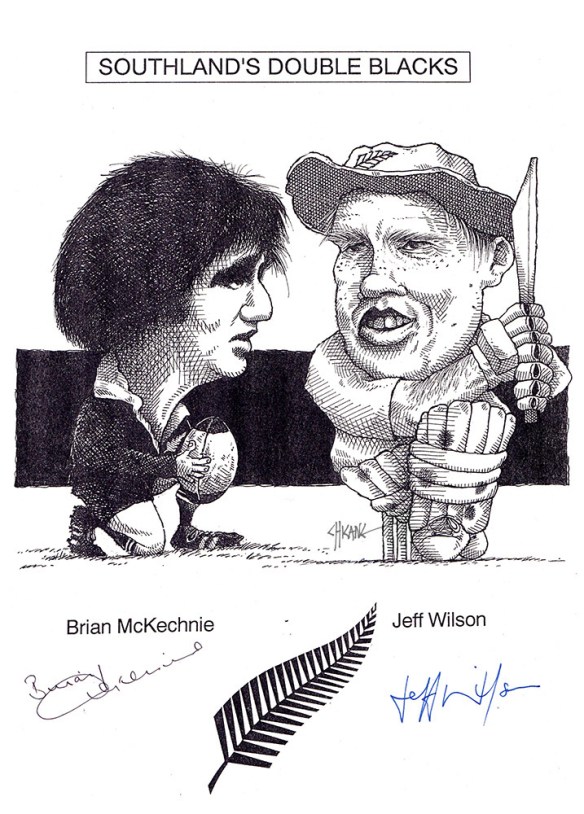
Drawing: Colt and Goldie (Brian McKechnie and Jeff Wilson)

Double Blacks

Only seven men have played both rugby union and cricket for New Zealand. The last two – Brian McKechnie and Jeff Wilson – are both from my home province of Southland and likely to be the last dual internationals dubbed “Double All Blacks”. It is a rare achievement from a forgotten era unlikely to be repeated because rugby has morphed into a year round code.

Jeff, nicknamed Goldie, played four ODIs as a 19 year old all rounder against Australia before turning his attention to rugby where he became an All Black legend with 44 tries in 60 appearances on the wing. After retiring from footy he returned to cricket after a 12 year gap and played two more ODIs and a one off Twenty20 in 2005.

Brian, known as Colt, was an unwilling participant in controversies in both sports. In 1981 he was the batsman on the receiving end of Trevor Chappells’ infamous underarm delivery  at the end of the third final in the World Series against Australia at the MCG. Oz captain Greg Chappell ordered his brother to bowl the controversial final ball to prevent a six being hit to tie the match. It was an incident he later described as the biggest regret of his career.

Three years earlier McKechnie kicked a late penalty that gave the All Blacks a 13-12 win over Wales at Cardiff, securing the ‘Grand Slam’. Andy Haden’s ‘dive’ from a line out near full time was thought to be the reason for the penalty, but years later the referee said it was a completely separate incident – which video footage clearly verifies.

An economical right-arm pace bowler and useful lower-order batsman, McKechnie played 14 ODIs for the Black Caps. The underarm incident was his final match. He played 26 matches for the All Blacks at first five-eigth (fly half) and full back, between 1977-1981.

I drew these two caricatures of Colt and Goldie sometime in the 1990s. Twenty five prints were signed by both as part of a fundraiser for charity.

Drawing: Gillian Anderson in A Doll’s House at The Young Vic Theatre

gillian anderson

Kfir Yefet’s staging of Ibsen’s A Doll’s House played London’s Donmar Warehouse through the summer of 2009. I’ve been carrying this sketch around with me ever since. Well, not this specific sketch and not ever since. I originally did another one which I carried arouond with me, hoping to get Gillian to sign it since I missed her at the theatre (note to self: never leave signings to the last performance). Gillian was a regular at screenings, premieres, film festivals and press nights, so I carried the sketch just in case. When I didn’t have the sketch, Gillian would make an appearance. In the end I mailed it to her via her agent and re-drew this one, which I have carried around ever since (and when I haven’t, déja vu!)

My chance came last night. Gillian has returned to the London stage to rave reviews as Blanche Dubois in Tennessee Williams’ A Streetcar Named Desire at the Young Vic. He opened this week after a short preview season. It’s a long play which can be a help or a hinderance for ‘graphing. After three and a half hours of “shatteringly powerful”  performing I guess the last thing she would want to do is meet, greet and ‘graph with the gathered throng.

Normally at the Young Vic I position myself near the interior stage door that opens out onto The Cut Bar, but the two security persons (first time I’ve seen that at the Young Vic) corral to  a line near the ticket desk. It’s well after 11pm, so the bar’s closing. “Programmes and tickets only,” one of the security guys told the handful of people waiting.

“Ms Anderson will only be signing programmes or tickets, so don’t offend her by offering anything else.”

Gillian popped down and stood behind the ticket desk and started signing. I waited until everyone had finisihed then approached her, apologising that I didn’t have a programme or a ticket, but a sketch from 2009, which I showed her and asked if she could sign it “to Mark”. She looked at it, smiled and said, “is that with a ‘c’ or a ‘k’?”

“A ‘k’,” I replied, and left thanking the security on my way out to catch the last train.