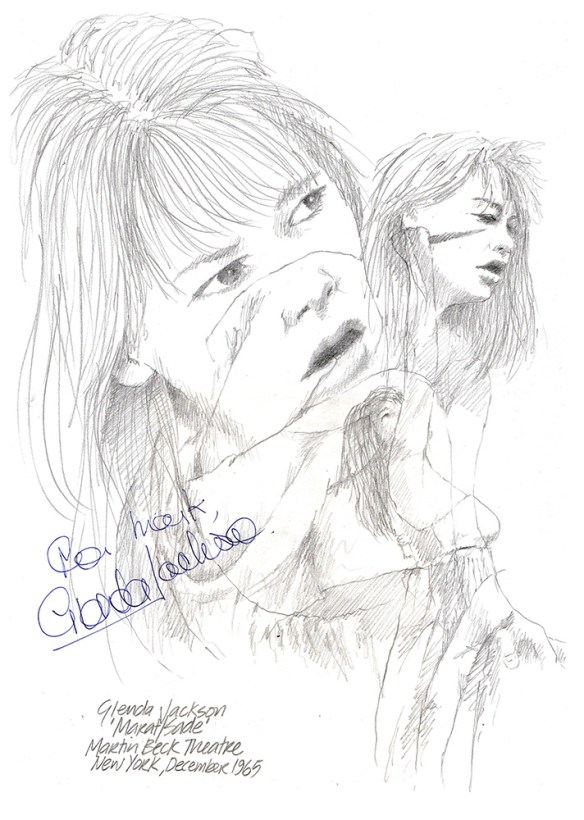
Drawing: Glenda Jackson in Marat/Sade

Glenda Jackson

The Persecution and Assasination of Jean-Paul Marat As Performed by the Inmates of the Asylum of Charenton Under the Direction of the Marquis de Sade (whew) is a 1963 play by German writer Peter Weiss. I won’t give you the German version. Thankfully, it’s usually shortened to Marat/Sade.

Set in the historical French Charenton Asylum, it is a ‘play within a play’, where the actors are inmates. The play within the play is directed by the Marquis de Sade (the man after whom sadism is named) culminating in the assasination of Jean-Paul Marat.

The 1964 production was staged at London’s Aldwych Theatre, directed by Peter Brook. It featured the powerhouse actress Glenda Jackson in her first major role. She played Marat’s assassin Charlotte Corday as a ‘waif-like narcoleptic unable to control her behaviour’.

Writing in The Observer thirty six years later, David Edgar said, “I was 16 when I saw this and it suddenly made clear to me what theatre could do… it was the best performance I’ve ever seen”. The production ran on Broadway in 1965 and in Paris. Glenda also appeared in the 1967 film version. Glenda was nominated for a Tony Award.

She left the theatrical stage for the political boards in 1992, where she is a Labour Party MP representing Hampstead and Kilburn. She signed this sketch at the House of Commons last week.
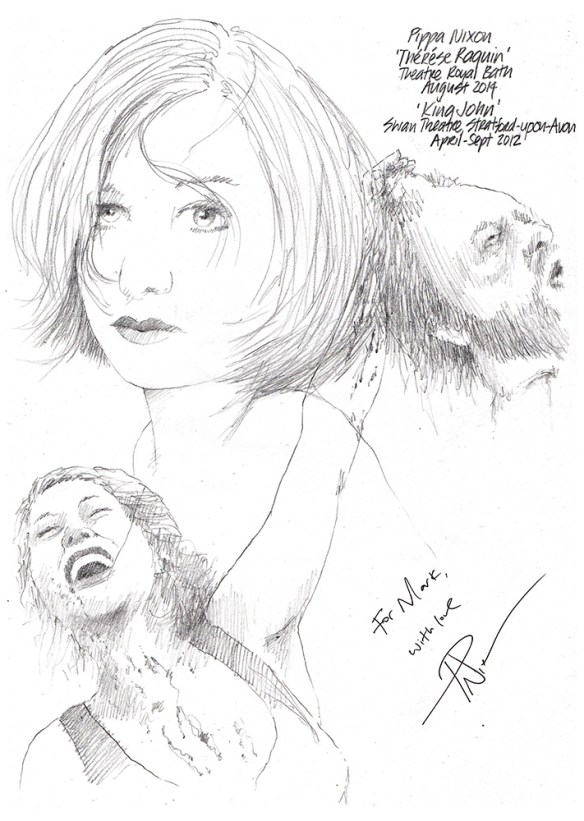
Drawing: Pippa Nixon in Thérèse Raquin and King John

Pippa Nixon

Over the past seven years English actress Pippa Nixon has taken on a mixture of critically acclaimed stage roles in both contemporary and classical writing. Her three year residency at the Royal Shakespeare Company saw Pippa play many leading roles. In 2012 she worked with Maria Aberg in a production of Shakespeare’s King John where she played a female bastard, the illegitimate offspring of Richard I. It was a part that earned her many stars. Simon Taverner said, :Outstanding – no other word for it.”

Pippa has just completed a short season of Thérèse Raquin at the Theare Royal in bath, Michael Billington said in The Guardian, “Pippa Nixon is destined for stardom… Her great gift is the ability to act with every inch of her body.”

Drawing: Luisa Omielan in What Would Beyonce Do

Luisa Omielan

Luisa Omielan is a fresh and frank new female comic, in fact the Telegraph called her “Fresh, frank and fearless – a gutsy new star is born!” Vogue used the other ‘f’ words, “so fresh, so funny, so original prepare for a full on rearrangement of your insides.”

She scored a sleeper hit with What Would Beyonce Do?, which completed a sell-out, twice extended Edinburgh Festival Fringe run and four sell out shows at London’s Soho Theatre in 2012.

WhatsOnStage said, “uplifting, intense and fearless… The Queen B of comedy.”

Her follow up is Am I Right, Ladies? which she performed at the Soho before taking it to the Edinburgh festival where she is currently in residence at the Laughing Horse @ the Counting House until the end of this week, playing once again to packed houses. She will be returning to the Soho in September, so Londoneres, watch out!

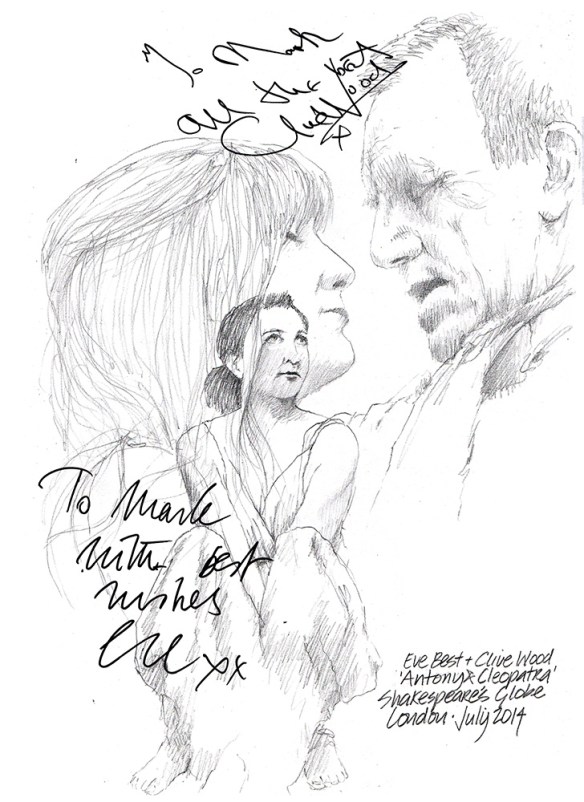
Drawing: Eve Best and Clive Wood in Antony and Cleopatra at Shakespeare’s Globe

Antony and Cleopatra

The season of Shakespeare’s Antony and Cleopatra is into its final week at the Globe in London, with Olivier award-winning actress Eve Best and RSC veteran Clive Wood in the title roles.

It’s Shakespeare’s greatest exploration of the conflicting claims of sex and power, but its contradictory features make it difficult to put into a single genre. It can be classified as a history play, a tragedy, comedy and a romance! Cleopatra is the Bar’s most complex female role.

The Guardian’s Michael Billington summed up the performance of the two leads “restlessly sensual, Best is excellent at capturing Cleopatra’s mercurial contradictions… Wood plays Antony as an old ruffian who is seduced by the Alexandrian fleshpots… more at ease with the ragged world of male soldiery… is faintly apprehensive of the quixotic, mood-changing queen.”

Paul Taylor in The Independent reinforces this, “Best is a supreme mistress at working the Globe space, wonderfully unforced audience rapport and brings a terrific impatient energy to Cleopatra’s capricious changes. She even flirts with the groundlings (standing audience members) planting a kiss on one of them. Clive Wood is a natural casting as Antony – a sexy ageing lion torn between two worlds, who vacillates between duty and pleasure.”

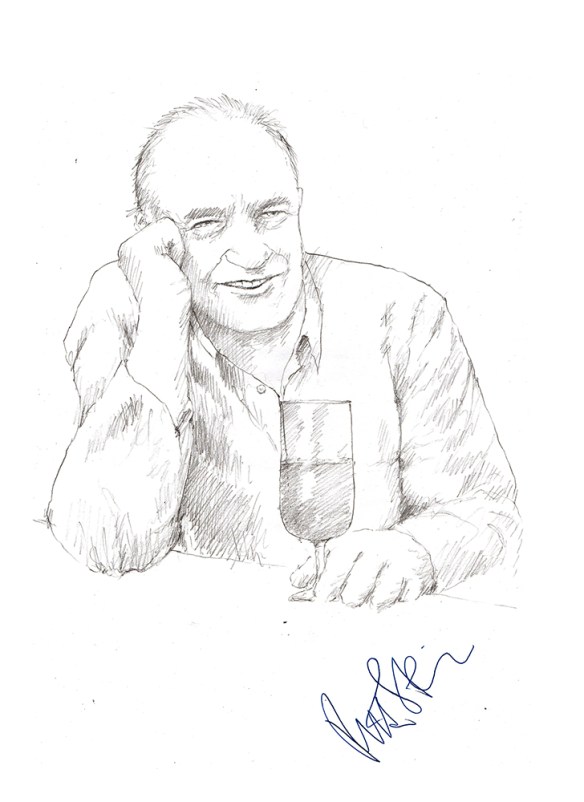
Drawing: Rick Stein

Rick Stein

Combining two of my vices – drawing and watching cooking programmes on TV – I decided to draw a few of my favourite celebrity chefs. Rick Stein was the first. I sent this sketch to him at his flagship, The Seafood Restaurant in Padstow on the northern Cornish Coast and he sent it back quicker than you could boil a lobster.

He’s been on our TV screens for the past two decades with that happy laid-back demeanour. He also sells seafood by the seashore, and more. His empire includes The Seafood Restaurant, S Petroc’s Bistro, Rick Stein’s Café, Stein’s Fish & Chips, a cookery school, accommodation, a gift shop, a deli, a patisserie, a fishmongers and The Cornish Arms pub in nearby St Merryn… and no Rick Stein at Bannisters in Mollymook in NSW, Australia.

Rick has to be credited for single-handedly reviving the British seafood industry. Padstow is now a popular tourist destination. His impact on the local econmy has led some to call the once sleepy Cornish fishing village ‘Padstein’.

Drawing: Lucy Briggs-Owen and Tom Bateman in Shakespeare In Love at the Noel Coward Theatre

Shakespeare In Love

“I will have poetry in my life. And adventure. And love. Love above all.”

After six weeks of rehearsals and three weeks of previews, Shakespeare In Love opened at the Noel Coward Theatre in London last month, sixteen years after the original film version.

Featuring a company of 28 actors and musicians, this sweeping rom-com, based on the Oscar winning screenplay by Marc Norman and Tom Stoppard, has been adapted for the stage by Lee Hall, directed Declan Donnellan.

Shakespeare in forbidden love summarises the tale of a  promising new playwright, Will (Tom Bateman), short of cash with writer’s block and in desperate need of a new hit, finding his muse in passionate young noble woman Viola De Lesseps (Lucy Briggs-Owen) who inspires him to write Romeo and Juliet.

The play within a play (with music) opened to excellent reviews and is booking through to 25 October this year. There’s also a dog named Barney. He sometimes steals the show.

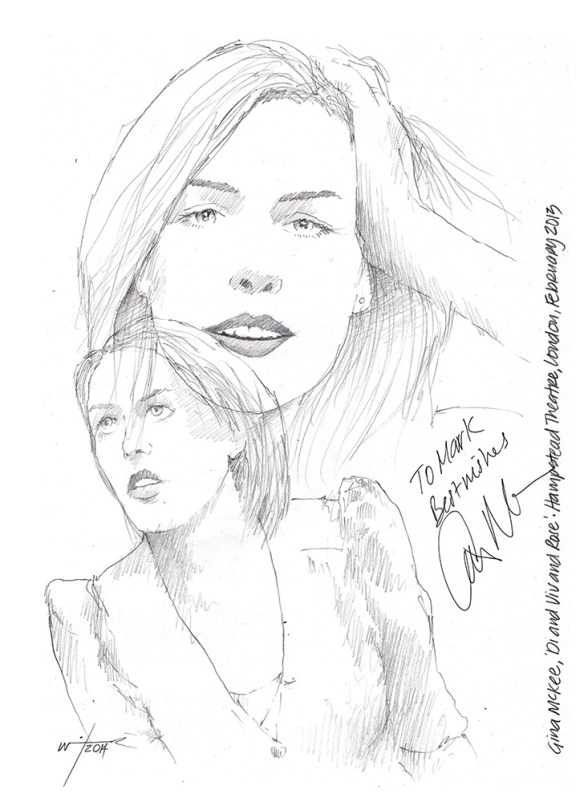
Drawing, Gina McKee in Richard III at Trafalgar Studios

Gina McKee

BAFTA winning British actress Gina McKee is currently starring opposite Martin Freeman in Richard III at London’s Trafalgar Studios. She made her Hampstead Theatre debut in early 2013 playing Viv alongside Anna Maxwell Martin and Tamzin Outhwaite in Amelia Bullmore’s comedy Di and Viv and Rose. It dealt with the vagaries of friendship among a group of co-habitating women – three students at a northern university in the early 1980s.

In 2010 she appeared as Goneril in King Lear at the Donmar Warehouse with Derek Jacobi and directed by Michael Grandage. She received an Olivier nomination for her performance.

This year she reunited with director Jamie Lloyd to play Queen Elizabeth in Richard III at the Trafalgar Studios, whre she signed my sketch this week. The play runs until 27 September 2014.

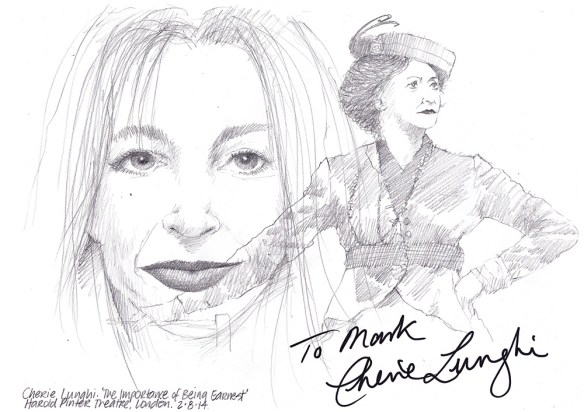
Drawing: Cherie Lunghi in The Importance of Being Earnest

cherie lunghi

British actress Cherie Lunghi is currently appearing in Oscar Wilde’s The Importance of Being Earnest at the Harold Pinter Theatre in London’s West End. In one of her biographical blurbs, Cherie was described as a ‘leading ingénue’ at the Royal Shakespeare Company in the late 70s. An ingénue is a stock character, typically beautiful, gentle, sweet, virginal and often naive – the usual foil to a vamp or a femme fatale. Her roles at the RSC included Perdita, Cordelia and Viola.

She then left to play Guinevere (probably more of a vamp) in John Boorman’s Excalibur (1981) and pursue a film and TV career.

At the Pinter she plays the conventional Victorian woman, Gwendolen Fairfax – Lady Bracknell’s sophisticated, intellectual, cosmopolitan and utterly pretentious daughter who is in love with Wilde’s protagonist, Jack, whom she knows as Earnest. It’s a name she is fixated upon and will not marry a man without that moniker that “inspires absolute confidence”. Ingénue or vamp? Or maybe a mixture of both. Either way, in real life she was most fun to meet and chatted with a handful of us at the stage door before Saturday’s matinée. I told her that sketching was one of my vices, and she said “it’s a vice you’re good at”.

Drawing: Sian Phillips in The Importance of Being Earnest at The Harold Pinter Theatre

Sian Philips

The ageless Siân Phillips made her Shakespeare Theatre Company debut as Oscar Wilde’s ‘dragon of propriety’ in The Importance of Being Earnest at the Lansburgh Theatre in Washington this year. It’s a role she is currently playing at the Harold Pinter Theatre in London’s West End. Well, in reality she plays a member of the amateur Burbury Company of Players rehearsing the role of Lady Bracknell.

She made her first appearance on the London stage in 1957 as a student, appearing in Hermann Sudermann’s Magda for RADA to critical acclaim. It provided the launching pad for her long and distinguished career, which has included Oliver and Tony nominations and a TV BAFTA win for Best Actress in I Claudius and How Green Was My Valley.

In his review for the Express, Neil Norman states, “Phillips is one of the Lady Bracknells I have ever seen, skirting caricature without embracing it, she encapsulates the low venality of the high born.

I based the drawing on one of Scott Suchman’s numerous publicity stills for the Washington Production. Unfortunately, it wasn’t one of Siân’s favourite shots.

“Oh, that’s from that bad photo of me.” I picked it because of the ‘expression’ which I though really captured the character – my explanation offered in mitigation and hope. But she was good humoured about it and signed and dedicated it for me on her way into last Saturday’s matinée.

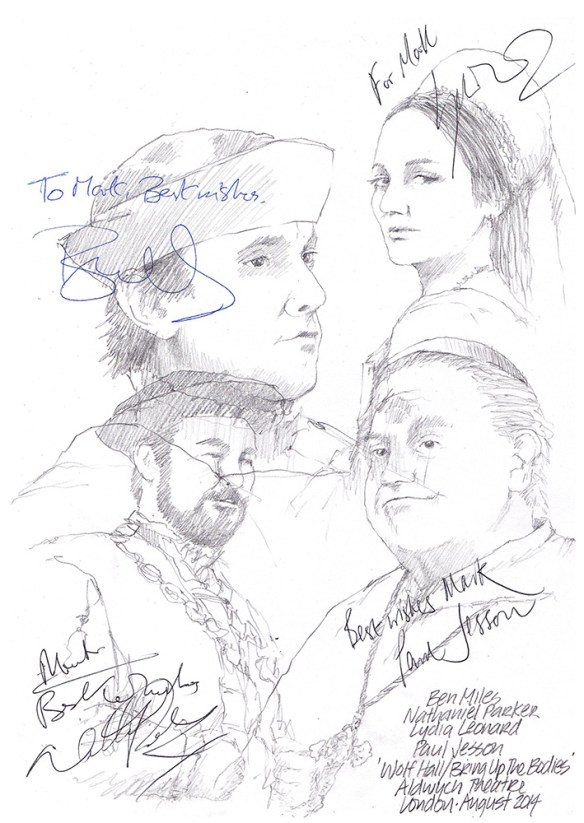
Drawing: Ben Miles, Nathaniel Parker, Lydia Leonard and Paul Jesson in Wolf Hall / Bring Up The Bodies

Wolf Hall Bring Up The Bodies

After selling out its RSC premiere at Stratford, acclaimed productions of Hilary Mantel’s novels Wolf Hall and Bring Up The Bodies made their London transfer to the Aldwych Theatre in May. Both plays are running in repertory until September.

The double bill, adapted by dramatist Mike Poulton and directed by Jeremy Herrin, tell the compelling story of the political rise to power of Thomas Cromwell, in the court of Henry VIII. He was Britain’s original working class hero, according to the author.

The adaptions compress 1,246 pages of print into five and a half hours of stage time with the complex interactions of 70 characters, seven of whom are annoyingly called Thomas.

Hilary won the 2009 Man Booker Prize for Wolf Hall, and repeated the success with Bring Up The Bodies in 2012. They are the first two parts of Hilary’s projected trilogy of Henry’s fixer – the third, The Mirror and the Light is currently being written “at haste”, as you read this.

Ben Miles plays Cromwell, Lydia Leonard is Anne Boleyn, Nathaniel Parker as Henry VIII and Paul Jesson as Cardinal Wolsey.

Mark Lawson in The Guardian says: “English ecclesiastical reform was driven by the King’s soul as well as his penis… Henry’s succession needs gave an opening to Protestant plotters in his court.”