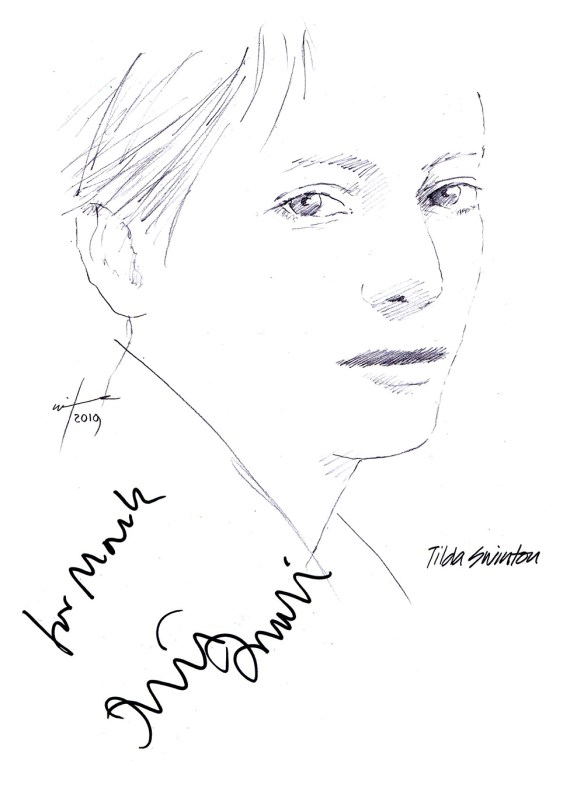
Drawing: Tilda Swinton

Autographed drawing of actress Tilda Swinton

Just prior to the March Covid lockdown the British Film Institute hosted a Tilda Swinton season, during which the celebrated British actor was presented with its highest honour, the BFI Fellowship recognising her contribution to film culture, independent film exhibition and philanthropy and her “daringly eclectic and striking talents as a performer and filmmaker… for her work is which is powerful and far ranging and as such occupies a unique place in our collective film history.” Tilda responded saying she “was very happy and touched,” sharing the honour with her “beloved film-making playmates, living and departed.”

After finishing school Tilda spent two years as a volunteer in Africa, before studying for a Social and Political Sciences degree at Cambridge University, where she also performed on stage. She joined the Royal Shakespeare Company in 1984, appearing in MEASURE FOR MEASURE. Her screen career, which includes small independent and mainstream projects to international blockbusters AVENGERS:ENDGAME and THE CHRONICLES OF NANIA, began with experimental films directed by Derek Jarman, beginning with CARAVAGGIO in 1986. She went on to appear in a further six films by the late renowned British director.

Her supporting performance as Karen Crowder, the ruthless lawyer on the verge of a mental breakdown in the 2007 legal thriller MICHAEL CLAYTON, was recognised with both BAFTA and the ACADEMY AWARD victories, as well as Golden Globe and Screen Actors Guild nominations. Tilda won a BAFTA Scotland award for her role as Ella Gault in the erotic drama YOUNG ADAM (2003). She has also developed a live performance art installation with producer and friend Joanna Scanlan, entitled THE MAYBE in 1995, where she was asleep in a glass box on public display at the Serpentine Gallery in London. It was repeated the following year in Rome and again in 2013 at the Museum of Modern Art in New York.

Tilda appeared in person at the BFI on London’s Southbank on numerous occasions during the 1-18 March season, introducing screenings and participating in Q+A’s. Always friendly and accommodating with fans, she kindly signed my quick portrait sketch at the venue during the final week.
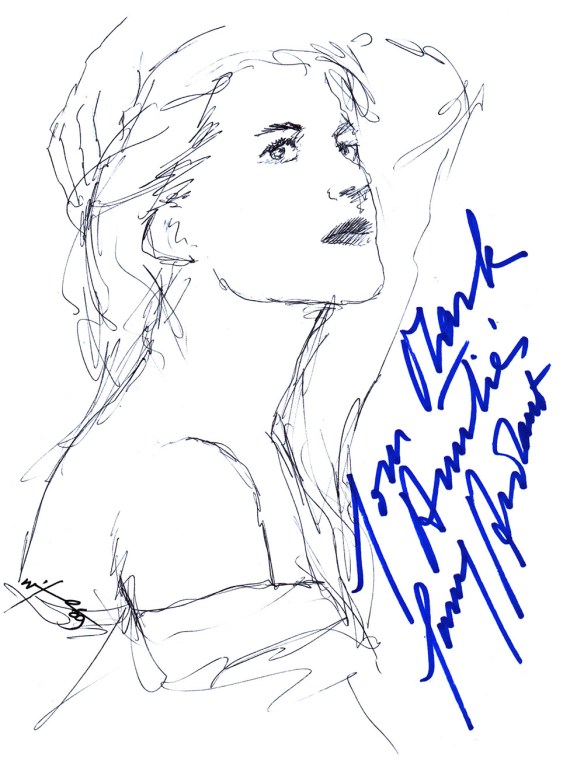
Drawing: Fanny Ardant

Autographed drawing of actress Fanny Ardant

While my physical ‘stalking’ at stage doors and events in London came to an abrupt halt in March – the 14th to be precise – due to a you-know-what, the mail has continued to be delivered, albeit reduced, but a signed treasure arrived recently, a sketch I sent to one of France’s most admired actresses, Fanny Ardant, back in 2009.

More than a movie star, Fanny was part of cinema history, the muse and companion of the great French new wave director Francois Truffaut during the early 1980’s, before his early death. Fluent in English and Italian, she has appeared in more than eighty motion pictures since 1976, including Hollywood and British films, thirty theatre productions and twenty TV dramas. She has also become an acclaimed director and screenwriter.

At this year’s Cesar Awards in Paris, a couple of weeks before France went into lockdown for the aforementioned you-know-what, Fanny won her second Cesar for her supporting portrayal of Marianne in the romantic comedy-drama LA BELLE EPOQUE, having previously won for Best Actress in 1997, for her comedic role of Eva, the gay bar manager in PEPALE DOUCE. She has also been nominated for two Moliere theatre awards. Last year Fanny directed the opera LADY MACBETH OF MTSENSK at the Greek National Opera.

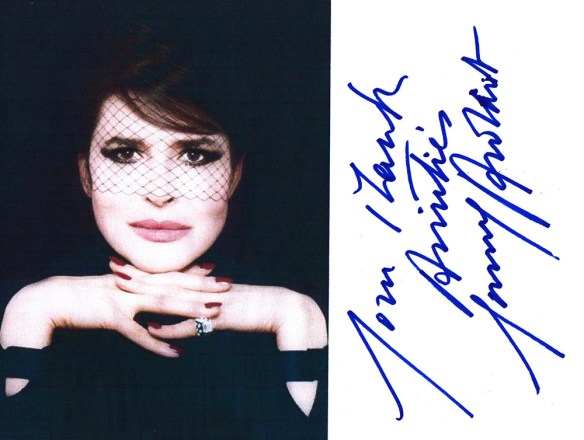
The sketch, drawn in my fine black biro style, prior to the 4B pencil take over, was accompanied by a signed photo. It took eleven years, but well worth the wait.

Autographed photo of Fanny Ardant

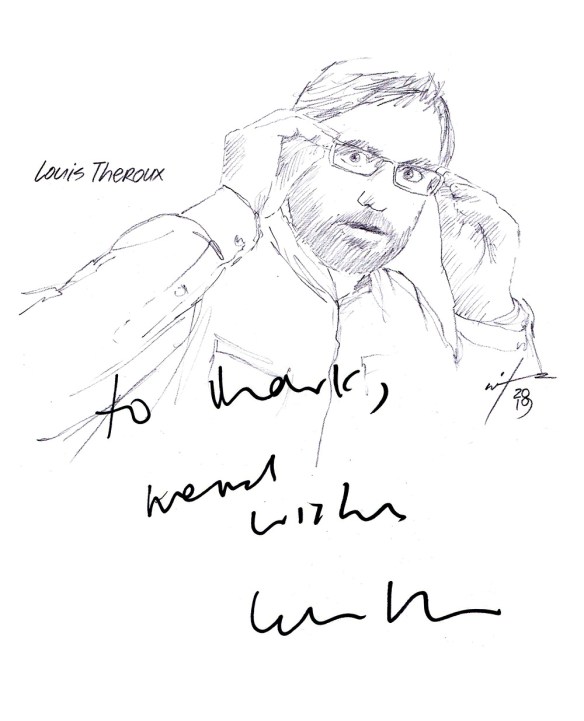
Drawing: Louis Theroux

Autographed drawing of documentary filmmaker Louis Theroux

It just so happens that while as I was contemplating my next post subject today, (20 May) it’s Louis Theroux’s 50th birthday, so what better reason to select him. After graduating from Oxford University, the British-American documentary filmmaker and author moved to the US and worked as a journalist, before becoming a TV presenter on Michael Moore’s satirical news magazine series TV NATION, providing off-beat cultural segments. He was nominated for an Emmy Award in 1995.

This led to a series of BBC Documentaries- LOUIS THEROUX’S WEIRD WEEKENDS (1998-2000) following mostly American subcultures and WHEN LOUIS MET… (2000-2002) accompanying a British celebrity, interviewing them during their daily lives. He won a BAFTA Award for each. He’s currently podcasting a BBC Sounds series called GROUNDED, speaking to celebs under covid lockdown.

Louis was a guest on Graham Norton’s BBC Radio2 show in September last year at the programmes studio in London’s Wogan House where he signed for me.

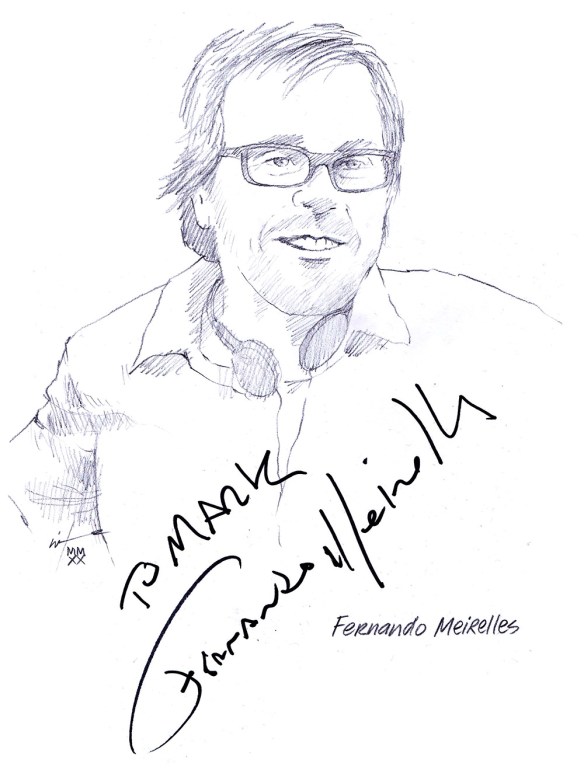
Drawing: Fernando Meirelles

Autographed drawing of director Fernando Meirelles

Brazilian film director Fernando Meirelles is not only an excellent filmmaker he’s an even better human being. I have had the privilege of meeting him in London on a few occasions and they have always been memorable. The last time was outside the Corinthia Hotel on the northern bank of the river Thames on the first Sunday in February this year as he prepared to go to the BAFTA Awards. His latest film THE TWO POPES with Anthony Hopkins and Jonathan Pryce playing Pope Benedict XVI and Pope Francis respectively was nominated for Best British Film.

Fernando became interested in filmmaking while studying architecture at the University of São Paulo. “An architect is someone who really doesn’t know how to build a building. They need engineers, just as directors need writers and actors. What both architects and directors do is bring a vision”, he has said. He followed the film path and with considerable success winning over 65 awards.

After initially working in television, he made his first feature MENINO MALUQUINHO 2:A ADVENTURA in 1998. Based on Paulo Lin’s best-seller CIDADE DE DEUS, his 2003 film adaptation, CITY OF GOD went on to huge success. It was a low budget production, with an intimidating story of the growth of organised crime in a Rio de Janeiro superb, involving over 350 characters, using mostly inexperienced actors.

Fernando was nominated for a Best Director Oscar and his direction was also recognised at the Cannes Film Festival. His next feature, John Ie Carre’s thriller THE CONSTANT GARDENER (2005) was nominated for four Academy Awards, ten BAFTAS, including Best Film and Director and three Golden Globes. BLINDESS, the story of a city ravaged by an epidemic of instant white blindness was nominated for the Palm d’Or in 2008.

Away from cinema and TV, Fernando has directed an opera, Bizet’s PEARL FISHERS and was one of the directors of the 2016 Olympics opening ceremony in Rio. He is also a farmer. He plants sugar cane, avocado, coffee and mahogany, developing ways to produce organically on a large scale. His future plans involve working on projects related to the environmental crisis and climate emergency. But he is quoted as saying, “I will never stop making a film. I can’t help myself.”

It was great to catch up with him for a brief chat at the Corinthia, where he signed for me on 2 February, before heading to the BAFTA ceremony at the Royal Albert Hall.

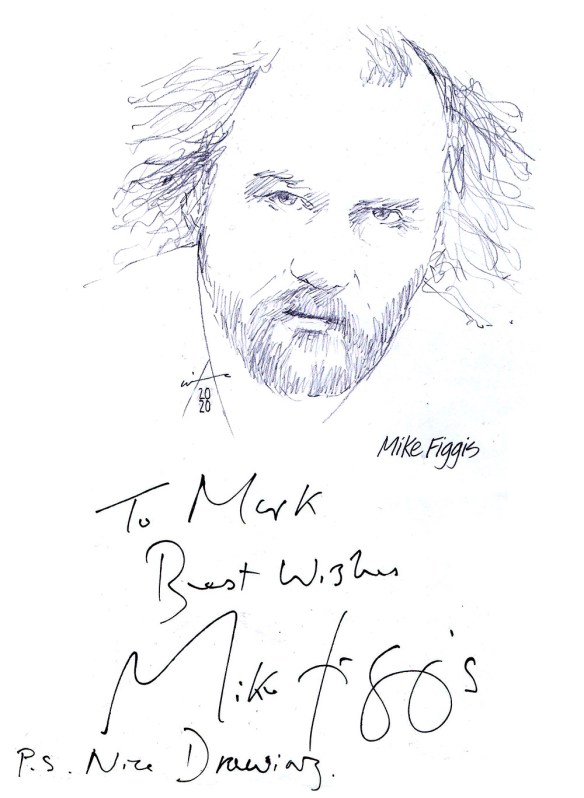
Drawing: Mike Figgis

Autographed drawing of filmmaker Mike Figgis

One of the most innovative filmmakers in the business is Mike Figgis, the British director, screenwriter, musician and composer. After initially working in theatre as a director and performer he made his feature film directorial debut with the neo-noir thriller STORMY MONDAY in 1988 featuring Sean Bean, Tommy Lee Jones, Sting and Melanie Griffith. Six years later he directed Terrance Rattigan’s THE BROWNING VERSION based on Terrance Rattigan’s 1948 play with Albert Finney in the lead role. It was nominated for the Palme d’Or at the Cannes Film Festival and a BAFTA for Mike’s screenplay.

The following year he received two Academy Award nominations for Direction and Adapted Screenplay for the romantic drama LEAVING LAS VEGAS. Nicolas Cage starred as a suicidal alcoholic who moves to Las Vegas to drink himself to death after being fired from his LA law firm. It was based on the semi-biographical novel by John O’Brien, who shot himself two weeks after signing away the movie rights. His father said the novel was his suicide note. The low budget film was shot on 16mm with Mike composing his own musical score. Nicolas loved working with the smaller camera, said it was less intimidating and allowed the actors give more relaxed, nuanced performances. He won the Best Actor Oscar.

TIMECODE (2000) is an experimental film with a ensemble cast that included Salam Hayek, Stellen Skardgard and Holly Hunter. Four continuous 93 min hand-held takes were filmed simultaneously by four cameramen beginning at 3pm on 19 November in 1999 with the cast improvising, using a predetermined structure. It follows a group of people in an LA office, prepping a movie. The screen was divided into quarters to show each take.

Since 2008 Mike has been Professor of Film Studies at the European Film School, teaching summer seminars in Saas-Fee in Switzerland. He is also an Associate at the London Film School.

Mike signed and returned my quick portrait sketch after I sent it to his London-based production company, Red Herring.

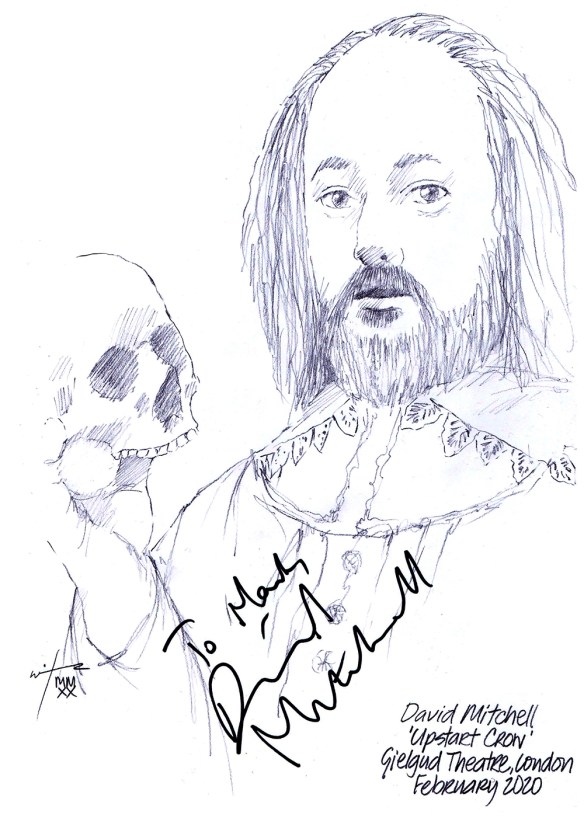
David Mitchell in Upstart Crow

Autographed drawing of David Mitchell in Upstart Crow in the Gielgud Theatre on London's West End

Ben Elton’s BBC TV Blackadder-esque Shakespearean sitcom UPSTART CROW first screened in May 2016 to commemorate the 400th anniversary of the Bard’s death. In early February this year the stage version – or as Ben puts it, “an entirely original excursion, not a TV adaption,” opened at London’s Gielgud Theatre, directed by Sean Foley, with BAFTA- winner, David Mitchell reprising his lead role. The derogatory title refers to a critique of Shakespeare by his arch-rival Robert Greene, “an upstart crow, beautified with feathers.”

It is set in 1605, with Shakespeare, depressed after the death of his son Hamnet, needing to come up with a successful new play. In his LondonTheatre review Jack Hudson said that the TV series “has made an easy transition to critical acclaim in the West End. The Show is a hit-packed with intelligent, textured humour, acute historical insight, barbed wit and the welcome inclusion of a break-dancing bear.” It has been nominated for an Olivier Award for Best Entertainment or Comedy Play.

David kindly signed my Bard sketch when he arrived at the Gielgud for the final Saturday matinee before the production shut down due to the Covid-19 lockdown.

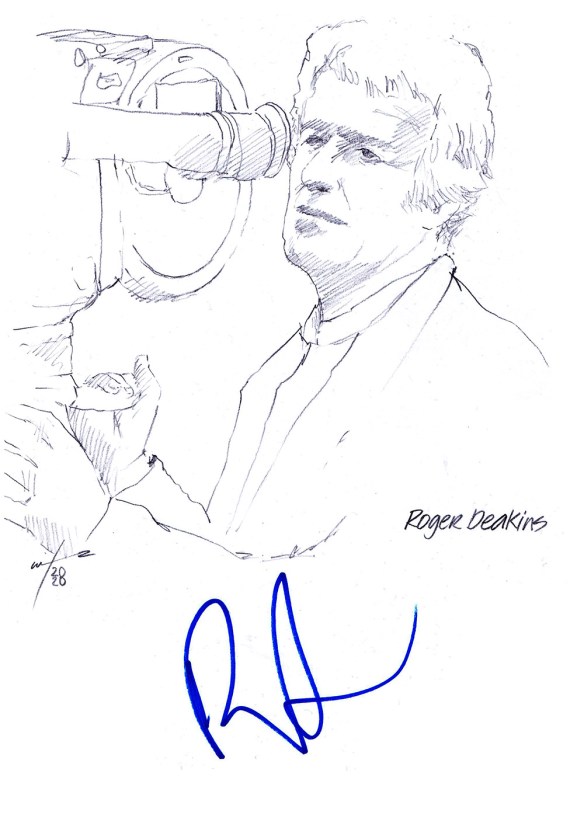
Drawing: Roger Deakins

Autographed drawing of cinematographer Roger Deakins

At one of the many crossroads earlier in my life, I entertained the notion of following a path to cinematography, influenced by the wonderful work of legendary lensman such as Haskell Wexler, Conrad Hall, Freddie Young, Vilmos Zsigmond, Gordon Willis and Sven Nyvist. I even subscribed to ‘American Cinematograper’, which proved a source of inspiration for my own, less ambitious super 8 and 16mm epics.

Often cited as one of the most influential cinematographers of all time is the Englishman Roger Deakins. ‘Sight & Sound’ listed him as one of the greatest artists of light and shade in movie history. His first dramatic feature as DP was ANOTHER TIME, ANOTHER PLACE in 1983, directed by his former schoolmate Michael Radford, who he teamed up with again the following year, appropriately to shoot the film version of George Orwell’s NINETEEN EIGHTY-FOUR. Roger used a bleach bypass process where silver is retained in the print to give it a washed out look reflecting The celebrated author’s bleak vision. Such ingenuity would be the hallmark of his illustrious career.

In 1991 he shot BARTON FINK, the first of 12 collaborations with Joel and Ethan Coen. Three years later he received the first of his 15 Academy Award nominations was for THE SHAWSHANK REDEMPTION. Roger achieved a degree of notoriety, as much for his acclaimed body of work as for his surprising lack of success at the Oscars. It would take until his last two noms to win the converted gold statue, consecutively, for BLADE RUNNER 2049 in 2019 and again this year for the Sam Mendes helmed (their fourth collaboration) war film 1917, renowned for its continuous ‘single’ tracking shot – actually ‘two takes’ with a blackout just over an hour into the film, when the main protagonist Lance Corporal Will Scholfield is knocked unconscious, separating afternoon to dusk then night to dawn. He is also credited with being the Camera A Operator.

Among his many other accolades, Roger has received ten BAFTA nominations, winning five, including his Academy winning films and the Coen’s THE MAN WHO WASN’T THERE (2001), NO COUNTER FOR OLD MEN (2007) and TRUE GRIT (2010) and has won five American Society of Cinematographer Awards.

I was very pleased to catch Roger at the Corinthia Hotel in London as he left for the Royal Albert Hall to attend this year’s BAFTA Awards in early February.

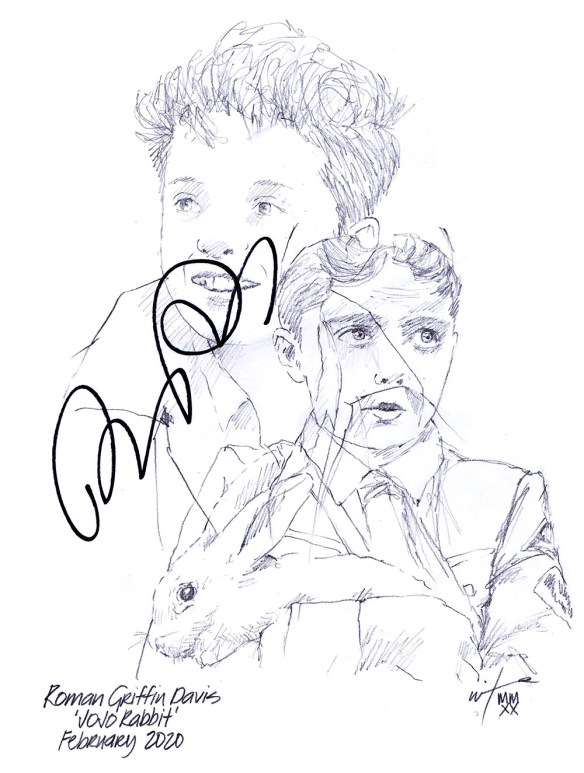
Drawing: Roman Griffin Davis in Jojo Rabbit

Autographed drawing of Roman Griffin Davis in Jojo Rabbit

One of the breakout film performances of 2019 was Roman Griffin Davis’ impressive acting debut as the twelve year old Hitler Youth member with his imaginary friend Adolf, Johannes ‘Jojo’ Betzler in Tamika Waititi’s Oscar-winning JOJO RABBIT. He received six award nominations, including a Golden Globe, a Screen Actors Guild and a Critic’s Choice Award which he won. Roman’s twin brothers, Gilby and Hardly also featured in the dark comedy as Hitler Youth clones.

His follow up film is the festive-themed dark romance about an extended family gathering, SILENT NIGHT (working title) opposite Keira Knightley, written and directed by his mother, Camille Griffin. It’s been described as LOVE ACTUALLY with a killer sting. Filming started in February, and managed to finish ‘by the skin of their teeth’ before the coronavirus-induced lockdown.

Roman signed my drawing at the Soho Hotel in London as he left to attend the BAFTA Awards at the Royal Albert Hall in February.

Drawing: Louise Fletcher as Nurse Ratched in One Flew Over the Cuckoo’s Nest

Autographed drawing of Louise Fletcher as Nurse Ratched in One Flew Over the Cuckoo's Nest

Milos Forman’s 1975 film adaption of Ken Kesey’s 1962 novel ONE FLEW OVER THE CUCKOO’S NEST is regarded as one of the greatest American films of all time, and a personal favourite of mine. It won the ‘Big Five Academy Awards’, Best Picture, Best Director, Best Actor, Best Actress and Best Adapted Screenplay.

Set in an Oregon psychiatric hospital, it centres on the rebellious and free-spirited con-man, Randle McMurphy, who is transferred from a prison work farm. Louise Fletcher collected the Oscar for her portrayal of his nemesis, the tyrannical and stereotypical ‘battle-axe’ head nurse Ratched. In her acceptance speech she thanked her deaf parents in sign language.

Nurse Ratched was named as the fifth greatest villain in film history and the second greatest villainess behind the Wicked Witch of the West in THE WIZARD OF OZ by the American Film Institute. In an interview Louise said that Ratched’s 1940’s hairstyle was “a symbol that life stopped for her a long time ago.” Louise also won the BAFTA and a Golden Globe Award.

I sent Louise this sketch to her Los Angeles agency, which she kindly signed and posted back last week.

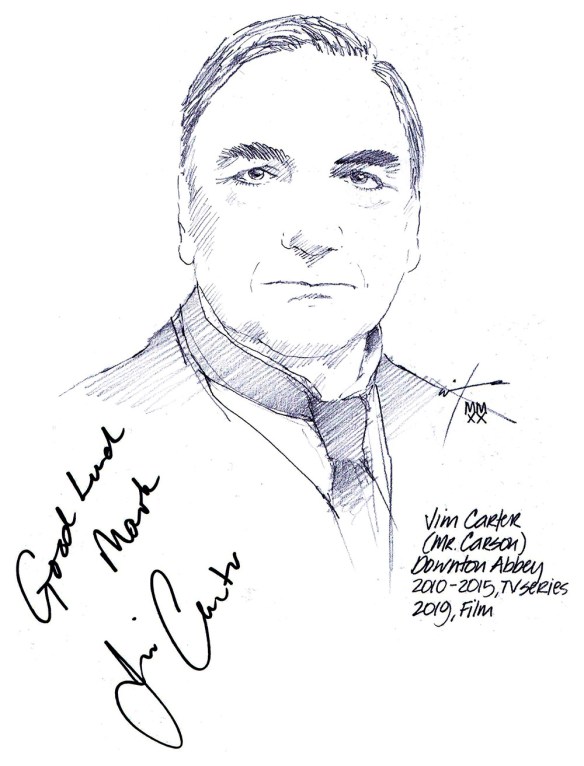
Drawing: Jim Carter in Downton Abbey

Autographed drawing of actor Jim Carter in Downton Abbey

Jim Carter’s portrayal of Charles Carson in the hugely successful and popular British historical drama DOWNTON ABBEY (2010-2015) is one of his most recognisable roles in a long and distinguished screen and stage career that began when he dropped out of his law studies at the University of Sussex fifty plus years ago to join a Brighton fringe theatre group for five quid a week, plus free board and lodgings.

His big stage break came with the National Theatre’s 1982 revival of GUYS AND DOLLS directed by Richard Eyre. At the same time he met his wife-to-be, Imelda Staunton, who was also in the show and they later appeared together in THE WIZARD OF OZ for the Royal Shakespeare Company – Imelda as Dorothy and Jim as the cowardly lion.

His film credits include THE MADNESS OF KING GEORGE (1994), RICHARD III (1995), BRASSED OFF (1996) and SHAKESPEARE IN LOVE (1998), which won the Outstanding Performance by a Cast Screen Actors Guild Award and the Oscar for Best Picture. On the small screen, Jim has appeared in so many, THE BILL, MIDSOMER MURDERS, ZORRO, CASUALTY, CRANFORD and THE SINGING DETECTIVE to name a few. Created and co-written by Julian Fellowes, DOWNTON ABBEY is based on the lives of the aristocratic Crawley family and their domestic servants in the fictional Yorkshire country estate of Downton Abbey during the early part of the 20th Century.

Jim played a leading role as Mr Carson, the butler who is In charge of the male staff, the pantry, wine cellar and the dining room. Mr Carson is described as having a ‘fatherly disposition over the other servants’ while making sure that their duties are carried out to his exacting standards. For his portrayal Jim has received four Primetime Emmy nominations and has twice won the SAG Award for Outstanding Performance by an Ensemble. He also reprised the role for the 2019 film version. Jim received the OBE for services to drama last year.

He signed my sketch last month at the Kiln Theatre in North London, where he was hosting a fundraising event with the screening of the 2014 film PRIDE followed by a cast Q&A.